What would you do to survive the French Revolution? Would you speak out against Robespierre, help a suspected enemy of the Republic, or keep your head down and hope nobody notices you?
The Reign of Terror (1793–1794) was a frightening period in French history. Political suspicion, denunciations, food shortages and revolutionary justice meant that ordinary people could find themselves in serious danger – sometimes simply because of what they said, who they knew or what others believed about them.
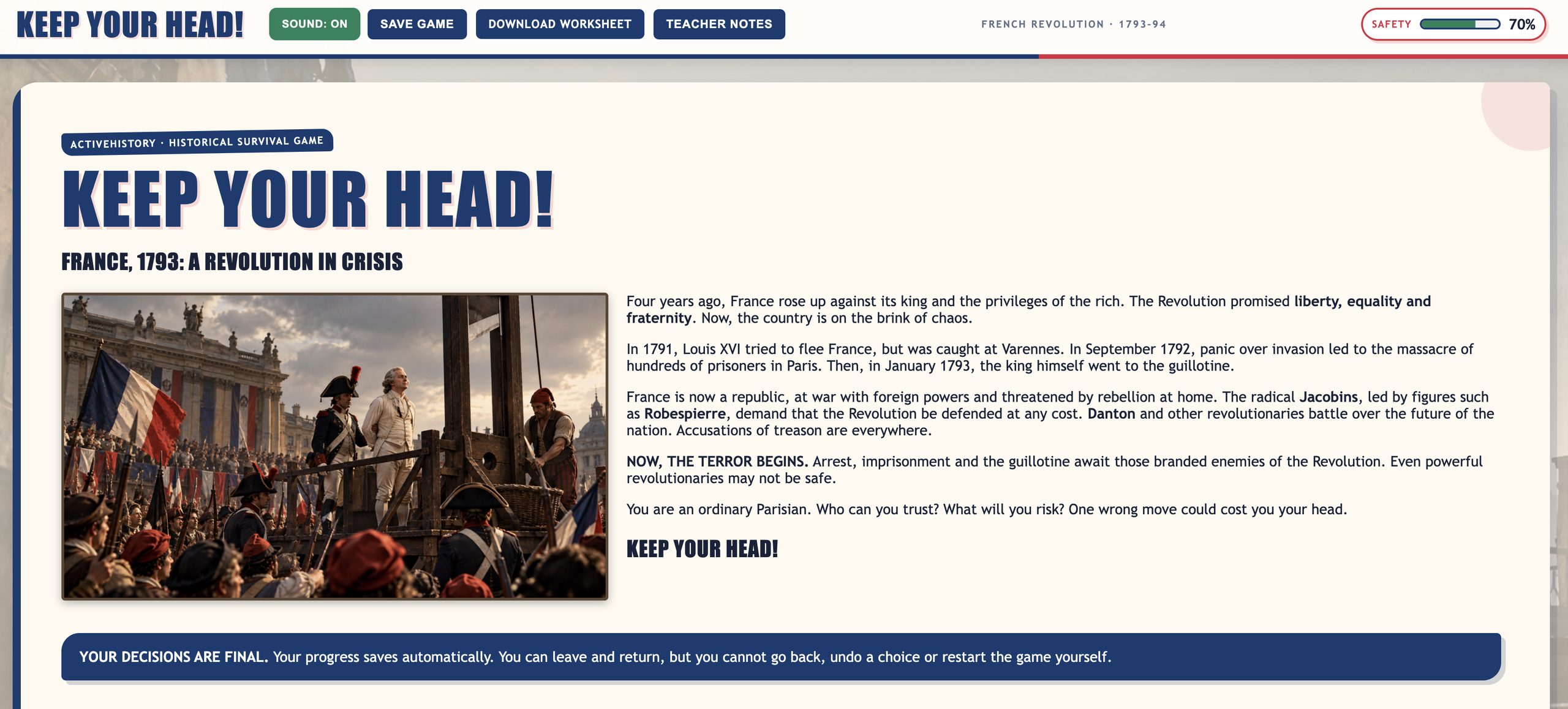
Our new interactive history simulation, KEEP YOUR HEAD! – Surviving the French Revolution, puts students in the middle of these events and challenges them to make difficult decisions as the Revolution unfolds.
Experience the French Revolution – one decision at a time
Rather than simply reading about the Reign of Terror, students experience some of the dilemmas faced by people living through it.
Across ten chapters, they encounter a series of challenging situations. Each presents a historical dilemma and asks students to decide how they will respond.
Should they:
- Give scarce bread to a hungry family, even if it attracts unwanted attention?
- Speak honestly when questioned about their political loyalties?
- Help someone who has been accused of being an enemy of the Revolution?
- Support revolutionary measures they privately disagree with?
- Protect themselves, even if that means putting someone else at risk?
There are rarely easy answers. Every decision has consequences, affecting the student’s chances of survival and how other people remember them.
Can you survive the Terror?
Students must keep an eye on their safety score, which changes as a result of their decisions. After each dilemma, they discover the consequences of their actions and see how their reputation develops.
The simulation also introduces students to important individuals, groups and events from the French Revolution, helping them understand the growing tensions between different revolutionary factions and the increasing dangers of political extremism.
At the end, students receive a personalised dossier recording their journey through the Revolution, their decisions, their reflections and their closest historical match.
Ten Big Questions to encourage historical thinking
Throughout the game, students are also asked to consider a series of bigger historical questions.
These encourage them to think beyond individual events and consider wider issues such as:
- Is violence ever justified in the fight against an unfair government?
- Can a revolution achieve lasting change without restricting people’s freedoms?
- Can a government defend freedom while executing those who challenge it?
- Is restoring order more important than achieving justice?
Students record their own answers, giving them the opportunity to reflect on how their views develop as the Revolution progresses.
An optional worksheet for additional focus
A supporting worksheet is available for teachers who want to give students additional structure during the simulation.
It includes five activities:
- Build the timeline: explore the key events leading up to, during and after the Reign of Terror.
- People to know: investigate important figures such as Robespierre, Danton, Desmoulins, Marie-Antoinette, Marat and Napoleon.
- Glossary: develop an understanding of key revolutionary terminology.
- Survival evidence log: record three difficult moments from the simulation and explain what they reveal about life during the Terror.
- Final judgement: answer the question, “Why did ordinary people find it so difficult to stay safe during the Reign of Terror?”
The worksheet is entirely optional. The simulation can be played independently, but the additional activities provide useful opportunities to consolidate historical knowledge.
What happens at the end?
Completing the simulation is not the end of the learning. Each student receives a personalised dossier containing their decisions, reflections and historical match, together with three suggested follow-up tasks:
- PEOPLE: research their closest historical match and consider how similar or different they really were.
- EVENTS: decide when the Terror became most dangerous and explain why.
- THE BIG PICTURE: look back at their ten Big Question responses and identify the most important lesson they have learned about the French Revolution.
These activities provide a useful starting point for class discussion, further research or homework.
Try it with your students
KEEP YOUR HEAD! – Surviving the French Revolution is designed to help students engage with the challenges of the Reign of Terror through historical decision-making, reflection and discussion.
It is particularly suitable for secondary history students studying the French Revolution, the development of revolutionary government and the causes and consequences of the Reign of Terror.
PLAY KEEP YOUR HEAD! – SURVIVING THE FRENCH REVOLUTION
An ActiveHistory interactive simulation.