

The revised IB History syllabus will generally allow teachers to stick closely to existing schemes of work, requiring only minor adjustments to selected topics and assessment approaches.
ActiveHistory resources are already aligned to these changes, helping you focus on teaching, not rewriting courses.
| Content | Standard Level + Higher Level These tasks are the same for both SL and HL students | Higher Level Only | |||
Paper 1Choose ONE set of focused studies from a choice of five |
Paper 2Choose ONE thematic study from a choice of four |
IAInternal Assessment 20% of the final grade for HL, 30% for SL |
Paper 3Choose TWO regional studies from a choice of twelve per region |
||
| Assessment |
Sourcework
1hr 15 mins
|
3 structured questions
1hr 45 mins
|
Internal Assessment
c.20 hours
|
Two essays
2 hours
|
|
| Changes | Paired studies changed. Longer exam. Fewer but longer sources. | Three structured responses instead of two essays. | Three sections only. Reflection removed. | Two essays from different sections in two hours. | |
| Weighting % | SL | 30 | 40 | 30 | — |
| HL | 20 | 25 | 20 | 35 | |
| Teaching Hours | 50 | 80 | 20 | 90 | |
One of the strengths of the new IB History syllabus is the flexibility it gives teachers. I look for clear content overlaps across the three examination papers and use these to build a course that unfolds in a broadly chronological way, giving students valuable breathing space to engage with topics in real depth.
Others may prefer a model that covers a wider range of topics and time periods more briskly - and the syllabus supports that approach just as well.
To illustrate how this can work in practice, I’ve shared my ActiveHistory draft curriculum map below.
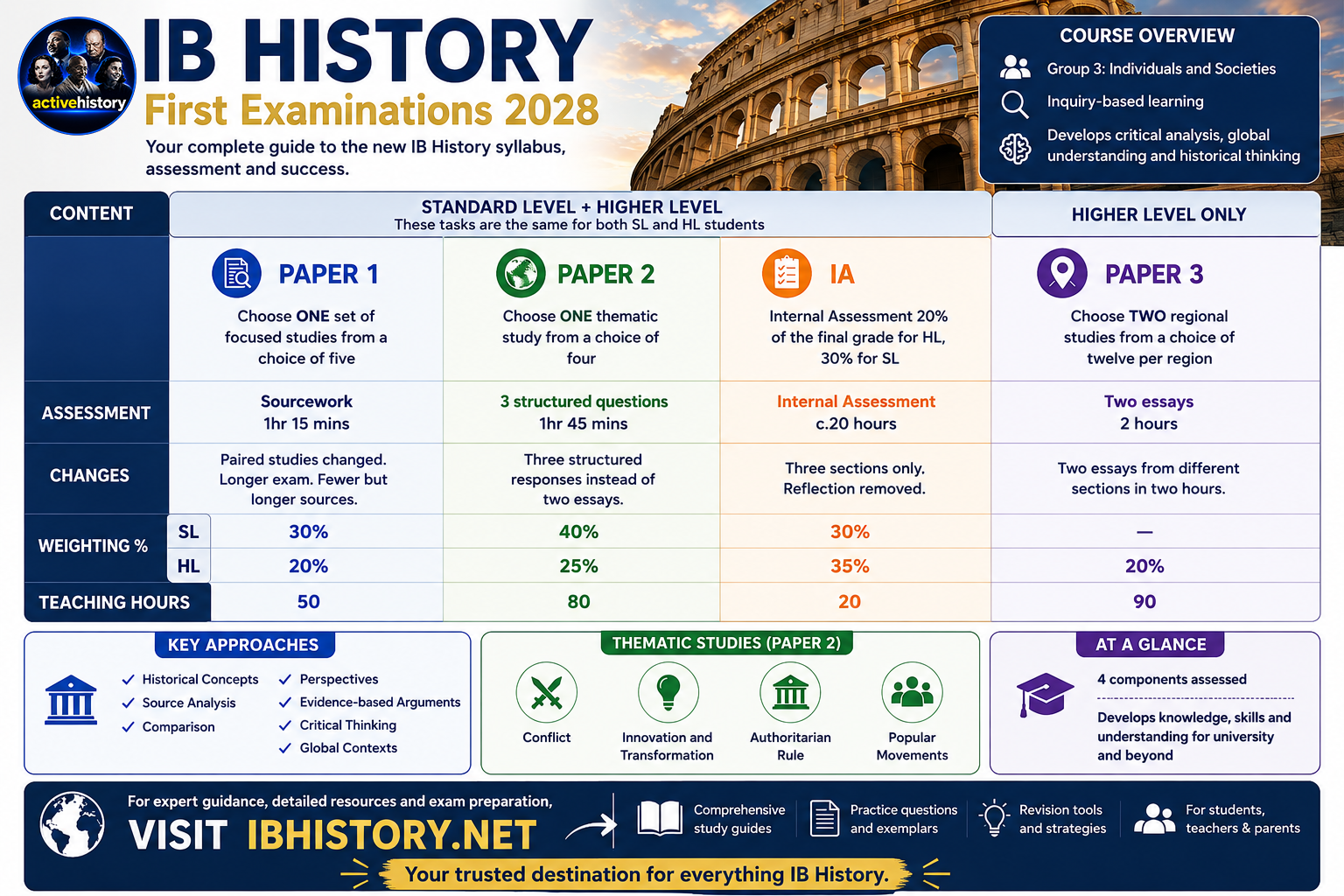
Download this classroom-ready poster summarising the new IB History syllabus (first examinations 2028), including Papers 1–3, Internal Assessment requirements, thematic studies, assessment weightings and key course features.
Ideal for classroom displays, department noticeboards, student handbooks and induction sessions.