IB History Paper 2 (2028): Global Thematic Studies, Exam Questions and Revision Guide
What is IB History Paper 2?
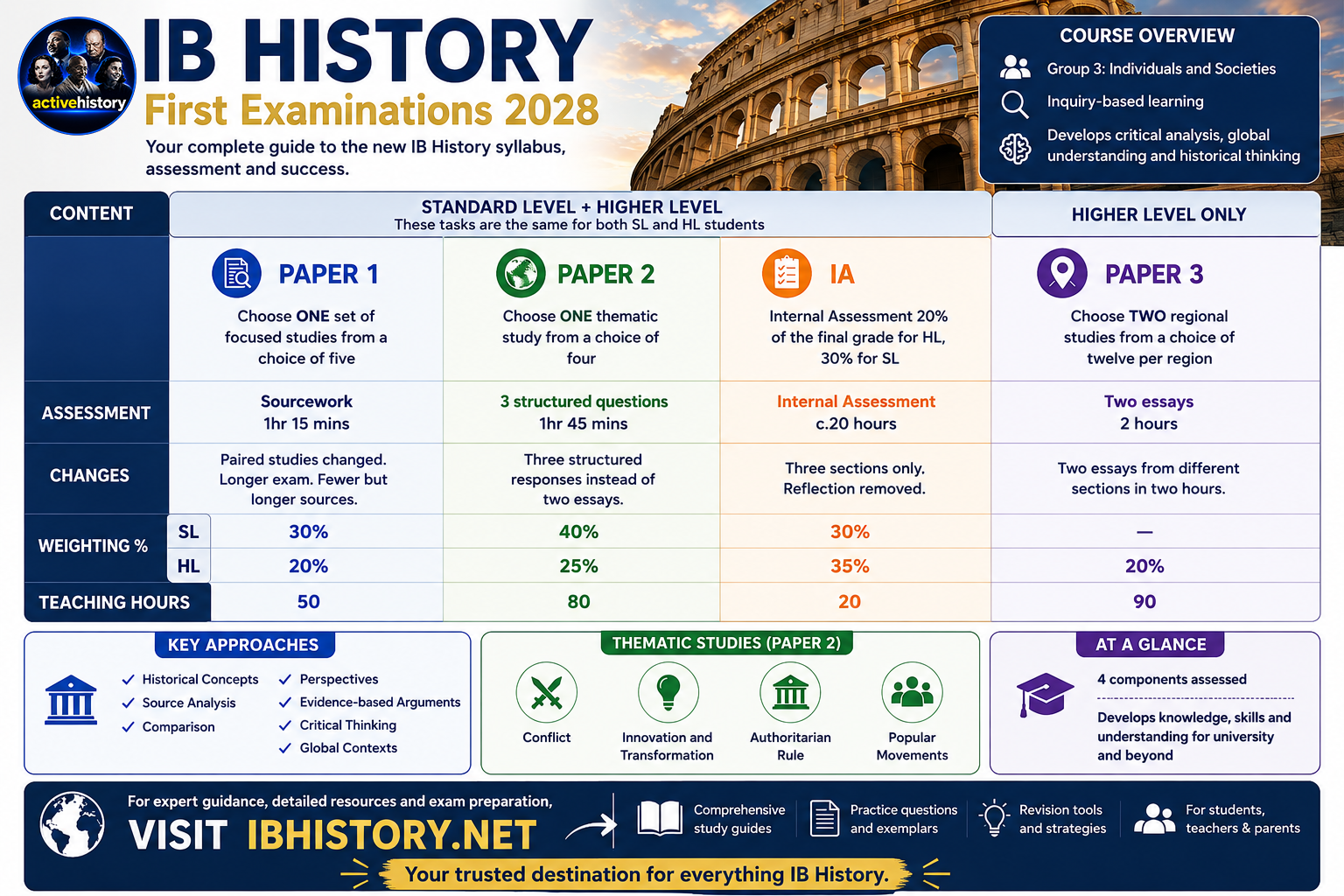
The new IB History Paper 2 is assessed through a series of structured questions based on one of four broad Global Thematic Studies: Conflict, Innovation and Transformation, Authoritarian Rule, or Popular Movements. Teachers select one thematic study and explore it through historical examples drawn from at least two different regions of the world.
Paper 2 forms a major part of the new IB History syllabus (first examinations in 2028) and is designed to assess students' ability to analyse historical concepts, explain historical developments, and evaluate evidence from different perspectives. Unlike traditional essay papers, students must demonstrate both detailed factual knowledge and strong analytical skills in response to clearly structured questions.
The examination lasts 1 hour 45 minutes and consists of two sections. In Section A, students answer a short analytical question focused on one of the IB's key historical concepts: cause and consequence, continuity and change, perspectives, or significance. In Section B, students answer a two-part question requiring both explanation and evaluation, supported by examples from at least two different regions.
Success in IB History Paper 2 depends on more than memorising content. Students need to develop a clear understanding of the thematic study they have chosen, make effective comparisons between different historical examples, and support their arguments with precise evidence. Strong responses combine factual knowledge with analytical thinking, showing not just what happened, but why it happened, how it can be interpreted, and how significant it was.
This page provides a complete guide to the new IB History Paper 2, including an overview of the thematic studies, assessment guidance, model question formats, writing frames, revision strategies, and random question generators to help students prepare effectively for examination success.
A. Content
Teachers choose just ONE of these Thematic Studies, then study at least TWO examples from different regions:
- Each study is based around four inquiry questions, and each inquiry question has four lines of inquiry (click each of the four topic titles for further detail). Two examples from different regions are needed to answer each inquiry question. Some teachers may wish to use the same two examples to answer all four inquiry questions with particular depth; others may wish to use different pairings for different questions for variety.
Choice of Examples
There are NO prescribed examples for thematic studies. Teachers have complete freedom in selecting case studies. Some may focus deeply on two examples across all inquiry questions, while others may use different paired examples depending on question focus.
How Many Examples?
Students must use examples from at least two different regions. Beyond three or four examples, analysis often becomes superficial. In practice, focusing on two strong examples is usually best.
Contemporary Examples
Contemporary case studies are permitted, but they must still lend themselves to historical analysis. Causes may often be studied effectively, whereas consequences usually require greater historical distance.
B. Assessment (Paper 2, 1 hour 45 minutes)
- The Paper 2 exam lasts 1 hour 45 minutes (in contrast to the old paper, which was 90 minutes). Students answer three questions:
| Section A |
6 marks |
≈ 25 minutes |
| Section B, Part A |
4 marks |
≈ 15 minutes |
| Section B, Part B |
15 marks |
≈ 60 minutes |
Section A
- Recommended timing: 25 minutes, 6 marks
- Question stem: "Analyse how..."
- Top markband: "The response clearly and accurately analyses the concept. The response is effectively supported by a relevant, specific example from the thematic study"
Question format
Choosing Examples
The "example" could focus on a narrow event or factor, or take a broader approach. For instance, economic factors in the rise of Hitler could focus specifically on the Great Depression or broaden into hyperinflation and reparations.
Double-Barrelled Concepts
Questions may focus on one element or both (for example: cause, consequence, or both together).
Understanding Perspectives
A perspective simply means a point of view of the past. It does not require historiography or named historians - students should think about contrasting angles such as short vs long term or social vs economic impacts.
Choosing Topics Carefully
Avoid locking students into fixed topics. Different question types naturally suit different topics, and students may draw evidence from across the course - including Paper 1 and Paper 3 - without needing to declare a global theme.
Section A - Random Question Generator
Generate a random Section A question:
SECTION A
Answer ONE of
the following questions.
Question 1 Cause and Consequence
Analyse how historical events have had multiple causes. Use one example from your Global Theme to support your response. (6 marks)
Question 2 Perspectives
Analyse how historical events can be seen from different perspectives. Use one example from your Global Theme to support your response. (6 marks)
Section A - Assessment
The generic markscheme provides a starting point for assessing responses to this question. A good approach might be to ask students to provide three developed reasons in three detailed paragraphs in the 25 available minutes for the 6 marks available, in the following format:
Chosen Global Thematic Study |
Opening topic sentence |
Substantiating evidence [1] |
Substantiating evidence [2] |
Example 1 |
|
|
|
Example 2 |
|
|
|
Example 3 |
|
|
|
Section B
- Recommended timing: 75 minutes, 19 marks
Question format
- Students choose one two-part question from a choice of two.
- These questions will be based around the four specific lines of inquiry for the thematic study.
- Part A will be "explain" (requiring students to provide a range of reasons)
- Part B will be "to what extent" (requiring students to evaluate different perspectives analytically to reach a reasoned conclusion). Part A will be an “explain” question, requiring students to provide a range of reasons.
Section B - Random Question Generator
Generate a random Section B question:
Conflict Innovation and Transformation Authoritarian Rule Popular Movements
SECTION B
Conflict (from 750 AD onwards)
Answer both Part A and Part B of ONE of the following questions.
Question 1
Part A: Explain how social factors led to the outbreak of conflict. Use one example from the global theme in your response. (4 marks)
Part B: To what extent was technology responsible for the outcome of conflict? Use examples from at least two regions to support your response. (15 marks)
Question 2
Part A: Explain how conflict affected the life of women. Use one example from the global theme in your response. (4 marks)
Part B: To what extent were post-conflict peace-building successful? Use examples from at least two regions to support your response. (15 marks)
Section B, Part A - approach and assessment
- Recommended Timing: 4 marks, 15 minutes
- Question stem: "Explain how..."
- Top markband: "The response effectively explains a relevant example from the thematic study".
The generic markscheme provides a starting point for assessing responses to this question. A good approach - building on the same format as the approach for Section A - might be to ask students to provide two developed reasons in two detailed paragraphs in the 15 available minutes for the 4 marks available, in the following format:
Chosen Global Thematic Study |
Opening topic sentence |
Substantiating evidence [1] |
Substantiating evidence [2] |
Example 1* |
|
|
|
Example 2* |
|
|
|
Example 3* [Optional] |
|
|
|
*e.g. chosen cause, impact, method depending on the question
Section B, Part B - approach and assessment
- Recommended Timing: 15 marks, 60 minutes.
- Question stem: "to what extent..."
- Top markband: "Students use examples from at least two different regions to produce a consistently analytical response focused on the question".
Structure Flexibility:
Students can either include multiple examples within each paragraph or structure separate paragraphs around individual examples - both approaches are equally valid.
Similarity to Previous Papers:
This question broadly reflects the essay questions which characterised Paper 2 in the previous syllabus and should be approached in a similar way.
Key Change:
Questions will now ALWAYS use the command term "To what extent...", and historical examples must ALWAYS come from at least two regions.
The generic markscheme provides a starting point for assessing responses to this question.
Possible Writing Frame [1]
-
1
Introduction: Define key terms and outline case studies.
-
2
Regional Study A: Ways it did.
-
3
Regional Study A: Ways it did not (or interacting factors).
-
4
Regional Study B: Ways it did (compare / contrast with A).
-
5
Regional Study B: Ways it did not (or interacting factors).
-
6
Conclusion: Summarise findings in relation to the question.
Alternates supporting and challenging evidence within each regional study.
Possible Writing Frame [2]
-
1
Introduction: Define key terms and outline case studies.
-
2
Regional Study A: Ways it did.
-
3
Regional Study B: Ways it did (compare / contrast with A).
-
4
Regional Study A: Ways it did not (or interacting factors).
-
5
Regional Study B: Ways it did not (or interacting factors).
-
6
Conclusion: Summarise findings in relation to the question.
Groups supporting arguments together before evaluating limitations.
×
What qualifies as an 'example'?
The "example" could focus on one narrow event or factor, or alternatively take a broader approach (e.g. a consideration of the role of economic factors in the Rise of Hitler might focus on the impact of the Great Depression in particular on the voting habits of certain groups, or alternatively broaden out into the longer-term impact of hyperinflation and the issue of reparations).
×
1: Conflict (from 750 AD)
Conflict occurs when groups resort to violence to settle disagreements.
Examples include civil wars, interstate wars, revolutions, wars of independence,
terrorist movements, world wars and proxy wars.
Why did conflict emerge?
- Economic causes
- Political causes
- Social causes
- Environmental causes
What determined the outcome of the conflict?
- Role of leadership
- Strategies and tactics
- Mobilization of resources
- Role of technology
How did the conflict affect people’s lives?
- Economic impact
- Social impact
- Experiences of women
- Experiences of marginalized groups
How was peace established?
- Military outcome
- Political decision-making
- Social factors
- Post-conflict peace-building
Recommended ActiveHistory Resources
Independence and Identity
Protest and Change
Origins of Conflict
USA
Russian Revolution
World War One
Spanish Civil War
World War Two
Modern Conflicts
Arab–Israeli Conflicts
×
2: Innovation and Transformation (from 750 AD)
A historical innovation is a new and influential idea, method, or technology.
Examples include technological advances (such as the Industrial or Digital Revolutions), or movements which are artistic (for example the Renaissance), religious (such as the Reformation), intellectual (such as the Enlightenment). Popular ideological movements (nonviolent resistance, feminism, communism, fascism and others) could also provide useful overlaps with Paper 1 and Paper 3 topics.
Why did new innovations emerge?
- Social factors
- Economic factors
- Political factors
- Environmental factors
How did innovations transform societies?
- Economic change
- Political change
- Environmental change
- Cultural change
How were innovations resisted?
- Resistance from established authorities
- Forms of popular resistance
- Resilience of traditional ideas
- Competing innovations
How did innovations affect people's lives?
- Experiences of innovators
- Experiences of social elites
- Experiences of women
- Experiences of marginalized groups
Recommended ActiveHistory Resources
Climate and Innovation
Protest and Change
Early Modern History
Suggested Crossovers
- Industrial Revolutions
- Religious transformation
- Political ideologies / Authoritarian States
- Social movements
- Paper 1 and Paper 3 overlap themes
×
3: Authoritarian Rule (from 1750 CE)
Authoritarian rule gives power to one leader or a small group.
Examples include monarchies, oligarchies, dictatorships, totalitarian states, colonial governments or military regimes.
Some systems mix authoritarian and democratic features.
Why did authoritarian rule emerge?
- Role of ideas
- Social factors
- Role of conflict
- Economic factors
How was authoritarian rule maintained?
- Legal methods
- Use of force
- Propaganda
- Popular support
How did authoritarian rule affect people's lives?
- Economic effects
- Social effects
- Experiences of women
- Experiences of marginalized groups
How was authoritarian rule challenged?
- Internal opposition
- Popular resistance
- Impact of policies
- External threats
Recommended ActiveHistory Case Studies
Europe Continued
Asia
Americas
Africa & Middle East
Other Possibilities
Compare emergence, maintenance and resistance across regions.
×
4: Popular Movements (from 1750 AD onwards)
Popular movements involve groups of people working together to create change.
These include campaigns led by minority groups, women, youth and workers for increased rights, as well as independence and anti-colonial movements.
Why did popular movements emerge?
- Political factors
- Economic factors
- Role of ideas
- Social factors
How did popular movements create change?
- Political participation
- Non-violent methods
- Cultural influence
- Violent methods
How were popular movements challenged?
- Political opposition
- Divisions within the movement
- Violent opposition
- Resilience of traditional ideas
What was the impact of popular movements?
- Political change
- Social change
- Experiences of women
- Experiences of marginalized groups
Recommended ActiveHistory Resources
Independence and Identity
Protest and Change
Rights & Protest
Social Movements
Suggested Themes
- Minority rights movements
- Anti-colonial campaigns
- Role of ideology
- Violence vs non-violence
- Continuity and change
Compare how movements emerged, organised support and achieved change across different regions.
×
Paper 2, Section A - Generic Mark Scheme
| Marks |
Level descriptor |
| 0 |
The response does not reach a standard described by the descriptors below.
|
| 1–2 |
The response describes the concept with minimal analysis.
The response makes limited reference to an example from the thematic study.
|
| 3–4 |
The response partially analyses the concept.
The response is supported by reference to a relevant example from the thematic study.
|
| 5–6 |
The response clearly and accurately analyses the concept.
The response is effectively supported by a relevant, specific example from the thematic study.
|
×
Paper 2, Section B, Part A - Generic Mark Scheme
|
Marks Level descriptor |
0
|
The response does not reach a standard described by the descriptors below. |
1 |
The response identifies a relevant example from the thematic study. |
2 |
The response describes a relevant example from the thematic study. |
3 |
The response partially explains a relevant example from the thematic study. |
4 |
The response effectively explains a relevant example from the thematic study. |
×
Paper 2, Section B, Part B - Generic Mark Scheme
| Marks |
Level descriptor |
| 0 |
The response does not reach a standard described by the descriptors below. |
| 1–3 |
The response is an outline of unsubstantiated, disconnected assertions lacking a clear judgement.
Where examples are used, they are irrelevant or vague.
|
| 4–6 |
The response is descriptive, and any judgement made is not substantiated.
The examples used are only partially relevant.
The response makes minimal connections between examples.
|
| 7–9 |
The response is mostly descriptive, though there is partial analysis. There is a judgement that is partially consistent with the rest of the response.
The examples used are mostly appropriate and relevant.
The response makes limited connections between examples, though these are superficial and provide limited support to the analysis.
|
| 10–12 |
The response is mostly analytical. There is a judgement that is consistent with the analysis.
The examples used are consistently appropriate and relevant, and support the analysis.
The response makes some connections between examples, and these connections partially support the analysis.
|
| 13–15 |
The response is consistently analytical. There is a reasoned judgement that is consistent with the analysis.
The examples used are consistently appropriate and relevant, and effectively support the analysis.
The response makes well-developed connections between examples, and these connections are effectively integrated to support the analysis.
|
×
Cause and Consequence
• Historical events always have multiple, interrelated, short- and long-term causes and consequences.
• The causes and consequences of historical events result from the interplay of two types of factors—historical actors, who are the people (individuals or groups) who take action, and the conditions within which these actors operate.
• Historical events and their consequences were never inevitable. These causes and consequences could be probable, improbable, intentional or accidental.