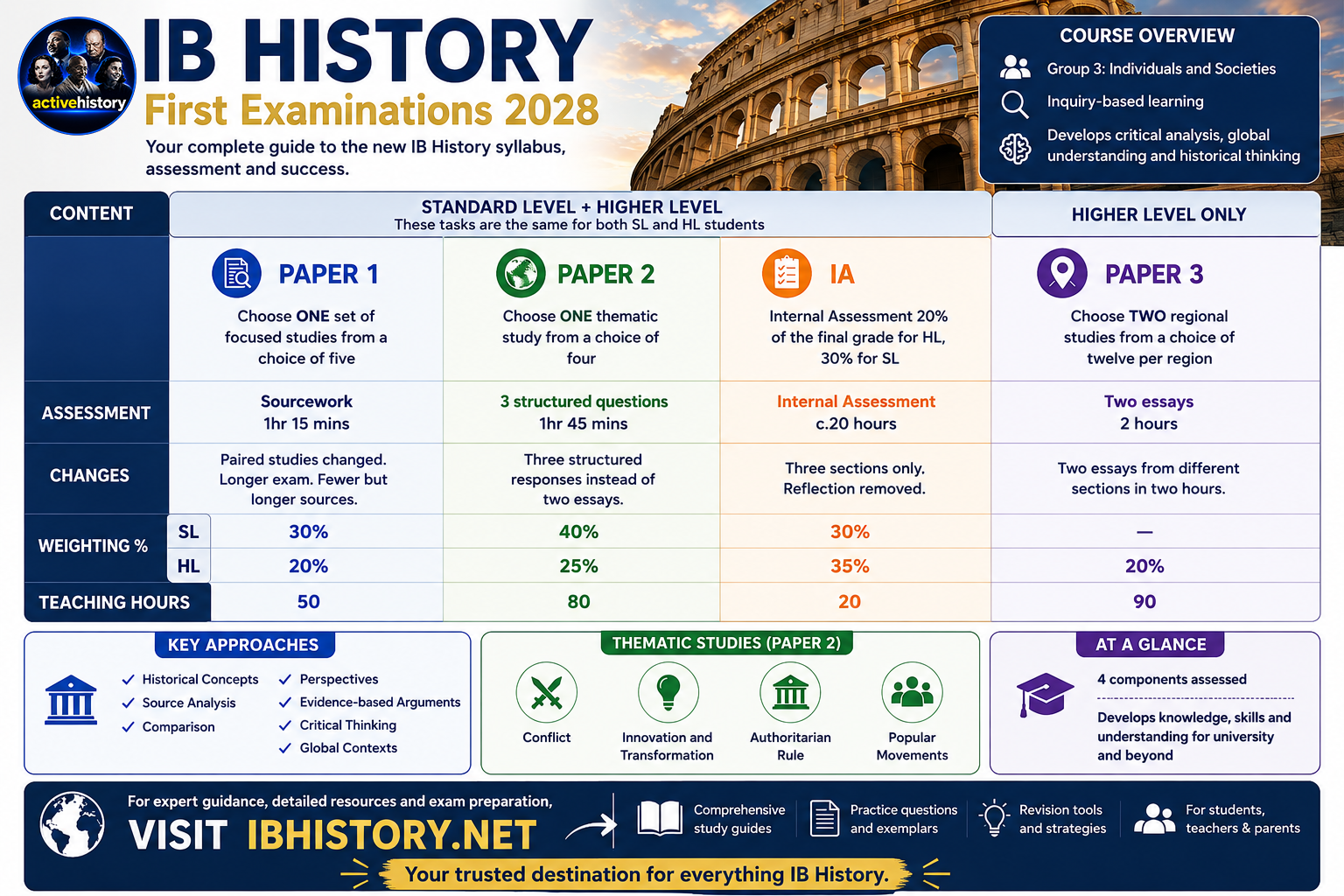
Paper 1 (Sourcework): Choose ONE focused study from a choice of FIVE
A. Content
• Teachers must select one of the following five focused studies. Each contains two topics, only one of which will be the focus for the final exam.
• Because Paper 1 is a source-based assessment, teachers should obviously ensure students use and interrogate a range of diverse historical sources in their focused study.
Paper 1: Observations by ActiveHistory
I am currently considering two possible approaches to maximise overlap with my existing Paper 2 and Paper 3 teaching.
PROTEST AND CHANGE
Feminism in the USA | Revolution in Tunisia
Because I already teach Feminism in the USA (1960–79) for Paper 3 Americas, this creates strong curriculum overlap.
This option also provides the two necessary case studies in two different regions for Paper 2 Popular Movements, which could reduce student workload massively. In Paper 2, Tunisia could also be used as an example of a 'conflict' and Feminism could be an example of an 'innovation' to open up further possibilities.
To support this pathway, I have already developed a brande new scheme of work on Revolution in Tunisia (1989–2015) .
POLITICAL AND ECONOMIC TRANSITIONS
The Meiji Restoration | The Russian Federation)
Since I already teach substantial Cold War content for both Paper 3 Americas and Paper 2 Authoritarian Rule, this option also provides considerable overlap.
The Meiji Restoration could be regarded as an example of one authoritarian regime for Paper 2, and the Rule of Gorbachev / Rise of Yeltsin or Putin or provides another in a second region. In Paper 2, the Meiji Restoration could also be an example of an 'innovation' to open up further possibilities.
To support this approach, I have already developed a brand new scheme of work on The Meiji Restoration (1853–94) .
B. Exam format / assessment
- Paper 1 (1 hour 15 minutes) (24 marks)
- Weighting: 30% (SL), 20% (HL)
- Students will be presented with three sources (A, B and C) relating to one of the two compulsory study topics. Sources will be a mixture of primary and secondary, and may be written, pictorial, and / or diagrammatic. Each source will be accompanied with a brief explanation to put it into context.
- Each set of sources will be framed by a single inquiry question at the beginning of the examination paper.
- Students will answer three compulsory questions based on the sources which will ask the student to consider how the sources can be used to address the overarching inquiry question.
- The questions are always in exactly the same format:
1. Explain how the content of both Source A and Source B can be used to answer the inquiry question (6 marks)
(5 mins planning, 15 mins writing)
• Ways the sources support the assumption in the question
• Ways the sources challenge or complicate the assumption
Strong responses use specific evidence and direct references from both sources.
Different source combinations are possible. For example:
• both sources may support the argument
• both sources may challenge the argument
• one source may strongly support while the other challenges
• each source may contain both supporting and opposing evidence
Your task is to select the most relevant evidence from each source- not to force every source into the same pattern.
Possible Ways Sources Can Support the Argument
- Explain how a specific detail or quotation supports the inquiry question.
- Link the evidence directly to the argument in the question.
- Use another piece of evidence that reinforces the same interpretation.
- Include precise references or quotations where appropriate.
Possible Ways Sources Can Challenge the Argument
- Explain how a source challenges or complicates the assumption in the inquiry question.
- Support the point with specific evidence from the source.
- Consider alternative causes, perspectives, or interpretations presented by the sources.
- Avoid treating the sources as entirely one-sided.
2. Analyse how the context of source C influences how it can be used to answer the inquiry question (6 marks)
(5 mins planning, 15 mins writing)
• Origin
• Purpose
• Content
In other words, its overall context.
Part 1: Values of the Source
- Explain ways in which the source agrees with the thesis statement.
- Support your analysis by cross-referencing other sources that make similar arguments.
- Explain why the author may be considered a credible witness.
-
Consider:
• Who wrote it?
• When was it written?
• Where was it written?
Part 2: Limitations of the Source
- Explain ways in which the source does not fully support the thesis statement.
- Compare the source to other perspectives or evidence.
- Explain limitations in the author’s perspective.
-
Consider possible:
• Bias
• Agenda
• Circumstances
• Missing perspectives
3. Examine how the perspectives in all the sources can be used to answer the inquiry question (12 marks)
(10 mins planning, 25 mins writing)
• identify different historical perspectives across the sources
• compare similarities and differences between them
• evaluate how convincing or reliable the perspectives are
• synthesise the sources into an overall argument
Perspectives may:
• strongly agree with each other
• strongly disagree
• partially overlap
• or contain mixed / nuanced viewpoints
Your goal is to organise the sources into meaningful perspectives and evaluate how convincing those perspectives are.
Step 1: Identify the Main Perspectives
Before writing, spend some planning time grouping the sources into broad perspectives or interpretations.
“Economic factors were the main cause of the Meiji Restoration.”
- Identify which sources broadly support this interpretation.
- Identify which sources challenge or complicate it.
- Stronger responses usually identify at least two or three distinct perspectives.
Step 2: Develop Each Perspective in a Separate Paragraph
Each paragraph should focus on one main perspective presented by the sources.
- Clearly identify the interpretation or viewpoint.
- Link it directly to the inquiry question.
- Use specific content or quotations from the source.
- Explain how the source supports the perspective.
-
Analyse provenance:
• Who created the source?
• When and where was it produced?
• Why was it created? - Explain why the source may be convincing or credible.
- Cross-reference other sources that support the same interpretation.
- Compare similarities and differences between the sources where relevant.
- Consider possible bias, agenda, or contextual limitations.
- Evaluate what the source may omit or under-emphasise.
Step 3: Write a Synthesis Conclusion
- Summarise the broad similarities and differences between the perspectives.
- Identify which interpretation appears most convincing overall.
- Avoid simply repeating earlier paragraphs- focus on synthesis and judgement.