The story of post-war displacement in Europe (1945–1960) is one of the most complex and humanly compelling legacies of the Second World War. In the aftermath of total war, more than 30 million people found themselves uprooted—liberated prisoners, refugees, ethnic minorities, and former soldiers—all struggling to survive amid ruined cities and redrawn borders. For IB History Paper 1, this topic is especially rich: the abundance of first-hand sources, from government reports and UN documents to camp newspapers and survivor testimonies, allows students to practise source analysis, evaluation, and comparison while grappling with urgent historical questions about identity, justice, and the birth of modern humanitarianism.
What were the conditions that led to mass displacement?
Combat operations and Allied victory
Frontline devastation and civilian flight
Between 1944 and 1945, as the Red Army advanced westward through Eastern Europe, millions fled before its arrival. In East Prussia, Pomerania, and Silesia, over 12 million Germans were uprooted, many perishing during the winter of 1944–45 on frozen roads or in attacks like the sinking of the Wilhelm Gustloff (January 1945), which killed around 9,000 civilians. Cities such as Königsberg and Breslau became scenes of chaotic evacuations under artillery fire.
Territorial shifts and expulsions
The Potsdam Conference (July–August 1945) sanctioned the “orderly and humane” transfer of Germans from Poland, Czechoslovakia, and Hungary. In practice, expulsions were brutal: 3 million Sudeten Germans were forced from Czechoslovakia in 1945–46, and 7 million more from Poland’s new western territories. Trains overflowed with deportees, often deprived of food and shelter, while local militias exacted revenge for wartime occupation and atrocities.
Demobilization and POW movements
The collapse of the Wehrmacht in May 1945 left over 11 million German soldiers as prisoners of war across Europe. Many were held in Soviet camps, with mortality rates exceeding 30% in 1945–47. Meanwhile, millions of liberated Allied POWs and Displaced Persons (DPs)—Poles, Ukrainians, and forced laborers—crowded into UNRRA-administered camps, straining postwar logistics and infrastructure.
Persecution and fear of reprisals
Ethnic cleansing and retribution
In postwar Eastern Europe, ethnic violence accompanied liberation. Poles expelled Ukrainians from southeastern Poland during Operation Vistula (1947), while Soviet forces deported Baltic peoples as “anti-Soviet elements.” Jewish survivors returning to Poland faced hostility: the Kielce pogrom (July 1946) killed 42 Jews, convincing many that “Poland had no place for Jews.” Roughly 250,000 Jewish DPs sought refuge in Western zones or emigration to Palestine.
Soviet repression and political purges
Stalin’s postwar consolidation triggered mass arrests and deportations. Between 1945 and 1952, over 1.5 million people were sent to the Gulag from annexed territories like the Baltic states and Western Ukraine. Former partisans, collaborators, and “bourgeois nationalists” faced execution or exile to Siberia. Fear of Soviet reprisals drove thousands westward, including anti-communist Poles, Hungarians, and Romanians escaping secret police surveillance and political trials.
Collaborators and civilians under threat
In Western Europe, liberation brought its own wave of vengeance. In France, some 9,000 “collaborateurs” were executed in l’épuration sauvage (1944–45). Across the Balkans, retreating fascist forces—such as Croatian Ustaše and Slovene Domobranci—fled toward Austria, fearing Tito’s Partisans, who executed tens of thousands at Bleiburg (May 1945). These reprisals prompted mass flights of civilians associated with Axis regimes, creating refugee crises along the Alps and Adriatic.
Economic factors
Destruction of housing and infrastructure
By 1945, one-third of Europe’s housing stock was destroyed or damaged. In Germany alone, 20% of urban dwellings lay in ruins; Warsaw, after the 1944 Uprising, was 85% demolished. Industrial collapse and food shortages left millions homeless, prompting migration toward areas with surviving infrastructure or Allied aid distribution, such as the American and British occupation zones.
Agrarian crisis and land reform
Postwar agrarian reforms disrupted traditional rural life. In Poland (1944–48), Soviet-backed redistribution broke up large estates, displacing landlords and tenants alike. In Hungary and Romania, collectivization drives and requisitions led to peasant resistance and flight. Many uprooted farmers and laborers moved westward, joining the estimated 8 million Displaced Persons still adrift in Europe by 1947.
Urban employment and reconstruction pull
The Marshall Plan (1948–52) created economic magnets in Western Europe. Industrial recovery in West Germany, France, and Benelux drew displaced Eastern workers, especially “DPs” unwilling to return under communist regimes. Between 1948 and 1960, hundreds of thousands resettled through International Refugee Organization (IRO) schemes, finding new lives in Western Europe, Canada, and Australia—transforming displacement from crisis to migration.
What was the national and international response to displacement?
Displaced persons camps, migration, emigration and repatriation
Creation and management of DP camps
By mid-1945, Allied authorities and the UN Relief and Rehabilitation Administration (UNRRA) established over 700 Displaced Persons (DP) camps in the Western occupation zones of Germany, Austria, and Italy. These camps, housing more than 11 million people, were divided by nationality—Polish, Baltic, Jewish, Ukrainian—and administered under military oversight. Conditions were often dire: food shortages persisted into 1946, and overcrowding led to protests such as the Landsberg camp demonstrations (1946), where Jewish survivors demanded emigration rights.
Repatriation drives and resistance
The Allies initially prioritised repatriation. Between 1945 and 1947, roughly 6 million DPs were returned home, many via Soviet “repatriation trains” from Germany and Austria. Yet hundreds of thousands—especially Poles, Balts, and Ukrainians—refused return, fearing NKVD persecution. The Yalta Agreement (February 1945) mandated forced repatriations, but public criticism, notably from British MP Victor Gollancz, curtailed the practice by 1947. Soviet “repatriation missions” in Western zones sparked protests and suicides among unwilling returnees.
Emigration and resettlement schemes
From 1947, international policy shifted toward emigration. The International Refugee Organization (IRO), established in 1946, coordinated large-scale resettlements: over 1 million refugees were moved by 1951, many to the United States, Canada, Australia, and Latin America under quotas like the U.S. Displaced Persons Act (1948). Jewish DPs found routes to Palestine and, after 1948, Israel, often with aid from the Bricha movement. Emigration transformed DP camps into transit centres, closing most by 1952.
Role of Allied governments and non-governmental organizations, including the International Red Cross
Allied military and administrative responses
The Supreme Headquarters Allied Expeditionary Force (SHAEF) initially handled refugees under Military Government Law No. 52, later transferring control to UNRRA. The British Zone, containing around 1.2 million DPs, faced chronic shortages, while the U.S. Zone offered relatively better conditions. General Dwight D. Eisenhower, criticised for early neglect, ordered camp improvements in September 1945 after a Harrison Report described “conditions only marginally better than concentration camps.” Allied policy evolved from containment to welfare and resettlement.
Humanitarian aid and non-governmental initiatives
Non-state actors filled crucial gaps. The International Committee of the Red Cross (ICRC) traced missing persons through its Central Tracing Bureau in Geneva, processing millions of inquiries. The American Joint Distribution Committee (JDC) funded Jewish schools and medical care in DP camps, while Catholic Relief Services and the World Council of Churches supported non-Jewish refugees. Their neutral status often enabled cross-zone aid delivery, providing moral and practical counterpoints to politicised Allied bureaucracy.
Emergence of international refugee governance
The UNRRA, created in 1943, coordinated European relief until 1947, spending $3.7 billion in aid. It was succeeded by the IRO, whose 1946 constitution defined “refugee” status for the first time in international law. By 1950, the United Nations High Commissioner for Refugees (UNHCR) assumed responsibility for the remaining DPs and future crises. As IRO director William T. Hamsher observed, “Europe’s displaced persons were the test case for an international conscience”—a legacy institutionalised in modern refugee law.
Role of United Nations (UN), including the UN Relief and Rehabilitation Administration (UNRRA)
Formation and mandate of UNRRA
The United Nations Relief and Rehabilitation Administration (UNRRA) was founded in November 1943 at a conference in Atlantic City, preceding the formal establishment of the UN itself. Backed by 44 member nations, it was tasked with providing emergency food, medical care, and repatriation for liberated civilians and Displaced Persons (DPs). Between 1944 and 1947, UNRRA operated in over 30 European countries, deploying more than 12,000 staff—including hundreds of volunteer doctors and social workers—to manage a humanitarian crisis of unprecedented scale.
Operations, challenges, and achievements
UNRRA distributed approximately $3.7 billion USD in supplies—mainly from the United States (72% of funding)—and ran 700+ DP camps in Western Europe. It coordinated transport for returning citizens, aided reconstruction of hospitals and farms, and oversaw refugee registration. However, its neutrality was strained: Soviet and Western zones diverged over repatriation policy, and field staff often faced shortages and disease outbreaks. Despite administrative limits, UNRRA’s relief efforts prevented famine in devastated regions like Poland and Czechoslovakia during the harsh winter of 1945–46.
Transition to the IRO and legacy in UN policy
As Cold War tensions deepened, UNRRA was dissolved in 1947 and replaced by the International Refugee Organization (IRO), formally established by the UN General Assembly in December 1946. The IRO’s focus shifted from repatriation to resettlement, managing the migration of more than 1 million refugees by 1951. Its successor, the UN High Commissioner for Refugees (UNHCR), created in 1950, institutionalised permanent international responsibility for refugees. The UN’s postwar relief apparatus thus evolved from short-term aid to a framework of human rights and refugee protection that still underpins global policy today.
How was displacement experienced by different groups?
Refugees and stateless persons
Loss of nationality and identity
In post-war Europe, millions were rendered stateless by border changes ratified at Potsdam (July–August 1945). Ethnic Germans from Silesia, East Prussia, and Czechoslovakia lost Reich citizenship, while groups like Latvians, Estonians, and Hungarians were left outside their redefined homelands. The 1948 Universal Declaration of Human Rights (Article 15) enshrined “the right to a nationality,” reflecting international concern. Statelessness deprived people of legal protection, forcing many to depend on UNRRA or IRO documentation to secure ration cards and movement permits.
Daily life in DP camps
Life in Displaced Persons camps across Germany, Austria, and Italy was shaped by monotony, uncertainty, and bureaucracy. By 1946, over 2 million DPs still resided in roughly 700 camps, many former Wehrmacht or concentration camp sites like Bergen-Belsen and Landsberg. Camp residents created schools, newspapers, and cultural associations—such as the Ukrainian Central Representation and Polish Relief Committee—to assert national identity. Food shortages and limited mobility led to frequent protests; one Polish DP in 1946 lamented, “We are free, but fenced in.”
Resettlement and integration
By 1951, the International Refugee Organization (IRO) had resettled over 1 million people, with the largest contingents moving to the United States, Canada, Australia, and South America. Resettlement often entailed labour contracts, such as the “Operation Matchbox” program in Australia (1948–52), which recruited Baltic DPs for industrial and agricultural work. Integration varied—while many adapted successfully, others faced cultural alienation and lingering trauma. The 1951 Refugee Convention, drafted amid these experiences, codified the principle of non-refoulement in international law.
Concentration camp survivors, including Jews, Roma and prisoners of war
Liberation and aftermath
When Allied forces liberated camps such as Auschwitz (January 1945), Buchenwald, and Bergen-Belsen, survivors were physically devastated and often alone. UNRRA and military doctors established emergency hospitals; at Belsen, Dr. Glyn Hughes oversaw the care of 13,000 survivors, though 14,000 died within weeks. Reuniting families proved nearly impossible—by 1946, the ICRC had processed over 5 million tracing requests. Many survivors faced homelessness and antisemitism upon returning to Eastern Europe, prompting renewed displacement.
Jewish Displaced Persons and Zionist mobilisation
Around 250,000 Jewish survivors lived in Western DP camps by 1946, forming self-governing communities with elected councils and Yiddish newspapers like Unzer Sztyme. Camps such as Landsberg and Föhrenwald became centres of Zionist activism, with the Bricha movement organising illegal migration to Palestine. The Harrison Report (1945) condemned Allied neglect of Jewish DPs, prompting U.S. policy changes and eventually influencing the creation of Israel (1948). Jewish survivors thus transformed from passive victims to active agents of political renewal.
Roma and former POWs
Roma survivors of the Porajmos genocide were largely excluded from UNRRA assistance, often reclassified as “itinerants” rather than DPs. Many were denied restitution and documentation until decades later. Meanwhile, Soviet POWs, numbering over 2 million, were forcibly repatriated under Operation Keelhaul (1945–47); thousands were executed or sent to the Gulag under Stalin’s Order No. 270. Their displacement was thus not one of refuge but of renewed captivity—an often-suppressed dimension of Europe’s postwar humanitarian crisis.
Former forces under German command
Axis auxiliaries and collaborators
Members of Waffen-SS foreign divisions, such as the Latvian Legion, Ukrainian Galicia Division, and Croatian Ustaše, fled westward in May 1945 to avoid Soviet retribution. Many were interned in Allied DP camps at Ingolstadt, Bellaria, or Spittal. The Bleiburg repatriations (May 1945) saw tens of thousands of surrendered Croats and Slovenes handed to Tito’s Partisans—most summarily executed. Western Allies gradually distinguished political refugees from war criminals, a complex moral dilemma of the early Cold War.
Screening and denazification
Allied forces conducted intensive screening: by 1947, over 6 million Germans had completed denazification questionnaires (Fragebogen). Many low-ranking soldiers or civilians sought to obscure their pasts, while higher-ranking officers were detained under Control Council Directive No. 38. The U.S. Army’s Special Branch identified suspected war criminals for trial or extradition. However, the onset of the Cold War (1947–48) softened scrutiny, as Western intelligence agencies began recruiting anti-communist veterans for covert operations.
Long-term exile and political reintegration
Thousands of former collaborators and ex-Axis soldiers settled permanently in exile. Baltic veterans joined émigré organisations like the Estonian Central Council (Toronto), while Ukrainian nationalists linked to the OUN and UPA became influential in diaspora politics. In West Germany, reintegration accelerated after the 1951 Federal Law on Expellees, which granted citizenship to ethnic German returnees. Former forces’ experiences embodied the blurred lines between displacement, guilt, and political utility in divided postwar Europe.
Recommended Sources
Primary sources
United States National Archives and Records Administration. Records Relating to World War II Era Refugees, Displaced Persons, 1938-49 (Microfilm Publication M1284) and Related Documents. Washington, DC: National Archives, 1945-49.
Extremely valuable as original government documentation of DPs, forced labourers, refugees and repatriation efforts. Because it’s archival, reliability in terms of authenticity is high, though interpretation still requires care. National Archives
The Wiener Library (UK) & UK National Archives. Post-War Europe: Refugees, Exile and Resettlement, 1945-1950. Digital Collection. London: Wiener Library / National Archives UK.
A digital collection of reports, photographs, administrative documents on displaced persons in Europe immediately after the war. Strong for visual and administrative detail; as a curated collection it is reliable but selection bias may apply. University of Wisconsin Library+1
Arolsen Archives. “Emigration Card File of Displaced Persons, Germany 1946-52.” Bad Arolsen: Arolsen Archives, ongoing digital project.
This dataset allows tracing individual displaced persons and migration/emigration trajectories. Very useful for micro-histories. As a source it’s credible (archival), though access can be partial. Arolsen Archives
United States Holocaust Memorial Museum (USHMM). “Jewish Displaced Persons in Postwar Europe: Collection of Letters, Camp Newspapers, Theatre Programmes, 1945-50.” Washington DC: USHMM Archives.
A highly useful set of primary sources for Jewish survivors in DP camps. Reliability is strong (direct survivor material), though one must contextualise with broader DP populations. Perspectives
United Nations Relief and Rehabilitation Administration (UNRRA). Report of the Director General on Relief and Rehabilitation Operations in Europe, 1944-47. New York: UNRRA, 1948.
Official multi-year relief report by UNRRA which details its operations, budgets, refugee flows and repatriation programmes. Offers strong official perspectives and data, but note potential institutional bias.
Secondary sources
Cohen, G. Daniel. In War’s Wake: Europe’s Displaced Persons in the Postwar Order. Oxford: Oxford University Press, 2011.
A comprehensive modern scholarly account of the DP crisis, drawing on IRO records and linking to Cold War themes. Reliable and up to date; excellent for interpretation and synthesis. OUP Academic+1
A classic detailed study of the DP population, camps, and resettlement. Reliable as one of the earlier major works, though subsequent scholarship has refined some arguments. JSTOR+1
Lowe, Keith. Savage Continent: Europe in the Aftermath of World War II. London: Penguin, 2012.
Broad-sweep post-war history with strong coverage of displacement, ethnic cleansing, and migration. Useful contextually though less narrowly focused on DPs. Wikipedia
Snyder, Timothy. The Reconstruction of Nations: Poland, Ukraine, Lithuania, Belarus, 1569-1999. New Haven: Yale University Press, 2003.
While not exclusively about post-war displacement, this work offers important background on national transformations, border changes and population transfers which underpin the DP phenomenon. Reliable and well-documented. Wikipedia
Judt, Tony. Postwar: A History of Europe Since 1945. London: Penguin, 2005.
A sweeping overview of Europe after 1945, offering useful context for mass displacement. Strong for situating DPs within broader European reconstruction. Wikipedia
Provides detailed archival finding aids for DP and refugee records in U.S. holdings. Very useful for primary-source leads; reliability is high given the archival institution. National Archives
Provides digitised documents and historical overviews of DP emigration, especially from Germany. Useful for individual case-studies; reliable though access may require registration. Arolsen Archives
Focuses on the Jewish DP experience, with documents, photographs and commentary. Very helpful especially for that group. Reliability is high. Perspectives
A curated research guide directing to various collections and sources on postwar displacement. Useful for locating further materials; reliability is strong though limited in itself. libguides.princeton.edu
A thematic site listing books and resources about DP camps in Europe. Useful as a bibliographic aid; as a non-institutional site use caution about citations. dpcamps.org
Videos & Podcasts
“The Last Million: Europe’s Displaced Persons from World War to Cold War” – YouTube video talk by David Nasaw. https://www.youtube.com/watch?v=NBR_CHphG8k (accessed 8 Nov 2025).
A recorded lecture discussing the “last million” DPs who remained after 1945. Useful for audio/visual teaching and context; reliability is good though not peer-reviewed. YouTube
A podcast with historian Anna Holian discussing DP communities in Germany. Useful for qualitative insights; reliable as an academic-hosted interview though not a primary source. displacement-and-migration-regimes.univie.ac.at
Podcast exploring the immediate post-war DP situation in Germany, including forced labourers and German civilians. Useful for accessible narrative; reliability reasonable but should be cross-checked. Acast
Visual lecture focused on Jewish DPs, their lives in camps and post-war transitions. Good for survivor perspectives; reliability is medium (lecture style) so best used with other sources. YouTube
An extension event with historian Nasaw and expert commentary linking post-war European DPs to refugee issues today. Good for engagement and modern parallels; reliability high but interpretative. tenement.org
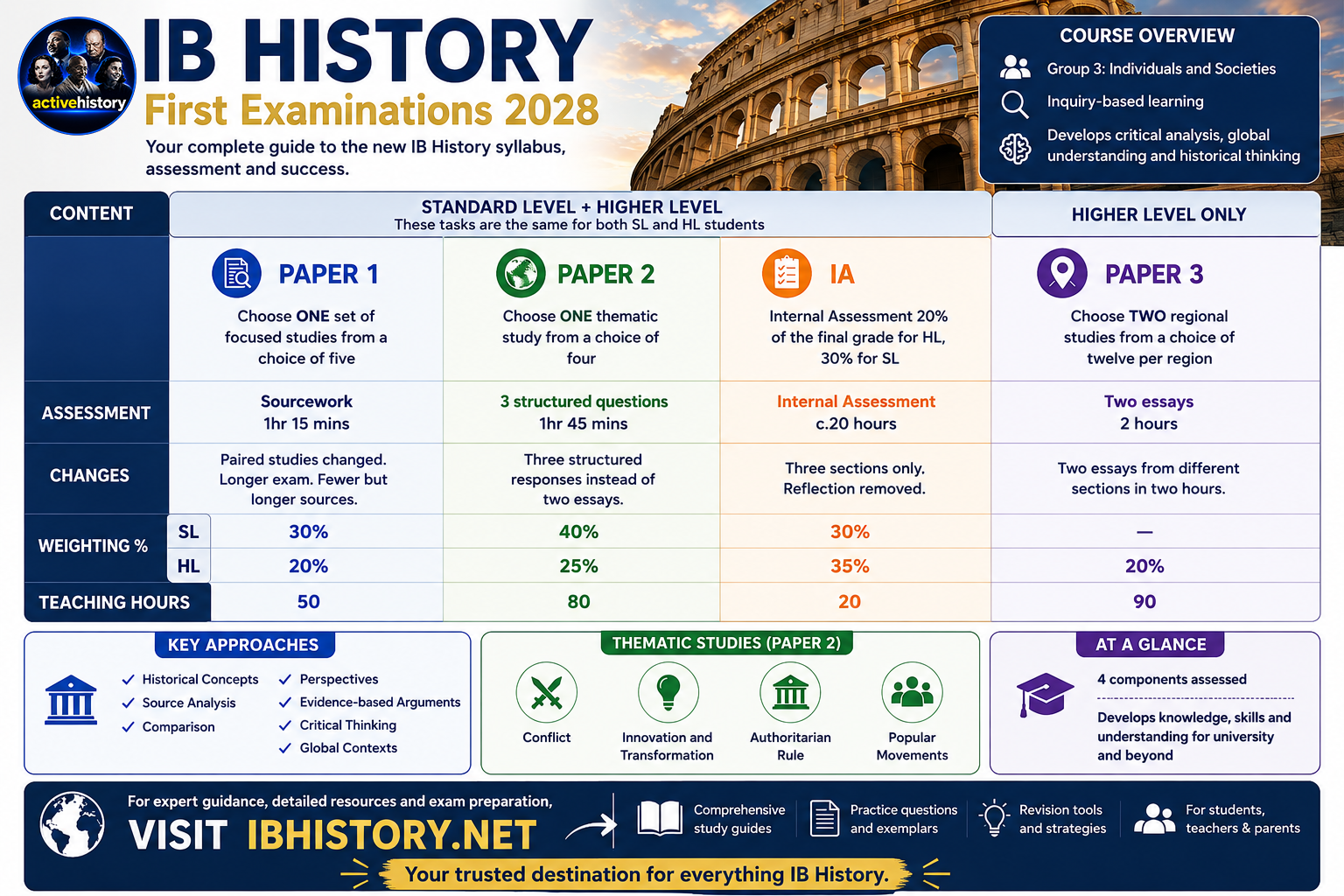
Click image to enlarge
📘 Free IB History Poster
Download this classroom-ready poster summarising the
new IB History syllabus (first examinations 2028),
including Papers 1–3, Internal Assessment requirements,
thematic studies, assessment weightings and key course features.
Ideal for classroom displays, department noticeboards,
student handbooks and induction sessions.