The Indochina refugee crisis (1975–1990) offers a vivid and human window into the aftermath of war, revolution, and Cold War geopolitics. Following the Communist victories in Vietnam, Cambodia, and Laos, over three million people were uprooted—many risking their lives as “boat people” or crossing treacherous borders to escape persecution and famine. For IB History students, it’s an exceptional Paper 1 topic because it is richly documented in government records, UN reports, photographs, and oral testimonies—allowing for deep analysis of origin, purpose, value, and limitation (OPVL) and encouraging critical engagement with humanitarian responses, ideology, and international cooperation in the late twentieth century.
What were the conditions that led to mass displacement?
Combat Operations and Communist Victory
Collapse of South Vietnam (1975)
In April 1975, North Vietnamese forces captured Saigon, ending the Vietnam War. The fall followed the rapid collapse of ARVN (Army of the Republic of Vietnam) defenses during the “Ho Chi Minh Campaign.” U.S. aid cuts and the withdrawal of American forces (by the 1973 Paris Peace Accords) left the South vulnerable. The evacuation of over 130,000 Vietnamese—Operation Frequent Wind—marked the first major wave of Indochinese refugees.
Communist Takeovers in Laos and Cambodia
Following Saigon’s fall, Communist forces triumphed in Laos and Cambodia. The Pathet Lao seized Vientiane in December 1975, deposing King Savang Vatthana. In Cambodia, the Khmer Rouge entered Phnom Penh on 17 April 1975, initiating the “Year Zero.” Across Indochina, non-Communist officials, soldiers, and urban elites faced detention or flight, with hundreds of thousands crossing into Thailand by 1976.
Regional Conflict and Border Wars
The postwar years saw escalating regional conflict. Vietnam’s invasion of Cambodia in December 1978 to oust the Khmer Rouge triggered the Sino-Vietnamese War in February 1979. Fighting devastated border provinces such as Lang Son and Kampot, while mass violence displaced civilians. By 1979, UNHCR estimated 1.5 million Indochinese—Vietnamese, Lao, and Cambodians—had fled by land or sea due to combat and political upheaval.
Persecution and Fear of Reprisals
Re-education Camps in Vietnam
After 1975, the Socialist Republic of Vietnam sent over 300,000 former South Vietnamese officials, soldiers, and intellectuals to “re-education camps.” Many endured years of forced labor, malnutrition, and torture in remote jungle sites like Son La and Yen Bai. The government labeled them “reactionaries,” and families were often exiled to “New Economic Zones.” Amnesty International in 1979 described conditions as “inhuman detention without trial.”
The Khmer Rouge Genocide (1975–1979)
Under Pol Pot’s Democratic Kampuchea, the Khmer Rouge sought to eliminate “bourgeois” and “foreign” elements. Between 1.7 and 2 million Cambodians—roughly one-quarter of the population—died through execution, starvation, or forced labor. Ethnic Vietnamese, Cham Muslims, and urban residents were especially targeted. Survivors fled en masse to Thai border camps such as Khao-I-Dang after Vietnam’s 1979 invasion toppled the regime.
Ethnic and Religious Persecution
Ethnic minorities across Indochina faced harsh repression. In Laos, the Hmong—who had fought alongside the CIA—were hunted by the Pathet Lao; thousands fled to refugee camps in Thailand. In Vietnam, ethnic Chinese (Hoa) communities suffered discrimination and purges, especially after the Sino-Vietnamese rift in 1978. Religious groups, including Catholics and Buddhists, saw churches and pagodas closed under tight state control.
Economic Factors
Collectivization and State Control
Following reunification, Hanoi imposed a socialist command economy across Vietnam. Private businesses were nationalized, agriculture was collectivized, and state quotas replaced market trade. In the south, “liberated” cities such as Saigon (renamed Ho Chi Minh City) faced massive unemployment and shortages. By 1978, the regime’s “reform through labor” zones pushed tens of thousands to flee by sea, seeking survival over ideology.
Collapse of Trade and Sanctions
The U.S. trade embargo on Vietnam (imposed in 1975) and the breakdown of relations with China after 1978 crippled the economy. Aid from the Soviet bloc could not replace lost Western trade. Vietnam’s 1979 occupation of Cambodia brought further isolation. Chronic shortages of rice, fuel, and medicines led to black markets and hunger, compelling many—especially ethnic Chinese traders—to escape by boat.
“Boat People” Exodus and Humanitarian Crisis
Between 1978 and 1980, over 500,000 Vietnamese fled by sea in fragile vessels, many dying to storms, pirates, or starvation. Malaysia, Thailand, and Hong Kong struggled to manage refugee inflows; at Pulau Bidong (Malaysia), population density reached 40,000 per km². The 1979 Geneva Conference on Indochinese Refugees—spearheaded by UNHCR—sought international resettlement, marking the crisis as one of the 20th century’s largest displacements.
What was the national and international response to displacement?
Displaced Persons Camps, Migration, Emigration and Repatriation
Refugee Camps in Southeast Asia
From 1975, makeshift camps emerged across Southeast Asia as hundreds of thousands fled Indochina. Thailand hosted Lao and Khmer refugees at Nong Khai and Khao-I-Dang, while Malaysia’s Pulau Bidong became one of the world’s most crowded camps—housing over 40,000 people by 1979. Conditions were dire: malnutrition, disease, and piracy plagued arrivals. Governments often pushed back boats; in June 1979, Malaysia threatened to refuse all landings unless international aid was increased.
Secondary Migration and Resettlement Programs
Between 1975 and 1990, more than 1.3 million Indochinese were resettled in Western countries. The United States, Canada, France, and Australia led admissions, using programs like the U.S. Indochina Migration and Refugee Assistance Act (1975). Ethnic Lao were resettled in Minnesota, Hmong in California, and Vietnamese across North America and Europe. The 1979 Geneva Conference coordinated global burden-sharing, pledging 260,000 resettlement places annually.
Repatriation and Voluntary Returns
By the late 1980s, host nations sought to curb arrivals. Under the 1989 Comprehensive Plan of Action (CPA), screening processes distinguished “political refugees” from “economic migrants.” Those denied asylum were repatriated, often under UNHCR supervision. Between 1989 and 1996, over 100,000 Vietnamese were voluntarily or forcibly returned, mainly from Hong Kong and Malaysia. The UNHCR funded reintegration aid and monitoring to ensure humane treatment, marking the crisis’s gradual resolution.
Role of the USA and the Vietnamese Government
U.S. Humanitarian and Legislative Response
The United States initially airlifted 130,000 Vietnamese and Cambodian evacuees in 1975 under Operation New Life. Congress passed the Indochina Migration and Refugee Assistance Act, allocating $405 million for resettlement. Subsequent initiatives like the Refugee Act (1980) institutionalized asylum policy, defining “refugee” status under U.S. law. By 1990, the U.S. had accepted nearly 800,000 Indochinese refugees—about half the total resettled globally.
Vietnam’s Restrictions and Boat Departures
The Socialist Republic of Vietnam, established in July 1976, viewed emigration as treasonous but later tolerated departures to ease internal pressures. Following the anti-Hoa (ethnic Chinese) campaigns of 1978–79, authorities covertly encouraged departures in exchange for gold payments—a practice dubbed “organized departures.” Despite the 1979 Orderly Departure Program, illegal boat escapes continued, with thousands dying at sea while officials profited from extortionate exit fees.
Normalization and Repatriation Agreements
By the late 1980s, Hanoi sought diplomatic normalization to end isolation. Agreements with Western countries and UNHCR in 1988–89 promoted “safe return” for screened-out migrants. Vietnam promised no persecution for repatriated persons and began small-scale reintegration projects in provinces like Dong Nai and Quang Ninh. These moves paved the way for Vietnam’s re-entry into international aid frameworks and the lifting of the U.S. trade embargo in 1994.
Role of the UN High Commissioner for Refugees (UNHCR), Including the Orderly Departure Program 1979
Humanitarian Coordination and Protection
The UNHCR took primary responsibility for the Indochina crisis from 1975 onward. Led by High Commissioner Poul Hartling (1978–85), the agency established coordination centers in Bangkok, Kuala Lumpur, and Geneva. It provided food, healthcare, and transport to resettlement countries, while negotiating with reluctant host governments. UNHCR’s 1979 report described the exodus as “the gravest refugee situation since World War II,” involving over 600,000 people across three nations.
The Orderly Departure Program (ODP), 1979
Created under a July 1979 UNHCR–Vietnam–U.S. agreement, the Orderly Departure Program sought to end dangerous sea escapes by allowing legal emigration from Vietnam. Initially focused on family reunification, it later expanded to former political prisoners and ethnic minorities. By 1994, over 500,000 Vietnamese had left safely under ODP procedures. The program was hailed by UNHCR as “a humanitarian alternative to the boats,” though bureaucratic delays persisted.
The Comprehensive Plan of Action (CPA), 1989
As arrivals surged again in the late 1980s, UNHCR convened a regional conference in Geneva in June 1989, producing the CPA. It balanced resettlement, screening, and repatriation, with commitments from 75 governments. Screening centers were established in Hong Kong, Indonesia, and the Philippines. Between 1989 and 1997, over 700,000 people were processed, marking a shift from open-door asylum to managed migration and formally concluding the Indochina refugee crisis.
How was displacement experienced by different groups?
Vietnamese, including Hoa, Montagnard, Hmong and Chams
Ethnic Vietnamese “Boat People”
After the Communist victory in April 1975, tens of thousands of South Vietnamese fled by sea to escape political retribution and economic collapse. By 1979, over 400,000 had departed in fragile vessels, many perishing en route to Malaysia, Hong Kong, or the Philippines. Survivors described “floating coffins” and pirate attacks in the Gulf of Thailand. One refugee told UNHCR: “We preferred the sea to the camps.” These journeys symbolized both desperation and defiance.
The Hoa (Ethnic Chinese) Exodus
The Hoa, a prosperous merchant community, became scapegoats after the Sino-Vietnamese split in 1978. Hanoi’s nationalization campaigns and anti-Chinese propaganda sparked mass flight. In May–June 1978 alone, 165,000 fled from Haiphong and Ho Chi Minh City by boat. Many sold possessions or paid bribes to officials to leave. Thailand and Malaysia were overwhelmed by arrivals, while Beijing condemned Vietnam’s “racial persecution of overseas Chinese.” By 1980, half a million Hoa had departed.
Montagnard, Hmong and Cham Minorities
Indigenous Montagnard and Hmong peoples, allied with U.S. and South Vietnamese forces during the war, faced reprisals after 1975. The Hmong of Vietnam’s Central Highlands and Laos’s Xieng Khouang fled across the Mekong into Thailand. Cham Muslims in southern Vietnam endured religious repression under the socialist regime; mosques were closed, and Arabic education was banned. Many sought refuge in Malaysia and Indonesia, forming small but cohesive exile communities by the mid-1980s.
Cambodians Fleeing the Khmer Rouge
Survivors of Democratic Kampuchea (1975–1979)
Under Pol Pot’s regime, cities were emptied and millions forced into rural labor camps. By 1979, famine and executions had killed up to 2 million Cambodians. As Vietnam invaded to topple the Khmer Rouge in December 1978, civilians fled en masse toward Thailand. Refugees trudged through minefields and jungles to reach camps like Khao-I-Dang, which held over 130,000 people by 1980. UN relief worker Karl D. Jackson called it “a society of survivors.”
Life in Thai Border Camps
From 1979, the Thai–Cambodian frontier became a humanitarian flashpoint. Camps such as Sa Kaeo and Site Two were overcrowded, disease-ridden, and militarized. Food shortages and forced repatriations were common. Relief efforts by Médecins Sans Frontières and UNHCR were hampered by Thai security restrictions and continued Khmer Rouge presence. By 1984, over 300,000 Cambodians were confined in border camps, many trapped between aid agencies and guerrilla factions.
Post-1979 Exile and Reconstruction
After the establishment of the Vietnamese-backed People’s Republic of Kampuchea in 1979, many refugees refused to return, fearing reprisals or famine. The UN recognized the exiled Coalition Government of Democratic Kampuchea, prolonging displacement. Cultural trauma endured: Buddhist monks rebuilt pagodas in exile, while survivors in resettlement countries like France and the U.S. founded “Killing Fields” memorials. By 1990, about 600,000 Cambodians had resettled abroad, symbolizing a shattered nation’s diaspora.
Laotians and Highland People of Laos
Flight of the Royalists and Hmong Allies
The Pathet Lao’s seizure of Vientiane in December 1975 triggered panic among royalists and ethnic allies. CIA-backed Hmong under General Vang Pao fled to Thailand’s Ban Vinai camp, which housed over 40,000 by 1980. Many traversed the Mekong River at night, under fire from Pathet Lao troops. U.S. aid groups described “the silent exodus” of mountain peoples, uprooted after decades of fighting in the “Secret War” waged alongside the CIA’s Air America.
Life in Thai Refugee Camps
Hmong, Lao, and Khmu refugees endured prolonged confinement in Thai camps like Ban Vinai and Nong Khai. Conditions were harsh—crowded bamboo huts, limited rations, and restricted movement. Children were born stateless, and Thai authorities viewed many as security risks. Yet refugee communities maintained schools, churches, and traditional ceremonies. Anthropologist Jane Hamilton-Merritt recorded that “Ban Vinai became a Hmong village in exile,” preserving identity amid loss.
Resettlement and Cultural Displacement
Between 1975 and 1990, over 400,000 Laotians were resettled abroad, primarily in the United States, France, and Canada. Programs like the U.S. Refugee Resettlement Office assisted adaptation but cultural shock was profound. Elder Hmong struggled with urban life in Fresno or Minneapolis, while youth assimilated quickly. Others were repatriated under the 1989 Comprehensive Plan of Action, returning to monitored villages in Laos. The exodus fractured families and reshaped the highland cultures of mainland Southeast Asia.
Recommended Sources
Primary sources
Richard B. Cheney, Indochina Refugees (Gerald R. Ford Presidential Library, Box 5 Folder “Indochina Refugees”, accessed via the Ford Library Museum website). fordlibrarymuseum.gov
This collection of U.S. government documents gives direct evidence of U.S. evacuation and refugee policy in 1975. Highly reliable as official records, although U.S.-centric.
Central Intelligence Agency, Indochinese Refugees: The Continuing Exodus (CIA Report RDP84S00558R000400020002-7, 1983). CIA
A declassified government report offering detailed statistics and analysis on refugee flows in 1978-83. Useful for quantitative data and U.S. intelligence perspective; subject to Cold-War framing.
U.N. High Commissioner for Refugees (UNHCR), Flight from Indochina (Geneva: UNHCR, 1987). UNHCR
Provides data on resettlement and camp conditions, with interviews and agency records. Reliable international humanitarian-agency source, though summary in nature.
U.S. Government Accountability Office, Operation New Life: Evacuation and Temporary Care Afforded Indochinese Refugees – Report to the Congress (Washington D.C.: GAO, 1976). Government Accountability Office
Detailed logistic and financial audit of U.S. refugee evacuation after April 1975. Useful for U.S. domestic policy dimension; narrow scope.
Frederic C. Benson, “Indochina War Refugee Movements in Laos, 1954-1975: A Chronological Overview,” The Journal of Lao Studies, Special Issue (2015). ResearchGate
Though published later, the article draws on newly digitised primary-source documents (USAID, Embassy reports) relating to Laos. Valuable for Laos highland displacement context; note it focuses pre-1975 and is narrow in geography.
Secondary sources
Joanna C. Scott, Indochina’s Refugees: Oral Histories from Laos, Cambodia and Vietnam (Jefferson, NC: McFarland, 2011). books.google.fr
A collection of refugee-narratives across countries. Valuable for lived experience and cross-national comparative depth; as oral history, individual subjectivities must be interpreted cautiously.
M. Osborne, “The Indochinese Refugees: Cause and Effects,” International Migration Review 14, no. 1 (1980): 81-94. JSTOR
An early academic assessment of the exodus from Vietnam, Laos and Cambodia; offers analysis of causes and policy responses. Reliable for contemporaneous academic perspective, though some data may be dated.
“Vietnam, ASEAN and the Indochina Refugee Crisis (1980),” in Turning Points and Transitions: Selections from Southeast Asian Affairs 1974-2018 (Singapore: ISEAS-Yusof Ishak Institute, 2018), pp. 738-761. Cambridge University Press & Assessment
A regionally-oriented secondary source situating the refugee crisis in ASEAN politics. Useful for Southeast Asian diplomatic context; less focus on individual refugee experience.
Rubén G. Rumbaut, “A Legacy of War: Indochinese Refugees in Historical Perspective,” (Washington D.C.: [Publisher], 1996). Scribd
This work analyses refugee resettlement and diaspora in the United States. Useful for post-arrival outcomes; U.S. refugee-settlement focus rather than region of origin.
“The Resettlement of Indochinese Refugees in Canada: Looking Back after Twenty Years,” Canadian Council for Refugees (CCRWeb, 1999). Canadian Council for Refugees
A national case-study of Canadian resettlement of Indochinese refugees. Useful for comparative resettlement policy; Canada-specific and somewhat descriptive.
Websites
U.S. House of Representatives History, “Refugee Crisis | U.S. House of Representatives” History House
Covers U.S. legislative responses including the Refugee Act of 1980. Useful for U.S. policy dimension and accessible; limited to U.S. legislative context.
Provides an overview of the crisis, numbers and major events. Useful for quick orientation and bibliography leads; must be treated with caution, verify via scholarly sources.
University of Wisconsin–Madison Southeast Asian Images & Texts (SEAiT) digital collection – “Indochina War Refugees in Laos, 1954-1975” (research data). ResearchGate
Useful as gateway to digitised primary-source documents on Laos; reliability depends on original provenance and documentation.
Canadian Council for Refugees (CCRWeb) – “Resettlement of Indochinese Refugees in Canada” (ccrweb.ca). Canadian Council for Refugees
Useful for policy and retrospective commentary; limited geographical scope.
Ford Library Museum digital archive – “Indochina Refugees” (fordlibrarymuseum.gov). fordlibrarymuseum.gov
Official U.S. archival collection of Cheney files and related documents; highly reliable as archival source but U.S.-government perspective.
This documentary-style oral history features Vietnamese boat-refugees recalling their experience. Useful for visual-narrative and first-person testimony; check production context for bias.
A British Broadcasting Corporation (BBC) archival news documentary on refugee camps in Thailand (1979). Good for contemporary media representation; context may reflect journalistic limitations.
This podcast offers first-person refugee stories and diaspora reflections. Useful for qualitative and contemporary diaspora perspective; as podcast, verify factual claims. Apple Podcasts
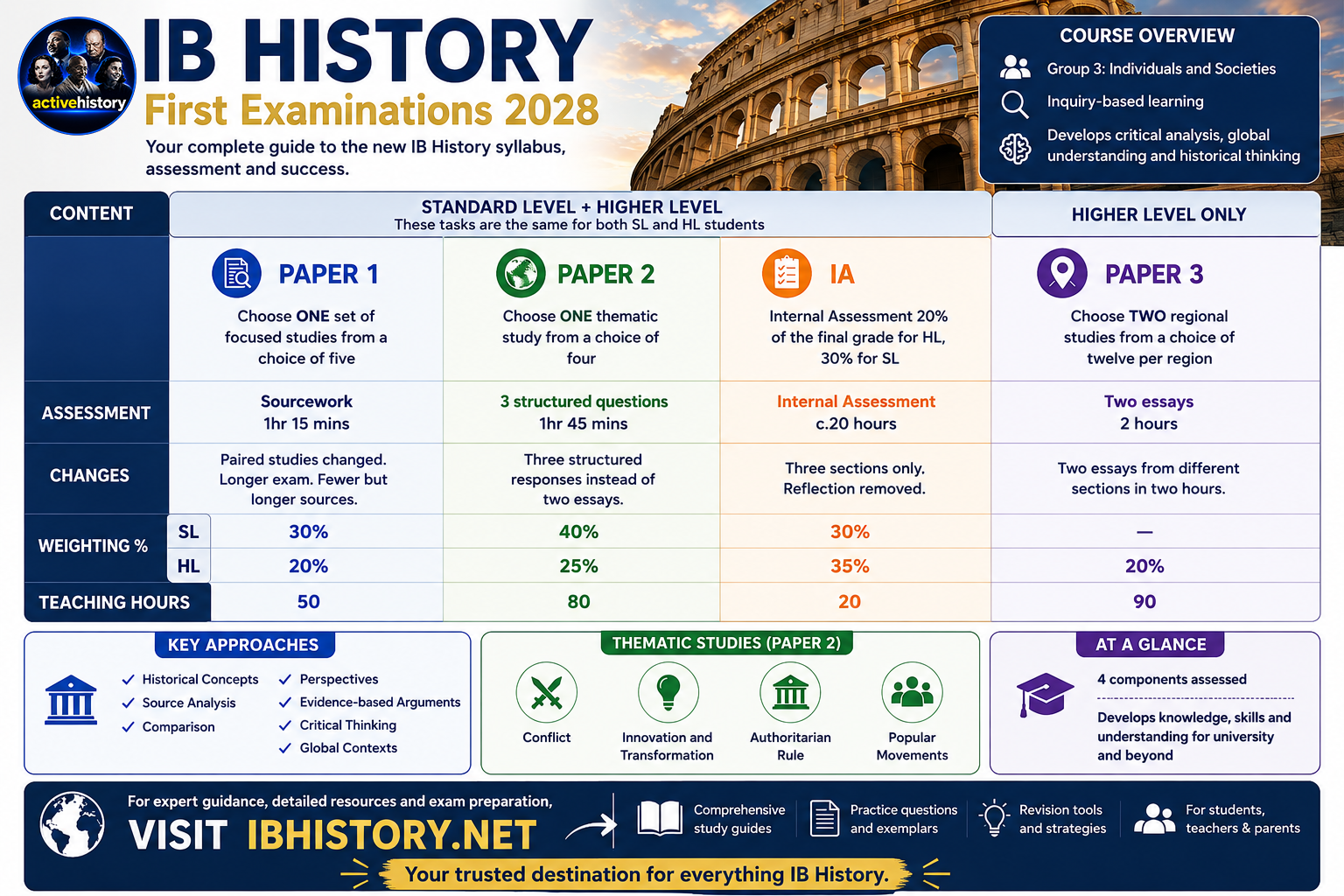
Click image to enlarge
📘 Free IB History Poster
Download this classroom-ready poster summarising the
new IB History syllabus (first examinations 2028),
including Papers 1–3, Internal Assessment requirements,
thematic studies, assessment weightings and key course features.
Ideal for classroom displays, department noticeboards,
student handbooks and induction sessions.