
ALL essay questions will use the command term "To what extent do you agree...?". No other command terms will be used!
 ActiveHistory Insight
There are two types of "To what extent do you agree...?" questions that need to be considered:
Understanding which type you are answering is the key to success.
ActiveHistory Insight
There are two types of "To what extent do you agree...?" questions that need to be considered:
Understanding which type you are answering is the key to success.
Inquiry topic |
Specified content |
Recommended Resources from ActiveHistory |
Establishment and maintenance of political authority |
|
Aztecs and Conquistadors (Grade 7 scheme of work)
|
Establishment and maintenance of economic structures |
|
|
Establishment and maintenance of social organization |
|
|
Impact of warfare on Indigenous societies |
|
|
Role of culture in maintaining Indigenous societies |
|
|
Challenges faced by Indigenous societies |
|
Regional study 2: Colonialism and the system of slavery in the Americas (circa 1492-1830)
Inquiry topic |
Specified content |
Recommended Resources from ActiveHistory |
Initial impact of European exploration |
|
[Note: Designed for Grade 8 teaching] |
Early treatment of Indigenous peoples by colonial governments |
|
|
Reasons for the development of the system of transatlantic slavery |
|
|
Impact of the system of transatlantic slavery |
|
|
Resistance by enslaved peoples |
|
|
Emergence and growth of early opposition to slavery |
|
Regional study 3: Independence movements in the Americas (1763-1860)
All examination questions will require students to refer to one country from the region.
Inquiry topic |
Specified content |
Recommended Resources from ActiveHistory |
Reasons for the emergence of independence movements |
|
The American War of Indpendence (Grade 8 study unit) |
Contributions of key leaders to the success of independence movements |
|
|
Reasons for the outcome of revolutionary wars |
|
|
Establishment of new nation states |
|
|
Post-independence challenges for new nation states |
|
|
Impact of US relations with independent states in Latin America |
|
Regional study 4: The US Civil War (1840-1877)
Inquiry topic |
Specified content |
Recommended Resources from ActiveHistory |
Impact of the system of slavery on the USA |
|
The American West (Grade 8 Unit) The American Civil War - Causes (Grade 8 Unit) The American Civil War - Events (Grade 8 Unit) |
Long-term causes of the Civil War |
|
|
Short-term causes of the Civil War |
|
|
Reasons for the outcome of the Civil War |
|
|
Impact of the Civil War |
|
|
Successes and failures of Reconstruction |
|
Regional study 5: The formation of modern nations in the Americas (1860-1929)
All examination questions will require students to refer to one country from the region.
Inquiry topic |
Specified content |
Economic transformation |
|
Impacts of migration |
|
Impact of ideological trends on the transformation of nations |
|
Political and social transformations |
|
Role of leaders in the transformation of nations |
|
Challenges in the transformation of nations |
|
Regional study 6: The Mexican Revolution (1884-1940)
Inquiry topic |
Specified content |
Reasons for the outbreak of the revolution |
|
Impact of revolutionary leaders on the revolution |
|
Impact of the 1917 Constitution |
|
Achievements and challenges of the post-revolutionary state (1920- |
|
Foreign contributions to the revolution |
|
Impact of the revolution |
|
Regional study 7: The Great Depression in the Americas (circa 1920-1939)
Inquiry topic |
Specified content |
Reasons for the Great Depression |
|
Political impact of the Great Depression in the USA |
|
Political impact of the Great Depression in one country of the Americas (excluding the USA) |
|
Social impact of the Great Depression in one country in the Americas |
|
Effectiveness of solutions in the USA and Canada |
|
Effectiveness of solutions in one country in Latin America |
|
Regional study 8: Emergence of the Americas in global affairs (1880-1945)
Inquiry topic |
Specified content |
Reasons for US expansionist foreign policy |
|
Impact of US expansionist foreign policy |
|
Changing regional and global role of the USA |
|
Changing regional and global role of one country in the Americas (excluding the USA) |
|
Domestic impact of the First World War on one country in the Americas |
|
Domestic impact of the Second World War on one country in the Americas |
|
Regional study 9: The Americas during the Cold War (1945-1991)
Inquiry topic |
Specified content |
Recommended Resources from ActiveHistory |
Impact of the Cold War during the presidencies of Harry S. Truman and Dwight D. Eisenhower |
|
Note: The emphasis should always be on the relevance / impact of the Cold War WITHIN THE AMERICAS but references to other regions might be appropriate for fuller context. |
Cuban Revolution and its impact in the Americas |
|
|
Impact of the Cold War during the presidencies of John F. Kennedy and Lyndon B. Johnson |
|
|
Impact of US foreign policies in the Americas (1968-1988) |
|
|
Impact of the Cold War on Canada |
|
|
Impact of the Cold War on one |
|
Regional study 10: Political developments in Latin America (1934-2020)
Inquiry topic |
Specified content |
Recommended Resources from ActiveHistory |
Reasons for the Cuban Revolution |
|
|
Maintenance of power and impact of rule of Fidel Castro |
|
|
Emerging challenges in one Latin American country |
|
|
Impact of a guerrilla movement on |
|
|
Impact of, and maintenance of power by, military dictatorship on one country in Latin America |
|
|
Reasons for the emergence of democratization in one country in Latin America |
|
Regional study 11: Social movements in the Americas (1945-2020)
Suggested social movements (excluding the African American civil rights movement) include, but are not limited to, Hispanic, feminist, Indigenous, youth, counterculture, disability, Afro-Latino and Afro-Caribbean movements.
Inquiry topic |
Specified content |
Recommended Resources from ActiveHistory |
Reasons for the emergence of the African American civil rights movement |
|
Civil Rights and Protest
Youth Protest / Counterculture after 1945
|
Methods used by the African American civil rights movement to create change |
|
|
Extent of change achieved by the African American civil rights movement |
|
|
Reasons for the emergence of one social movement (excluding the African American civil rights movement) in the Americas |
|
|
Methods used by one social movement (excluding the African American civil rights movement) in the Americas to create change |
|
|
Extent of change achieved by one social movement (excluding the African American civil rights movement) in the Americas |
|
Regional study 12: Political developments in the USA and Canada (1960-2020)
Inquiry topic |
Specified content |
Recommended Resources from ActiveHistory |
Challenges and successes in domestic politics of the USA (1961- 1977) |
|
|
Challenges and successes in domestic politics of the USA (1977- 2001) |
|
|
Challenges and successes in domestic politics of the USA (2001- 2020) |
|
|
Challenges and successes in domestic politics of Canada (1963- 1993) |
|
|
Causes and effects of the Quiet Revolution |
|
|
Challenges and successes in domestic politics of Canada (1993- 2020) |
|
Regional study 1: Transformation in North Africa and the Middle East (750-1291)
Inquiry topic |
Specified content |
Rise of the Abbasid Caliphate |
|
Impact of Abbasid rule |
|
Reasons for, and regional impact of, the collapse of Abbasid rule |
|
Reasons for emergence of the Crusades |
|
Reasons for the outcome of the Crusades |
|
Impact of the Crusades in the Middle East |
|
Regional study 2: Pre-colonial sub-Saharan African states (circa 800-1945)
All examination questions will require students to refer to one sub-Saharan state. Suggested examples include, but are not limited to, the Ghana Empire (830-1240), Swahili city-states (1000-1500), Mali Empire (1235-1400), Ashanti (1701-1902), Kongo (1400-1914), Ethiopian Empire (1850-1945) and Zulu Kingdom
(1816-1887).
Inquiry topic |
Specified content |
Emergence and consolidation of the state |
|
Reasons for the growth of production and trade |
|
Maintenance of authority |
|
Impact of the state |
|
Reasons for decline and collapse |
|
Post-decline and collapse impact |
|
Regional study 3: The African slave trade (1500-1900)
Inquiry topic |
Specified content |
Recommended Resources from ActiveHistory |
Reasons for the expansion of the Atlantic slave trade |
|
Note: Originally designed as a Grade 8 unit |
Reasons for the expansion of slavery in East Africa from the late 18th century |
|
|
Impact of slavery in Africa |
|
|
Resistance to slavery by enslaved peoples |
|
|
Economic reasons for the decline of the slave trade |
|
|
Reasons for the abolition of the slave trade |
|
Regional study 4: The Ottoman Empire and the creation of Turkey (circa 1790-1938)
Inquiry topic |
Specified content |
Decline of Ottoman power (from circa 1790) |
|
Emergence of the “Eastern Question” and increasing European influence |
|
Reasons for, and impact of, Tanzimat reforms (1839-1876) |
|
Emergence and impact of the Committee of Union and Progress (CUP) |
|
Impact of conflict on the Ottoman Empire |
|
Impact of the rule of Atatürk (1923- 1938) |
|
Regional study 5: European imperialism and the partition of Africa (circa 1840-1920)
Inquiry topic |
Specified content |
Recommended Resources from ActiveHistory |
Growth of European activity in Africa (from circa 1840) |
|
|
Reasons for emergence of “New Imperialism” in Africa |
|
|
Vulnerability of African societies to European imperialism |
|
|
Causes and impact of the partition of Africa |
|
|
Reasons for resistance and collaboration |
|
|
Successes and failures of African responses |
|
Regional study 6: Developments in South Africa (1867-2020)
Inquiry topic |
Specified content |
Recommended Resources from ActiveHistory |
Impact of the Mineral Revolution (from 1867) |
|
Apartheid South Africa to 1964 |
Outbreak and impact of the South African War (1899-1902) |
|
|
Emergence and development of apartheid |
|
|
Growth and development of resistance to apartheid |
|
|
Impact of international opposition and changing attitudes |
|
|
Successes and failures in the end of apartheid |
|
Regional study 7: Colonialism and crisis in Rwanda and the Congo (circa 1875-2003)
Inquiry topic |
Specified content |
Recommended Resources from ActiveHistory |
Impact of colonialism in the Congo Free State (1885-1908) and Belgian Congo (1908-1960) |
|
European Empires in the 19th Century |
Impact of German and Belgian colonialism in Rwanda (1885-1962) |
|
|
Reasons for the post-independence civil war in Rwanda |
|
|
Emergence and impact of Mobutu on Zaire |
|
|
Reasons for, and impact of, the Rwandan genocide (1994) |
|
|
Reasons for, and impact of, the Second Congo War (1998-2003) |
|
Regional study 8: Colonialism in Côte d’Ivoire, Kenya, Mozambique, Nigeria, Senegal and Uganda (1890-1980)
All examination questions will require students to refer to any one of the prescribed countries—Côte d’Ivoire, Kenya, Mozambique, Nigeria, Senegal and Uganda. It is recommended that a variety of the prescribed countries are taught to ensure coverage of all inquiry topics and specified content.
Inquiry topic |
Specified content |
Recommended Resources from ActiveHistory |
Methods used to establish and maintain colonial political authority |
|
Kenyan Independence |
Methods used to maintain power |
|
|
Impact of colonial economic policies |
|
|
Social and cultural continuity and change under colonialism |
|
|
Impact of colonial rule on different social groups |
|
|
Effectiveness of Indigenous resistance to colonial rule |
|
Regional study 9: Conflict and instability in the Middle East (1896-2020)
Inquiry topic |
Specified content |
Recommended Resources from ActiveHistory |
Origins of the Arab-Israeli conflict |
|
|
Reasons for Arab-Jewish tensions (to 1945) |
|
|
Reasons for the First Arab-Israeli War (1948) |
|
|
Continuation and escalation of the Arab-Israeli conflict |
|
|
Impact of the Arab-Israeli conflict |
|
|
Attempts to reach a peaceful settlement |
|
Regional study 10: Independence movements in Algeria, Angola, Ghana, Guinea, Namibia and Tanganyika (circa 1900-2000)
All examination questions will require students to refer to any one of the prescribed independence movements—Algeria, Angola, Ghana, Guinea, Namibia and Tanganyika. It is recommended that a variety of the prescribed countries are taught to ensure coverage of all inquiry topics and specified content.
Inquiry topic |
Specified content |
Domestic reasons for the emergence of independence movements |
|
External reasons for the emergence of independence movements |
|
Emergence and growth of pro- independence political parties |
|
Importance of non-violence in achieving independence |
|
Importance of armed struggle in achieving independence |
|
Impact of independence movements |
|
Regional study 11: Revolution, reform and foreign relations in the Middle East (circa 1945-2020)
Inquiry topic |
Specified content |
Recommended Resources from ActiveHistory |
Reasons for the 1979 revolution in Iran |
|
Events in the Gulf, c.1975-2000 |
Impact of post-revolution Iran |
|
|
Impact of the Iran-Iraq War (1980- 1988) |
|
|
Impact of Gamal Abdel Nasser’s rule in Egypt (from 1954) |
|
|
Reasons for the 2011 Egyptian revolution |
|
|
Impact of Lebanese Civil Wars (1975-1990) on regional politics |
|
Regional study 12: Modern developments in Ethiopia, Niger, Somalia, Tunisia, Zambia and Zimbabwe (circa 1945-2020)
All examination questions will require students to refer to any one of the prescribed countries—Ethiopia, Niger, Somalia, Tunisia, Zambia and Zimbabwe. It is recommended that a variety of the prescribed countries are taught to ensure coverage of all inquiry topics and specified content.
Inquiry topic |
Specified content |
Recommended Resources from ActiveHistory |
Reasons for the emergence of authoritarian rule |
|
Tunisia: Rule of Ben Ali / Jasmine Revolution |
Move to multi-party democracy in the 1980s and 1990s |
|
|
Reasons for economic growth and development (to 2020) |
|
|
Social challenges (to 2020) |
|
|
Causes of coups d’état and civil wars |
|
|
Impact of external involvement |
|
Regional study 1: Asian kingdoms and empires (750 CE-1500 CE)
All examination questions will require students to refer to one kingdom or empire from the region. Suggested examples include, but are not limited to, the Shogunate, Mongol Empire, Angkor Empire, Trầnh Dynasty of Vietnam and Srivijaya/Sailendra (Indonesia).
Inquiry topic |
Specified content |
Reasons for emergence |
|
Importance of leaders in the development of Asian kingdoms and empires |
|
Domestic developments |
|
Role of foreign relations in the development of Asian kingdoms and empires |
|
Maintenance of power |
|
Challenges and decline |
|
Regional study 2: The Mughal Empire and the British East India Company (1526 - 1858)
Inquiry topic |
Specified content |
Recommended Resources from ActiveHistory |
Reasons for the rise of Mughal power |
|
Note - designed as study units for younger students |
Consolidation of Mughal rule |
|
|
Challenges to Mughal rule |
|
|
Impact of the Mughal Empire |
|
|
Decline of the Mughals and establishment of East India Company rule |
|
|
Reasons for the end of the Mughals, the end of East India Company rule, and the establishment of direct rule |
|
Regional study 3: Challenges to imperial rule in China (1736 - 1911)
Inquiry topic |
Specified content |
Recommended Resources from ActiveHistory |
Challenges to the Qianlong Emperor |
|
European Empires in the 19th Century |
Efforts to “open up” China |
|
|
Reasons for, and impact of, the Opium Wars |
|
|
Reasons for, and impact of, the Taiping Rebellion |
|
|
Failure of the Qing Dynasty to reform |
|
|
Decline and fall of the Qing Dynasty |
|
Regional study 4: Indigenous societies and national identity in Australia and New Zealand (circa 1770-2020)
Inquiry topic |
Specified content |
Impact of colonization in Australia and New Zealand (to circa 1900) |
|
Experiences of colonization by Aboriginal, Torres Strait Islander and Māori peoples (to circa 1900) |
|
Reasons for the emergence of Australian and New Zealand nations |
|
Impact of the First World War on Australia and New Zealand |
|
Social and cultural developments after the Second World War in either Australia or New Zealand |
|
Successes and failures of foreign policy after the Second World War in either Australia or New Zealand |
|
Regional study 9: Politics and economy in Japan (1912-2020)
Inquiry topic |
Specified content |
Impact of the First World War on Japan |
|
Domestic achievements and challenges in the 1920s |
|
Growth of Japanese imperialism |
|
Reasons for Japanese defeat in the Second World War |
|
Recovery and growth in post-war Japan |
|
Economic, political and social challenges (1989–2020) |
|
Regional study 5: Korea (1840 - 1945)
Inquiry topic |
Specified content |
Mid-century challenges to the Korean monarchy |
|
“Opening up” of Korea and regional responses |
|
Impact of regional rivalries |
|
Impact of reforms under the Korean Empire |
|
Impact of Japanese rule |
|
Impact of the Second Sino - Japanese War |
|
Regional study 6: Independence of India (1857 - 1964)
Inquiry topic |
Specified content |
Reasons for the emergence of Indian nationalism |
|
Impact of political developments in the British Raj |
|
Methods used to achieve Indian independence |
|
Leaders and their importance in the independence movement |
|
Reasons for, and impact of, the Partition of India |
|
Challenges in post-independence India |
|
Regional study 7: The emergence of independent states in Southeast Asia (1900 - 1990)
All examination questions will require students to refer to one state from Southeast Asia.
Inquiry topic |
Specified content |
Social and economic impact of early colonialism |
|
Origins of nationalism and independence movements |
|
Growth of nationalist movements (from 1914) |
|
Impact of the Second World War on Southeast Asia |
|
Post-war methods used to achieve independence |
|
Achievements and challenges in the first 10 years of independence |
|
Regional study 8: Emergence of Modern China (1910 - 1949)
Inquiry topic |
Specified content |
Recommended Resources from ActiveHistory |
Rise of national identity in China |
|
|
Impact of the First World War on the development of nationalism |
|
|
Impact of Guomindang rule of China |
|
|
Reasons for the rise of communism in China (to 1936) |
|
|
Impact of the Second Sino - Japanese War (1937 - 1945) |
|
|
Reasons for the outcome of the Chinese Civil War (1946 - 1949) |
|
Regional study 10: The emergence of Central Asian republics (1917-2020)
All examination questions will require students to refer to one Central Asian republic. Suggested examples include, but are not limited to, Kyrgyzstan, Uzbekistan, Turkmenistan, Kazakhstan and Tajikistan.
Inquiry topic |
Specified content |
Impact of the Russian Revolution and Civil War (1917-1920) |
|
Impact of Soviet control and policies in the ASSR (1920-1940) |
|
Impact of the Second World War (1941-1945) |
|
Impact of changing Soviet policies in the ASSRs |
|
Reasons for the establishment of independent Central Asian republics |
|
Challenges and successes of nation- building (1991-2020) |
|
Regional study 11: The Cold War in Asia (1949-2002)
Inquiry topic |
Specified content |
Recommended Resources from ActiveHistory |
Reasons for the Korean War (1950- 1953) |
|
|
Impact of the war on North and South Korea and the region (to 1963) |
|
|
Reasons for conflict in Vietnam (1954-1975) |
|
|
Impact of the Vietnam conflict (to 1985) |
|
|
Reasons for conflict in Afghanistan (1979-1992) |
|
|
Impact of the conflict in Afghanistan (to 2002) |
|
Regional study 12: The People’s Republic of China (1949-2020)
Inquiry topic |
Specified content |
Recommended Resources from ActiveHistory |
Mao consolidation and maintenance of power (1949-1976) |
|
|
Economic and social transformations and challenges under Mao (1949-1976) |
|
|
Foreign policy successes and failures under Mao (1949-1976) |
|
|
Impact of political developments (1976-2020) |
|
|
Economic and social transformations and challenges (1976-2020) |
|
|
Foreign policy successes and failures (1976-2020) |
|
Regional study 1: Medieval kingdoms and empires (circa 750-1400)
All examination questions will require students to refer to one example of a medieval kingdom or empire. Suggested examples include, but are not limited to, the Carolingian Empire, Holy Roman Empire, North Sea Empire, Norman and Angevin England, Capetian France and Kingdom of Poland.
Inquiry topic |
Specified content |
Reasons for emergence and expansion |
|
Legitimization, consolidation and maintenance of authority |
|
Impact of religion |
|
Cultural and social developments |
|
Reasons for decline |
|
Role and importance of one leader in the kingdom/empire |
|
Regional study 2: Renaissance and Reformation (circa 1350-1700)
Inquiry topic |
Specified content |
Recommended resources from ActiveHistory |
Emergence of the Renaissance in Italy |
|
|
Emergence of the Renaissance in one country in Europe, excluding Italy |
|
|
Impact of the Renaissance in one |
|
|
Emergence of the Reformation |
|
|
Impact of the Reformation on one |
|
|
Responses of the Catholic Church and the Counter-Reformation |
|
Regional study 3: Enlightenment and Absolutism (1600-1800)
Examination questions concentrating on rulers will require students to refer to one enlightened despot. Suggested examples include, but are not limited to, Catherine the Great of Russia, Frederick the Great of Prussia, Charles III of Spain and Joseph II Holy Roman Emperor.
Inquiry topic |
Specified content |
Emergence of Enlightenment ideas |
|
Developments during the Enlightenment era |
|
Impact of Enlightenment ideas |
|
Maintenance of power by one |
|
Domestic impact of one |
|
Foreign policy of one enlightened despot |
|
Regional study 4: The French Revolution (1774-1815)
Inquiry topic |
Specified content |
Recommended resources from ActiveHistory |
Reasons for the revolution |
|
|
Radicalization of the revolution |
|
|
Rise of Napoleon |
|
|
Social change in revolutionary and Napoleonic France |
|
|
Impact of Napoleonic rule on any one country in the French empire or French colonial empire, excluding France |
|
|
Decline and defeat of the First French Empire |
|
Regional study 5: Unification of Germany and Italy (1815-1871)
Inquiry topic |
Specified content |
Recommended resources from ActiveHistory |
Impact of the Congress System on Germany and Italy |
|
|
Growth of nationalism and liberalism in Italy (1815-1848) |
|
|
Growth of nationalism and liberalism in Germany (1815-1848) |
|
|
Impact of the 1848 revolutions in Germany and Italy |
|
|
Unification of Italy (1849-1871) |
|
|
Unification of Germany and the establishment of the German Empire (1849-1871) |
|
Regional study 6: Europe and the First World War (1871-1923)
Inquiry topic |
Specified content |
Recommended resources from ActiveHistory |
Maintenance of peace and stability, and the changing balance of power in Europe (after 1871) |
|
|
Causes and impact of German foreign policy before the First World War |
|
|
Reasons for the First World War |
|
|
Reasons for the defeat of Germany and the other Central Powers |
|
|
Impact of the First World War on |
|
|
Impact of the Paris Peace Treaties (1919-1923) |
|
Regional study 7: The Russian Revolution (1855-1924)
Inquiry topic |
Specified content |
Recommended resources from ActiveHistory |
Impact of the policies of Alexander II (1855-1881), Alexander III (1881- |
|
|
Causes and impact of the 1905 Revolution |
|
|
Impact of policies of repression and reform (1905-1917) |
|
|
Reasons for the October/November Revolutions and rise to power of the Bolsheviks |
|
|
Survival and consolidation of Bolshevik rule |
|
|
Impact of Bolshevik rule (to 1924) |
|
Regional study 8: European totalitarianism (1918-1941)
Inquiry topic |
Specified content |
Recommended resources from ActiveHistory |
Benito Mussolini’s rise and consolidation of power (1918-1926) |
|
|
Domestic impact of Mussolini’s Italy (to 1940) |
|
|
Failure of Weimar Germany, and Adolf Hitler’s rise and consolidation of power (1918-1934) |
|
|
Domestic impact of Hitler’s Germany (to 1939) |
|
|
Joseph Stalin’s rise and consolidation of power (to 1941) |
|
|
Domestic impact of Stalin’s USSR (to 1941) |
|
Regional study 9: Europe and the Second World War (1918-1949)
Inquiry topic |
Specified content |
Recommended resources from ActiveHistory |
Successes and challenges of the League of Nations in Europe |
|
|
Reasons for the Second World War in Europe |
|
|
Reasons for Axis defeat and Allied victory (to 1945) |
|
|
Impact of the Second World War on |
|
|
Reasons for the persecution and mass murder of marginalized groups in Nazi-occupied Europe during the Second World War |
|
|
Responses to the persecution and mass murder of marginalized groups in Nazi-occupied Europe (to 1949) |
|
Regional study 10: Democracy, authoritarianism and conflict in Spain (circa 1920-2020)
Inquiry topic |
Specified content |
Recommended resources from ActiveHistory |
Challenges to Spanish democracy in the 1920s and early 1930s |
|
|
Immediate causes of the Spanish Civil War |
|
|
Reasons for Nationalist victory in the Spanish Civil War |
|
|
Impact of Franco’s regime |
|
|
Transition to, and establishment of, democracy (to 1982) |
|
|
Successes and challenges in Spain (1982-2020) |
|
Regional study 11: The USSR and post-Soviet Russia (1945-2020)
Inquiry topic |
Specified content |
Recommended resources from ActiveHistory |
Impact of policies in post-war USSR (1945-1953) |
|
|
Impact of Nikita Khrushchev’s rule (1953-1964) |
|
|
|
|
|
Impact of reaction and re- centralization (1964-1982) |
|
|
Impact of reform and transformation under Gorbachev (1985-1991) |
|
|
Challenges of the transition to post- Soviet Russia (1991-1999) |
|
|
Impact of Vladimir Putin on Russia (2000-2020) |
|
Regional study 12: Europe during and after the Cold War (1945-2020)
Inquiry topic |
Specified content |
Recommended resources from ActiveHistory |
Emergence of the Cold War in Europe |
|
Cold War
|
Impact of the Cold War on Germany (1945-1991) |
|
|
Impact of the Cold War on Western and Northern Europe |
|
|
Impact of the Cold War on Central and Eastern Europe |
|
|
Impact of European political integration after the Cold War (to 2020) |
|
|
Post-Cold War developments in one |
|
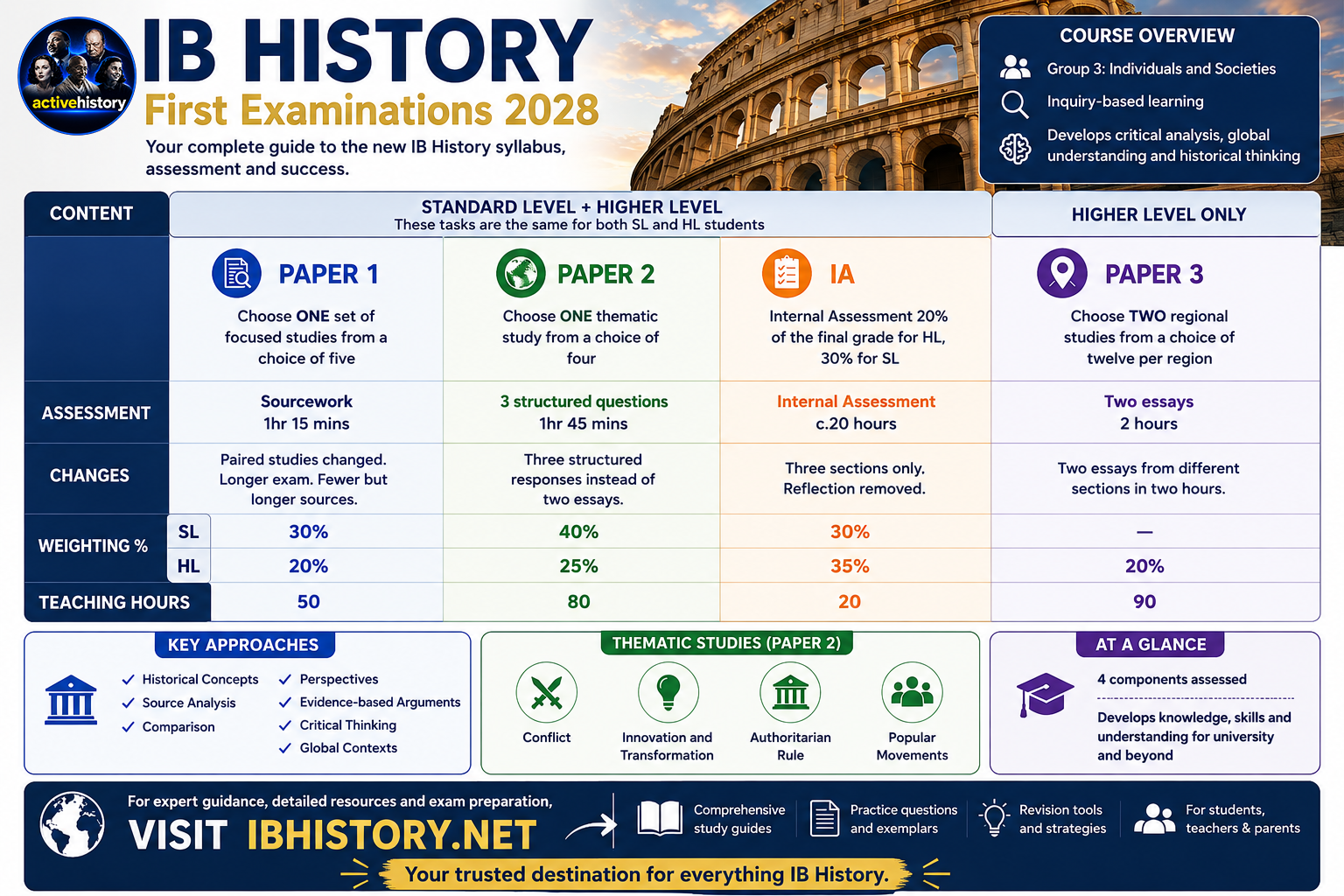
Download this classroom-ready poster summarising the new IB History syllabus (first examinations 2028), including Papers 1–3, Internal Assessment requirements, thematic studies, assessment weightings and key course features.
Ideal for classroom displays, department noticeboards, student handbooks and induction sessions.
Top-grade sample essays with examiner-style insights.
Explore Resource →Interviews, revision advice, historiography and exam support for IB History students.
Explore Resource →Explore historiography, interpretation and TOK connections in History.
Explore Resource →Annotated sourcework examples and model responses for Paper 1.
Explore Resource →Multimedia lectures and revision videos covering major IB History topics.
Explore Resource →Interactive simulations, roleplays and decision-making activities.
Explore Resource →