The Haitian Revolution (circa 1780–1811) stands as one of the most extraordinary and transformative events in global history—a successful revolt of enslaved people that shattered the world’s most profitable colonial system and founded the first independent Black republic. For IB History students, it offers a rich opportunity to explore themes of freedom, race, and empire through diverse and often conflicting voices: revolutionary leaders, colonial officials, and the enslaved themselves. As a Paper 1 sourcework topic, it is particularly rewarding because it invites critical analysis of bias, perspective, and context in a wide range of sources—from official decrees and personal letters to revolutionary constitutions and propaganda. Studying the Haitian Revolution challenges students to think deeply about how history is written, who gets to tell it, and how ideas of liberty and equality were contested in the Age of Revolution.
What factors prompted the emergence of the independence movement?
French Colonial Rule
Economic Exploitation and the Plantation System
The French colony of Saint-Domingue was the wealthiest in the Caribbean, built on the brutal exploitation of enslaved Africans who produced sugar, coffee, and indigo for export. The economic success of the colony relied on an inhumane system of forced labour and extreme punishment, fostering deep resentment among the enslaved population.
Racial Hierarchies and Social Stratification
French colonial society was rigidly divided along racial and class lines, with white planters at the top, free people of colour (gens de couleur) occupying an uneasy middle position, and enslaved Africans forming the oppressed majority. Discriminatory laws, such as the Code Noir, institutionalised racial inequality, fuelling anger and aspirations for freedom and equality.
Colonial Governance and Oppression
Harsh colonial administration and the absence of meaningful political representation for both free people of colour and the enslaved reinforced perceptions of injustice. The colonial authorities’ reliance on violence and repression to maintain control ultimately weakened their legitimacy and contributed to revolutionary discontent.
Slave Resistance, Maroonage, and Vodou
Traditions of Rebellion and Maroon Communities
Long before the revolution, enslaved Africans resisted through sabotage, escape, and the formation of maroon settlements in the mountains. These communities preserved African traditions and provided safe havens for rebels, creating a culture of defiance that laid the groundwork for coordinated uprisings.
The Role of Vodou in Unity and Resistance
Vodou served as both a spiritual and organisational force among the enslaved, helping to unite people of diverse African origins. The famous Bois Caïman ceremony in 1791, often seen as the spiritual spark of the revolution, symbolised the fusion of religious ritual and political rebellion.
Leadership and Organisation Among the Enslaved
Enslaved leaders such as Boukman Dutty, Jean-François, and later Toussaint Louverture channelled longstanding traditions of resistance into a revolutionary movement. Their ability to mobilise large numbers of people reflected both the desperation for freedom and the strategic organisation born from years of resistance.
Influence of the French Revolution
Spread of Revolutionary Ideals
The French Revolution of 1789 proclaimed liberty, equality, and fraternity—principles that resonated deeply in Saint-Domingue. Enslaved Africans and free people of colour interpreted these ideals as a promise of their own emancipation and equal rights.
Conflict Among Colonial Factions
The revolution in France destabilised colonial authority, as white planters, free people of colour, and royalist factions clashed over political power. This division weakened the colonial regime and created an opening for enslaved people to rise against their oppressors.
Abolition of Slavery and Revolutionary Momentum
The French National Convention’s 1794 decree abolishing slavery in the colonies—though initially a strategic move—validated the revolutionary cause in Saint-Domingue. The alignment between local insurgents and the broader revolutionary movement in France helped transform the struggle from a slave revolt into a full-fledged independence movement.
How was independence achieved?
War for Freedom in Saint-Domingue (1791) and the Abolition of Slavery (1793)
The 1791 Slave Uprising
The revolution began in August 1791 with a massive slave revolt in the northern plain of Saint-Domingue. Organised through networks of enslaved leaders and inspired by Vodou ceremonies such as Bois Caïman, the uprising destroyed plantations and challenged French control. This marked the beginning of a sustained armed struggle for freedom.
Conflict Between Colonial Factions and Foreign Powers
The uprising coincided with intense political divisions among whites and free people of colour, as well as invasions by Spain and Britain seeking to exploit France’s revolutionary chaos. These conflicts weakened colonial authority and allowed enslaved insurgents to gain territory and political leverage.
Abolition of Slavery by the French Republic (1793–1794)
In 1793, faced with mounting pressure from the insurgents and the threat of losing the colony entirely, French commissioners Sonthonax and Polverel proclaimed the abolition of slavery in Saint-Domingue. The French National Convention later ratified this decree in 1794, transforming the struggle from a revolt into a legitimate fight for emancipation and equality under the new Republic.
Independence Struggle (1794–1804)
Toussaint L’Ouverture’s Consolidation of Power
After aligning with the French Republic, Toussaint L’Ouverture emerged as the dominant leader. He defeated Spanish and British forces, restored the economy, and established relative stability while asserting greater autonomy from France. His governance laid the institutional foundations for an independent state.
Napoleon’s Intervention and the Return of French Forces (1802)
Napoleon Bonaparte sought to reassert French control and reinstate slavery across the empire. He sent a large expedition under General Leclerc to subdue the colony. The French initially gained ground and captured Toussaint, but their brutality and disease decimated their forces, reigniting local resistance.
Final War of Independence and Victory (1803–1804)
Under Jean-Jacques Dessalines, the Haitian forces united to defeat the remaining French troops at the decisive Battle of Vertières in November 1803. On January 1, 1804, Dessalines declared Haiti’s independence—the first free Black republic and the second independent nation in the Americas.
Roles of Toussaint L’Ouverture and Jean-Jacques Dessalines
Toussaint L’Ouverture as Revolutionary Architect
Toussaint L’Ouverture combined military strategy, diplomacy, and governance to transform the revolution into a disciplined movement. He sought to reconcile liberty with order, maintaining plantation production under paid labour while negotiating autonomy from France. His 1801 Constitution asserted self-rule, foreshadowing full independence.
Jean-Jacques Dessalines as Military Commander and Liberator
After Toussaint’s capture, Dessalines took command of the revolutionary army. He pursued total independence and was uncompromising in his fight against re-enslavement. His leadership in the final campaigns ensured victory over the French and the establishment of a sovereign Black nation.
Founding of the Haitian State
Dessalines proclaimed Haiti’s independence in 1804, symbolically reversing colonial oppression by renaming the territory with its indigenous Taíno name. As Emperor Jacques I, he sought to secure Haiti’s freedom through unity and self-reliance, cementing the revolution’s legacy as a triumph of anti-slavery and anti-colonial resistance.
How, and with what challenges, was a new identity formed?
Constitution (1801) and Declaration of Independence (1804)
Toussaint L’Ouverture’s 1801 Constitution
Toussaint L’Ouverture’s Constitution of 1801 sought to establish a new political identity for Saint-Domingue within a framework of autonomy under nominal French sovereignty. It abolished slavery permanently, proclaimed equality for all citizens regardless of colour, and made Toussaint governor for life. This marked an early attempt to define a post-slavery, multiracial society founded on liberty and discipline.
The 1804 Declaration of Independence
Under Jean-Jacques Dessalines, the 1804 Declaration of Independence formally broke all ties with France and renamed the nation Haiti, reclaiming an Indigenous Taíno term. The declaration asserted the right of formerly enslaved people to freedom and sovereignty, rejecting European domination and racial hierarchy.
Forging a Collective National Identity
These foundational documents symbolised the emergence of a distinctly Haitian identity built on resistance, emancipation, and pride in African heritage. They represented not only political independence but also a moral and cultural break from the colonial past, uniting diverse populations under a shared vision of freedom.
Continuing Social Inequalities Established During French Colonial Rule
Persistence of Class Divisions
Despite the revolution’s egalitarian ideals, social and economic hierarchies persisted. Freedmen who had acquired land or held military positions often maintained power over poorer rural workers, echoing colonial patterns of inequality.
Labour and the Plantation Economy
Leaders like Toussaint and later Dessalines reintroduced plantation-style production systems to sustain the economy, now using paid labour instead of slavery. However, strict labour regulations and limited land ownership for the peasantry caused tensions, as many former slaves sought independent farming rather than plantation work.
Regional and Racial Tensions
Divisions between the Black majority, mixed-race elites, and military leaders continued to shape Haitian politics. These inherited tensions from colonial society complicated the creation of a unified national identity and contributed to internal conflicts in the early republic.
Independence Debt
France’s Demands for Compensation (1825)
In 1825, under King Charles X, France demanded 150 million francs as compensation for losses incurred by former slaveholders, in exchange for recognizing Haiti’s independence. This “independence debt” imposed enormous financial strain on the young nation.
Economic and Social Consequences
To pay the debt, Haiti resorted to heavy taxation and foreign loans, diverting resources from development and entrenching poverty for generations. The debt crippled the nation’s economy and undermined its capacity to build institutions reflective of revolutionary ideals.
Impact on National Identity and Sovereignty
The indemnity symbolised the persistence of colonial injustice and external domination, even after independence. Yet, it also reinforced a resilient Haitian identity defined by endurance and resistance against global racial and economic oppression—a struggle to assert sovereignty in a hostile international order.
Recommended sources
Primary Sources
Toussaint L’Ouverture. “The 1801 Constitution of Saint-Domingue.” In The Haitian Revolution: A Documentary History, edited by David Geggus. Indianapolis: Hackett Publishing, 2014.
A foundational document outlining Toussaint’s vision for an autonomous, egalitarian Saint-Domingue. Extremely useful for understanding early Haitian political identity and governance.
Jean-Jacques Dessalines. “Haitian Declaration of Independence, 1804.” In The Haiti Reader: History, Culture, Politics, edited by Laurent Dubois et al. Durham: Duke University Press, 2020.
A primary expression of Haiti’s postcolonial identity and rejection of racial oppression; indispensable for examining revolutionary rhetoric and ideology.
The Code Noir (1685). Translated by John Garrigus.
The French colonial law regulating slavery and race. Provides insight into the institutional framework the revolution sought to destroy; highly reliable for examining colonial oppression.
Letters of Toussaint L’Ouverture to the Directory, 1797–1801. In The Black Jacobins: Toussaint L’Ouverture and the San Domingo Revolution, by C. L. R. James, appendix. New York: Vintage, 1989.
Reveals Toussaint’s diplomatic and political strategy; essential for understanding his leadership style and relations with France.
Proclamations of Léger-Félicité Sonthonax (1793–1794).
These decrees officially abolished slavery in Saint-Domingue, providing context for France’s evolving revolutionary policy; reliable for studying the transformation from revolt to emancipation.
Secondary Sources
Dubois, Laurent. Avengers of the New World: The Story of the Haitian Revolution. Cambridge, MA: Harvard University Press, 2004.
A highly respected synthesis providing social, political, and cultural analysis; accessible and scholarly.
James, C. L. R. The Black Jacobins: Toussaint L’Ouverture and the San Domingo Revolution. New York: Vintage, 1989.
A classic Marxist interpretation linking the Haitian struggle to global revolutionary movements; influential but interpretative.
Geggus, David P. Haitian Revolutionary Studies. Bloomington: Indiana University Press, 2002.
Detailed and empirically grounded research; essential for serious historical study.
Popkin, Jeremy D. You Are All Free: The Haitian Revolution and the Abolition of Slavery. Cambridge: Cambridge University Press, 2010.
Examines the global and ideological dimensions of emancipation; highly reliable academic source.
Fick, Carolyn E. The Making of Haiti: The Saint Domingue Revolution from Below. Knoxville: University of Tennessee Press, 1990.
Focuses on grassroots and slave resistance movements; useful for understanding social dynamics and agency.
Includes data relevant to Saint-Domingue’s slave trade; credible and quantitative source for economic historians.
Videos
“The Haitian Revolution.”BBC In Our Time (YouTube, 2018).
Offers a concise academic discussion led by historians; suitable for introductory understanding.
“Toussaint Louverture: The Slave Who Defeated Napoleon.”BBC Documentary (2015).
Well-produced and historically informed; provides visual context and narrative clarity.
“Crash Course World History: The Haitian Revolution.” (YouTube, 2012).
An engaging overview for students; accurate though simplified.
PBS, The Black Atlantic: The Haitian Revolution. (2010).
Examines the transatlantic impact of the revolution; reliable with expert commentary.
“Haiti: The Untold Story of the Revolution.”Al Jazeera World (2020).
Offers critical perspectives on the revolution’s legacy; valuable for modern interpretations.
Podcasts
“Revolutions Podcast” by Mike Duncan – Series on the Haitian Revolution (Episodes 3.1–3.19).
A thorough and accessible chronological narrative; reliable and well-researched.
“History Extra Podcast – The Haitian Revolution.” BBC History Magazine (2021).
Interviews with historians provide analytical insights; trustworthy mainstream history source.
“Stuff You Missed in History Class: The Haitian Revolution.” iHeartRadio (2018).
Offers an approachable summary for general audiences; fact-checked and accessible.
“Throughline: Haiti, the First Black Republic.” NPR (2021).
Connects historical and contemporary Haitian identity; reliable journalistic quality.
“The Age of Revolutions Podcast: Haiti.” (2019).
Academic-level discussion linking the Haitian Revolution to broader Atlantic revolutions; scholarly and informative.
Click image to enlarge
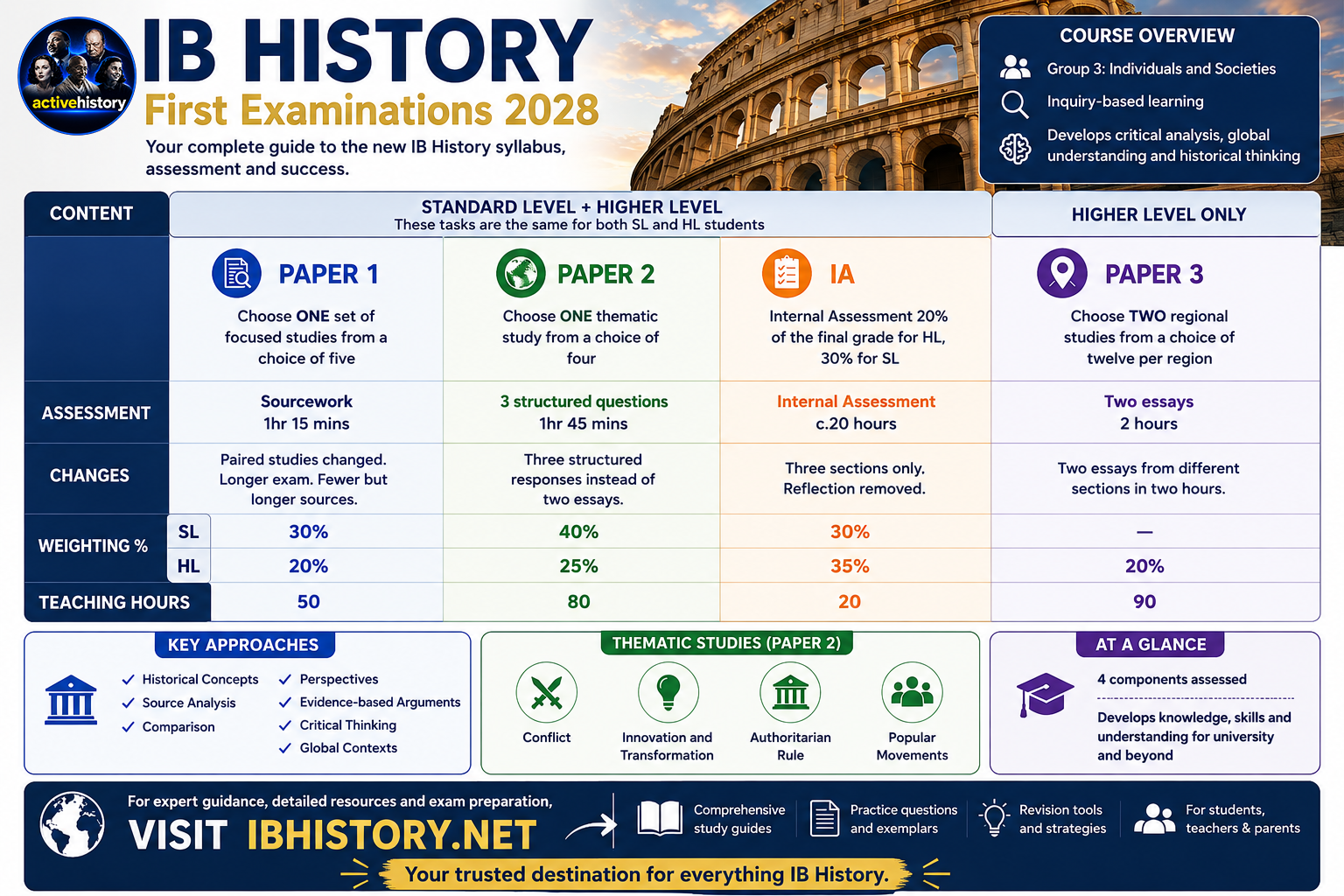
📘 Free IB History Poster
Download this classroom-ready poster summarising the
new IB History syllabus (first examinations 2028),
including Papers 1–3, Internal Assessment requirements,
thematic studies, assessment weightings and key course features.
Ideal for classroom displays, department noticeboards,
student handbooks and induction sessions.