The struggle for Kenyan independence (1945–1978) offers a compelling window into the dynamics of decolonization in Africa, combining political negotiation, grassroots activism, and violent resistance. From the Mau Mau Uprising to the Lancaster House Conferences and the leadership of Jomo Kenyatta, this period reveals the tensions between colonial power and emerging African nationalism. It is particularly rich for Paper 1 sourcework because students can explore diverse perspectives—colonial reports, nationalist speeches, eyewitness accounts, and post-independence reflections—allowing critical analysis of bias, purpose, and context in historical sources.
What prompted the emergence of the independence movement?
British Colonial Rule
Land Alienation and Economic Inequality
The British colonial government seized large areas of fertile land from Africans to create settler farms, displacing many indigenous communities. Africans were forced into wage labor on European farms under poor conditions and low pay. This deep economic inequality and loss of ancestral land created resentment and became a central grievance that fueled the demand for independence and the restoration of African control over their resources.
Political Exclusion and Racial Discrimination
Africans were denied meaningful political representation under colonial rule, as the Legislative Council was dominated by European settlers. The system entrenched racial discrimination in politics, education, and employment, leaving Africans marginalized. The denial of civil rights and the lack of political participation motivated African leaders to organize and advocate for self-rule, laying the groundwork for the independence movement.
Harsh Colonial Administration and Repression
The British maintained control through harsh laws, forced labor, and heavy taxation. Colonial administrators used violence and imprisonment to suppress dissent, especially against early nationalist organizations. These repressive tactics deepened African opposition to colonial authority and convinced many that peaceful reform within the colonial system was impossible, leading to stronger calls for independence and self-determination.
Influence of the Second World War
Exposure to New Ideas and Experiences
Thousands of Kenyans served in the British army during the Second World War, traveling abroad and witnessing political and social freedoms denied to them at home. This exposure broadened their worldviews and inspired demands for equality and self-government. Returning soldiers became politically conscious citizens who questioned the legitimacy of colonial rule and demanded the same freedoms they had helped defend abroad.
Economic Hardships and Postwar Expectations
Wartime economic pressures increased taxation, food shortages, and unemployment in Kenya. After the war, expectations for improvement were unmet as colonial policies continued to favor settlers. Frustrated by continued exploitation, Africans became more politically active, organizing protests and strikes that laid the foundation for nationalist movements and demands for self-rule.
Global Momentum for Decolonization
The aftermath of the war saw a worldwide shift against imperialism, with newly formed organizations like the United Nations promoting self-determination. The success of independence movements in Asia inspired African nationalists to intensify their own struggles. Kenya’s leaders drew encouragement from this global context, situating their fight within a broader wave of decolonization that reshaped the mid-20th-century world.
Resistance of the Kenya African Union (KAU)
Formation and Political Mobilization
Founded in 1944 and renamed in 1946 under Jomo Kenyatta, the Kenya African Union became the primary organization demanding greater African rights and representation. The KAU mobilized mass support through rallies, petitions, and public education campaigns. It united diverse ethnic groups under a common political vision, marking a significant step from localized protests to a national independence movement.
Advocacy for Land and Civil Rights
The KAU focused on key grievances such as land redistribution, racial equality, and political participation. It challenged European land ownership and the exploitation of African labor. By articulating these demands through organized political action, the KAU gave voice to widespread discontent and transformed economic and social frustrations into a coherent call for liberation from colonial rule.
Suppression and Radicalization
The colonial government viewed the KAU as a threat and banned it in 1952 during the Mau Mau uprising. Many of its members were imprisoned or went underground, fueling radicalization within the movement. The suppression of moderate political efforts convinced many Africans that independence could only be achieved through direct resistance, linking the KAU’s legacy to the broader armed struggle for freedom.
How was independence achieved?
Mau Mau Uprising (1952–1960)
Causes and Organization of the Revolt
The Mau Mau Uprising emerged from deep frustration with British land policies, forced labor, and racial inequality. Primarily involving the Kikuyu, Embu, and Meru peoples, the movement organized secret oaths to unite members in resistance. It represented the culmination of years of economic and social oppression, transforming popular grievances into a violent struggle against colonial authority.
British Response and the State of Emergency
The colonial government declared a state of emergency in 1952, arresting nationalist leaders including Jomo Kenyatta and deploying troops to crush the rebellion. Thousands of Africans were detained or executed, and entire villages were relocated into “protected” camps. Despite its defeat militarily, the brutal suppression of the Mau Mau exposed the unsustainability of British rule and generated international sympathy for Kenyan independence.
Impact on the Independence Movement
Though portrayed as a failure at the time, the Mau Mau uprising transformed Kenya’s political landscape. It highlighted widespread African resistance and forced Britain to reconsider colonial policies. The rebellion radicalized many Kenyans and convinced the British that political reforms were necessary. This paved the way for negotiations with moderate nationalists and ultimately accelerated Kenya’s path toward self-government and independence.
Lancaster House Conference (1960–1962), Self-Government and Multi-Party Politics (1960–1963)
Negotiating the Constitutional Framework
The Lancaster House Conferences in London brought together British officials and Kenyan leaders to discuss Kenya’s constitutional future. The talks produced agreements that expanded African political representation and laid the foundation for internal self-government. These negotiations marked Britain’s acceptance of the inevitability of independence and established a peaceful framework for the transition of power.
Rise of Political Parties and Internal Self-Government
Following the conferences, African political parties such as the Kenya African National Union (KANU) and the Kenya African Democratic Union (KADU) were formed to represent different ethnic and regional interests. Elections in 1961 and 1963 gave Africans increasing control over governance. By 1963, a coalition led by KANU formed the first African government, marking the final step before full independence.
Preparation for Independence and Nationhood
Between 1960 and 1963, Kenya transitioned from colonial rule to self-governance, developing national institutions and administrative systems. British officials gradually transferred responsibilities to Kenyan leaders. The process culminated in the declaration of independence on 12 December 1963, with Jomo Kenyatta as Prime Minister and later as the first President of the Republic of Kenya.
Role of Jomo Kenyatta
Leadership and Political Mobilization
Jomo Kenyatta emerged as the foremost nationalist leader, advocating for unity, land rights, and self-rule. As head of the Kenya African Union and later KANU, he emphasized non-racial nationalism and negotiated for independence through diplomacy rather than violence. His leadership brought together diverse ethnic groups and provided a unifying vision for a postcolonial Kenya.
Imprisonment and Symbolism of Resistance
Arrested during the Mau Mau emergency, Kenyatta became a powerful symbol of African resistance to colonial oppression. His imprisonment (1952–1961) strengthened his status as the face of the independence struggle. Upon release, he was widely celebrated as “Mzee” (the elder), embodying the hopes of a nation seeking unity and freedom after years of turmoil.
Negotiations and Establishment of Independence
Kenyatta played a central role in the Lancaster House negotiations, steering Kenya toward peaceful independence. As Prime Minister and later President, he guided the transition to self-rule, promoting national reconciliation after the Mau Mau period. His pragmatic leadership helped stabilize the young nation and ensured that Kenya’s independence in 1963 was achieved through a combination of resistance, diplomacy, and compromise.
How, and with what challenges, was a new identity formed?
Independence Constitution (1963) and Transition Towards a One-Party Political System
Formation of a New Government Structure
The 1963 Independence Constitution established Kenya as a constitutional monarchy with an elected government and regional assemblies. It sought to balance power among Kenya’s diverse ethnic communities through a semi-federal system (majimboism). However, as the new nation faced administrative and economic challenges, this system proved difficult to sustain, prompting moves toward centralization and stronger executive authority under Jomo Kenyatta.
Move Toward Centralization and Political Unity
By 1964, Kenya became a republic with Kenyatta as President, and regional governments were replaced by a centralized system. The Kenya African National Union (KANU) consolidated power, arguing that national unity required strong central leadership. While this strengthened government control and stability, it also limited political pluralism and gradually eroded democratic checks and balances.
Emergence of One-Party Politics and Political Challenges
By the late 1960s, Kenya had effectively become a one-party state after the collapse of KADU and the banning of opposition movements. This system fostered stability and national cohesion but also bred corruption, ethnic favoritism, and political repression. Balancing unity with diversity became a major challenge as the government sought to create a national identity while managing ethnic and regional divisions.
Education and Promotion of Cultural Diversity
Expansion of Education for Nation-Building
After independence, Kenya prioritized expanding education to promote literacy, citizenship, and economic development. Schools became instruments for instilling a shared sense of national pride and unity among diverse communities. The government introduced policies to make education more accessible, helping to bridge colonial-era inequalities and create opportunities for upward mobility.
Promotion of Swahili as a National Language
Swahili was adopted as a unifying national language to bridge ethnic and linguistic divides. It became central to education, administration, and national media, fostering communication and a collective Kenyan identity. This linguistic policy helped reduce ethnic barriers and symbolized independence from colonial cultural domination, reinforcing the idea of one nation with many peoples.
Balancing Cultural Unity and Diversity
While the state promoted national unity, it also encouraged respect for Kenya’s cultural diversity through art, music, and local traditions. National holidays, cultural festivals, and heritage programs celebrated different ethnic identities as part of a shared national story. However, balancing ethnic pride with national loyalty remained difficult, as some communities felt excluded from state recognition or development benefits.
Land Reforms
Redistribution and Settlement Schemes
After independence, the government initiated land redistribution programs to resettle Africans on former European-owned farms. Schemes such as the Million Acre Settlement aimed to correct colonial injustices and provide livelihoods for displaced people. While these efforts promoted economic opportunity, limited resources and administrative corruption hindered fair distribution, leading to regional disparities.
Land Ownership and Social Inequality
The uneven implementation of land reforms created new inequalities, as wealthier or politically connected individuals acquired large tracts of land. This deepened resentment among poorer rural communities and sparked tensions between ethnic groups over land rights. Land remained a symbol of identity and justice, making it a persistent source of political and social conflict in post-independence Kenya.
Land, Identity, and National Cohesion
Land reform was central to defining postcolonial Kenyan identity, symbolizing both freedom and self-reliance. Access to land represented economic empowerment and belonging in the new nation. However, unresolved disputes and regional imbalances complicated efforts to forge a unified identity, revealing the enduring link between land, power, and ethnic politics in shaping modern Kenya.
Original departmental reports and official documents covering the late colonial period in Kenya. Useful for deep archival insight; subscription required.
Historian interview; reliable specialist perspective, check date and context.
Podcasts
“SpyCast – ‘Kenya, East Africa, and America’ (Episode 601),” 5 Sept 2023.
Podcast discussing colonial legacies and independence; useful for contemporary reflections. Link
“The Late British Empire, History Matters” – episode on Kenya (search platform).
General history podcast; reliability varies with host, good for background.
“Africa Past & Present” – episodes covering Kenya’s decolonization.
Academic-focused; useful for historian interviews.
“Decolonisation Voices” – Kenyan historian interviews on independence.
Valuable for primary experiences; academic rigor varies.
“Kenya History Podcast” – episodes on Mau Mau and independence (check Spotify/Apple Podcasts).
Provides narrative history with interviews; moderate reliability.
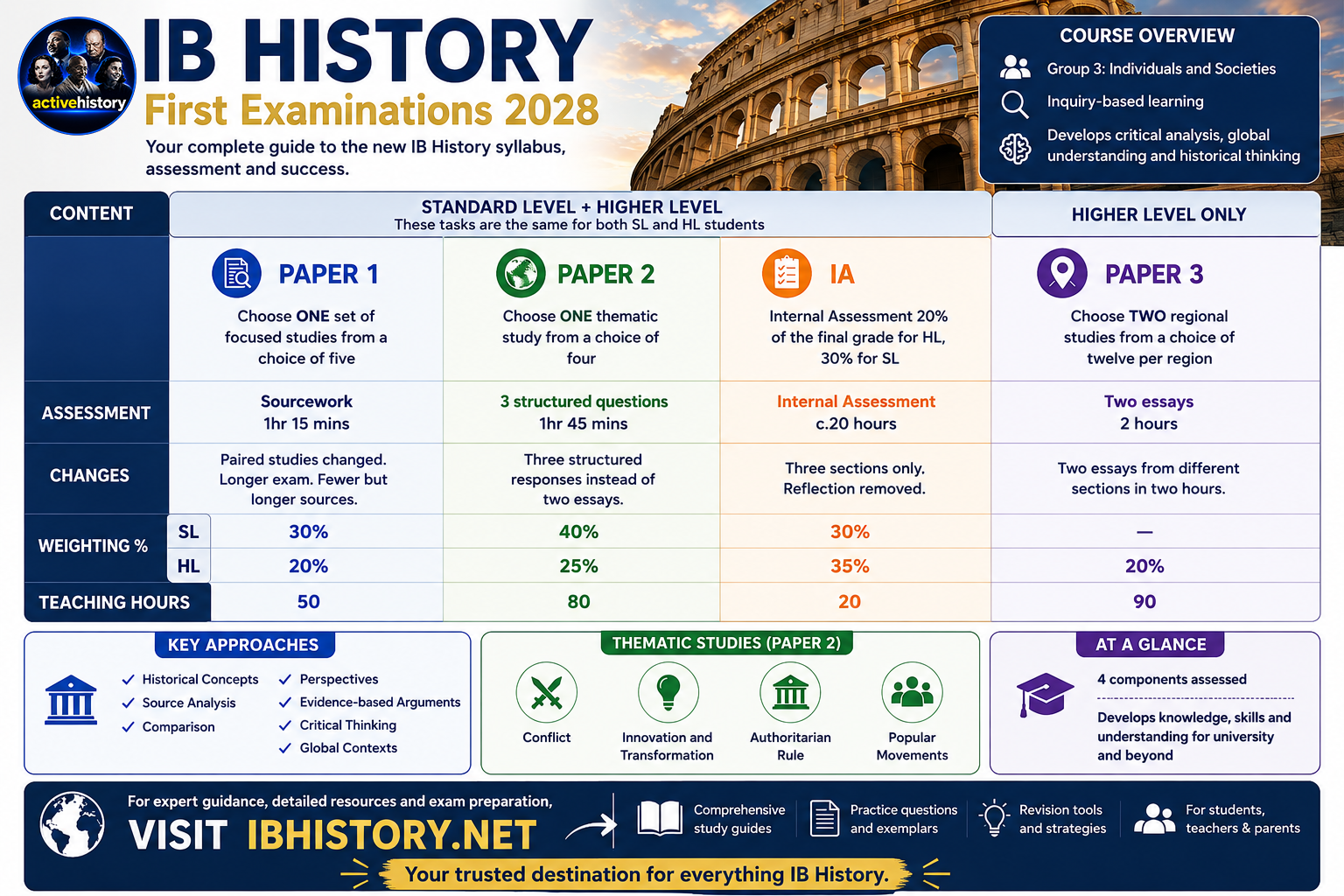
Click image to enlarge
📘 Free IB History Poster
Download this classroom-ready poster summarising the
new IB History syllabus (first examinations 2028),
including Papers 1–3, Internal Assessment requirements,
thematic studies, assessment weightings and key course features.
Ideal for classroom displays, department noticeboards,
student handbooks and induction sessions.