
The extended essay is a formal piece of academic writing containing no more than 4,000 words, accompanied by a reflective statement of no more than 500 words.
It is supervised by your History teacher, but marked by the IB board.
It gives you a chance to study in real depth a topic that you have an interest in and to work closely with your History teacher to ‘fast-track’ your historical skills with one-to-one tutoring.
As such it is a great opportunity to produce a mature academic study on something that you might never again have the chance to research.
An Extended Essay in History involves applying your skills to explore a topic of personal interest in an imaginative, critical, focused way.
It is important that you choose a topic that lends itself to critical investigation and analysis (e.g. the causes, consequences or significance of an event, development or individual), rather than one that steers you towards a descriptive or narrative piece of writing.
A thoughtfully chosen topic that inspires your curiosity and spirit of inquiry paves the way for a strong, interesting essay.
You cannot investigate the same question that frames your Internal Assessment, but beyond this you have great freedom to choose your period, place and theme.
TOP TIP: Use the ActiveHistory IBDP Historical Question Generator to help you at this stage!
www.activehistory.co.uk/ibdp/question-generator
TOP TIP: Use the ActiveHistory Historical Podcast Database to search for your favoured topic!
www.activehistory.co.uk/library/podcasts
You should then use your topic to generate a workable, focused research question.
Avoid broad and general questions, which will produce to superficial and descriptive accounts.
Frame instead a question which allows you to analyse and evaluate different factors and perspectives through the use of a varied range of historical sources.
Using the IBO key command term "To what extent...?" is usually a good idea (although other command terms such as “How far...?”, “How important...?” and “How significant...?” are equally valid).
It is also important to be flexible. If your early investigation suggests a lack of suitable resources needed to support research, be prepared to amend or change your question or topic.
TOP TIP: Use the ActiveHistory IBDP Historical Question Generator to help you at this stage!
www.activehistory.co.uk/ibdp/question-generator
| To what extent was... | [Event] [Situation] [Development] [Individual] [Policy] |
the main cause of... |
[Event] [Situation] [Development] [Policy] |
| the most important consequence of... | |||
| How useful is... | the Novel... the Album... oral testimony... photography... the painting... the film... |
to the historian studying... | |
| How successful / significant was... | [Individual] (e.g. politician / sportsperson / entertainer / film director / etc) | in the context of... |
You will be expected to locate and make use of a diverse range of primary and secondary sources in your Extended Essay. The following links might prove useful.
JSTOR | Google Books Search | Google Scholar Search | Amazon Search | BBC History Magazine Search | History Today Magazine Search
After your supervisor has commented on one full draft, the next version of the essay that the supervisor sees must be the final one submitted to them before the viva voce. This version of the extended essay must not contain any comments from the supervisor or any other person. Once this version has been submitted to the supervisor, you are not permitted to make any further changes to it, unless deemed appropriate by the supervisor because of an administrative error. So you must ensure that your work meets all formatting and submission requirements before it is submitted.
The title page should include only the following sort of information:
Student Code: 987653
“To what extent was the overthrow of Salvador Allende in 1973 the results of external factors?”
Subject-Focused Extended Essay in History (Group 3, Individuals and Societies)
Word Count: 3800
Provide a breakdown of the investigation in the following format. Note that page numbering is compulsory, beginning with the first page following your contents page.
Introduction Page 1
Investigation
1. [Perspective / Factor 1] Page X
2. [Factor 2] Page X
3. [Factor 3] …etc
Conclusion Page X
Reference List Page X
Appendix Page X
1. [Description] Page X
2. [Description] …etc
There are no formal requirements on how to write the introduction, but the following steps may help:
Use of historical sources
Use of footnotes
Footnotes should only be used referencing purposes, using the Chicago format:
Author. Title (Publisher, Date), Page, e.g.
Tarr, Russel. Luther and the Reformation 1500-64 (Hachette, 2015), Page 27
Footnotes provided for referencing purposes are NOT included in the word count.
Footnotes providing further information ARE included in the word count.
TOP TIP: Use the ClassTools Citation Generator to efficiently generate your footnotes:
www.classtools.net/citation-generator
Any references to interviews should state the names of the interviewer and interviewee, the date and the place of the interview.
Websites that do not give references or that cannot be cross-checked against other sources should be avoided.
Avoid footnotes to lame sources like Wikipedia, GCSE Bitesize, History.com, Biography.com and similar. These are amateurish!
Any information that is important to the argument must not be included in appendices or footnotes/endnotes. The examiner will not read notes or appendices.
Use of tables, maps, charts, illustrations
There are no formal requirements on how to write the conclusion, but the following steps may help:
“This investigation has sought to answer the question ‘[your question here’].”
(Restate the research question)
“The evidence and arguments I have considered and evaluated leads me to the conclusion that the answer to this question is that…”
(reach a clear, synthesized judgement consistent with the analysis of your investigation).
“Nevertheless, my studies demonstrate that there are clearly problems with reaching a final answer to the question because…”
(Comment here on such things as (a) weaknesses of the source material available; (b) gaps in the historical record; (c) the question produced different answers depending on “When / Where / For Whom / What” lens you consider it through.
You should maintain a bibliography and a list of page references from the outset. That way you are less likely to forget to include a citation. It is also easier than trying to add references at a later stage.
All sources should be listed alphabetically (by author surname), using the Chicago format.
This reference list must list only those sources cited in the footnotes.
Organise these under three headings:
1. Primary Sources
2. Secondary Sources
3. Other sources (including websites)
Any sources included as Appendix items must be referred to within the main body of the study either in brackets like this (Appendix 1) or as footnotes like this .
Material in the Appendix will not be read by examiners. Therefore, students must ensure that all information with direct relevance to the analysis, discussion and evaluation of their essay is contained in the main body of it.
Appendices are therefore usually best avoided.
After your supervisor has commented on one full draft, the next version of the essay that the supervisor sees must be the final one submitted to them before the viva voce.
This version of the extended essay must not contain any comments from the supervisor or any other person. Once this version has been submitted to the supervisor, you are not permitted to make any further changes to it, unless deemed appropriate by the supervisor because of an administrative error.
So you must ensure that your work meets all formatting and submission requirements before it is submitted.
▪ Given that the extended essay is a formally written research paper, it should strive to maintain a professional, academic look. To help achieve this, the following formatting is required:
• the use of 12-point, readable font
• 1.5 line spacing
• page numbering
• no candidate or school name on the title page or page headers.
· A file size of no more than 10MB
▪ Submitting the extended essay in the required format will help set the tone of the essay and will aid readability for on-screen assessment by examiners.
· Examiners are instructed not to read or assess any material in excess of the word limit. This means that essays containing more than 4,000 words will be compromised across all assessment criteria.
Included in the word count |
Not included in the word count |
The introduction |
The contents page |
The main body |
Headers |
The conclusion |
Maps, charts, tables, diagrams, illustrations |
Quotations |
The bibliography / reference list |
Footnotes that are not references |
The Reflection and progress form |
▪ The whole essay needs to be proofread carefully by the student (computer spelling and grammar checkers are useful but will not do everything). They must not ask someone else to proofread their work as this is an important part of the learning experience.
Here is a student-friendly version of the IB mark scheme, combining the generic guidance from the IB as well as its subject-specific criteria for History.
The "Reflection" involves thinking about how the Extended Essay process has impacted on you as a learner. This includes how you envisage transferring the skills and lessons you have learned to other circumstances, including future studies, career or life in general.
To assist you with this, there are three formal reflection sessions with your supervisor. Your reflective thinking is recorded as a 500-word reflective statement that is written at the end of the extended essay process.
Keeping an ongoing record of your reflective thinking will support you in the writing of the reflective statement.
▪ how your arrived at your topic of study and why it’s historically significant.
▪ your planned scope / approach / structure
▪ the sources you settled upon use and how you decided upon them
▪ the progress you made up to and including the EE day - in terms of content, insight and skills
▪ challenges and difficulties you faced
▪ comments and suggestions made by your supervisor
▪ how you changed your question / approach / sources as necessary to meet these challenges
▪ The progress you made over the Summer– not just in terms of content, but of insight and skills
▪ Challenges and difficulties you faced
▪ Comments and suggestions made by your supervisor
▪ How you changed your question / approach / sources as necessary to meet these challenges
The Viva Voce is a short discussion which should celebrate completion of the essay and reflect on what the student has learned from the process. Unless there are particular problems (e.g. of plagiarism or some other form of academic misconduct), the viva voce should begin and end positively. Completion of a major piece of work such as the extended essay is a great achievement for students.
The following questions might come up:
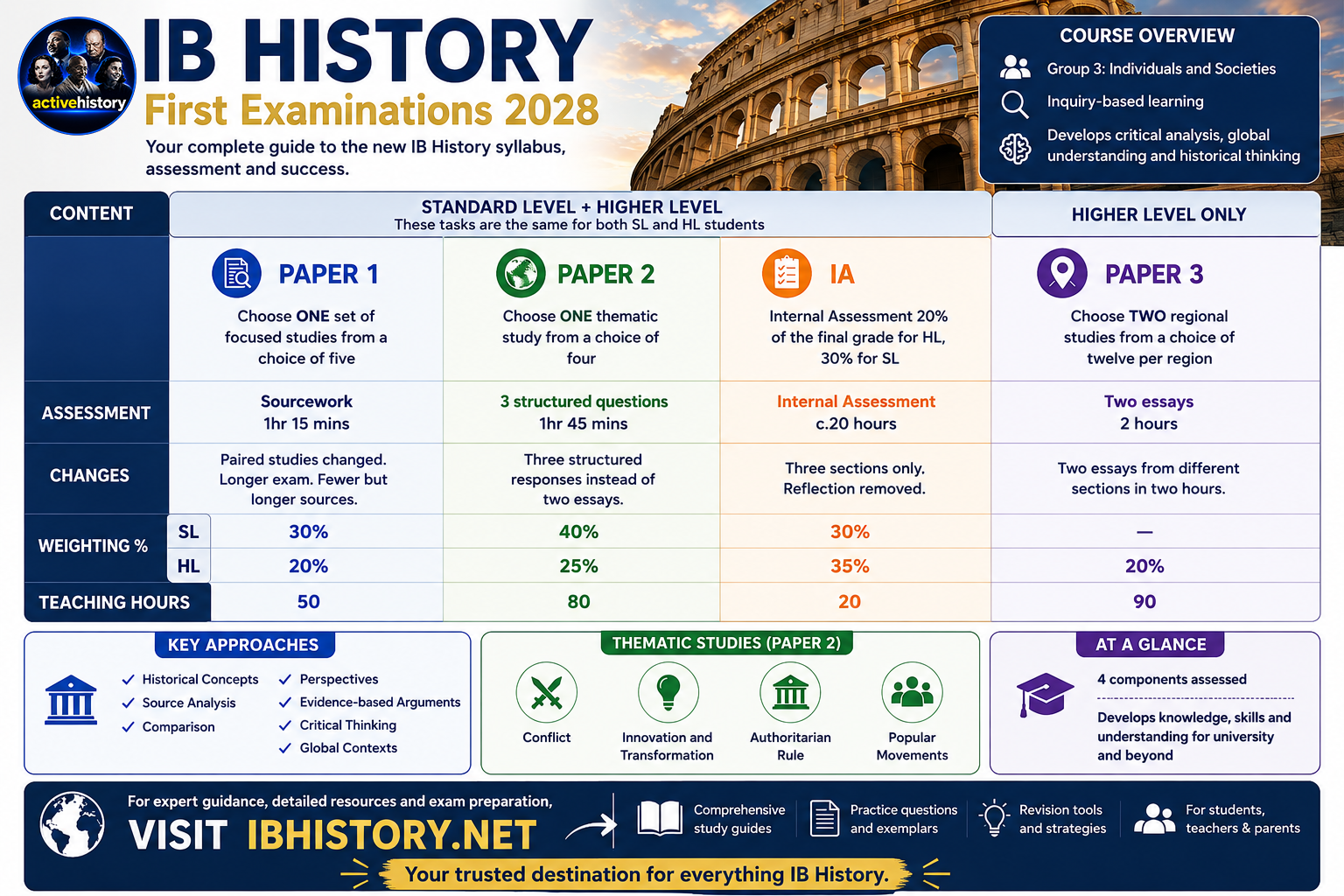
Download this classroom-ready poster summarising the new IB History syllabus (first examinations 2028), including Papers 1–3, Internal Assessment requirements, thematic studies, assessment weightings and key course features.
Ideal for classroom displays, department noticeboards, student handbooks and induction sessions.