
IBDP - Paper 1, 2, 3 Overlaps

IBDP History: Designing a High-Overlap Course

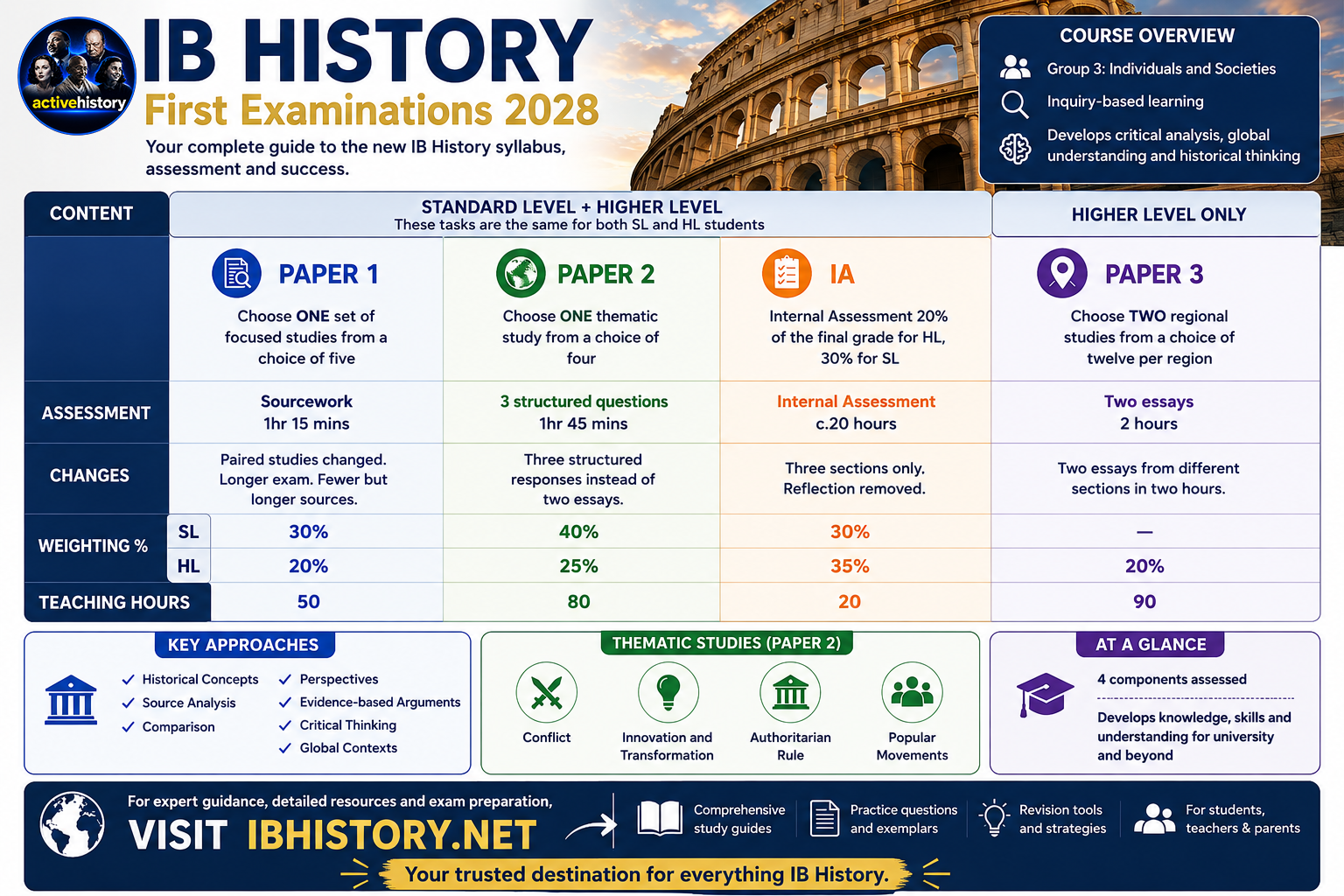
The new IBDP History syllabus aims to reduce the amount of content students need to cover, allowing them to focus more on skills of analysis and evaluation.

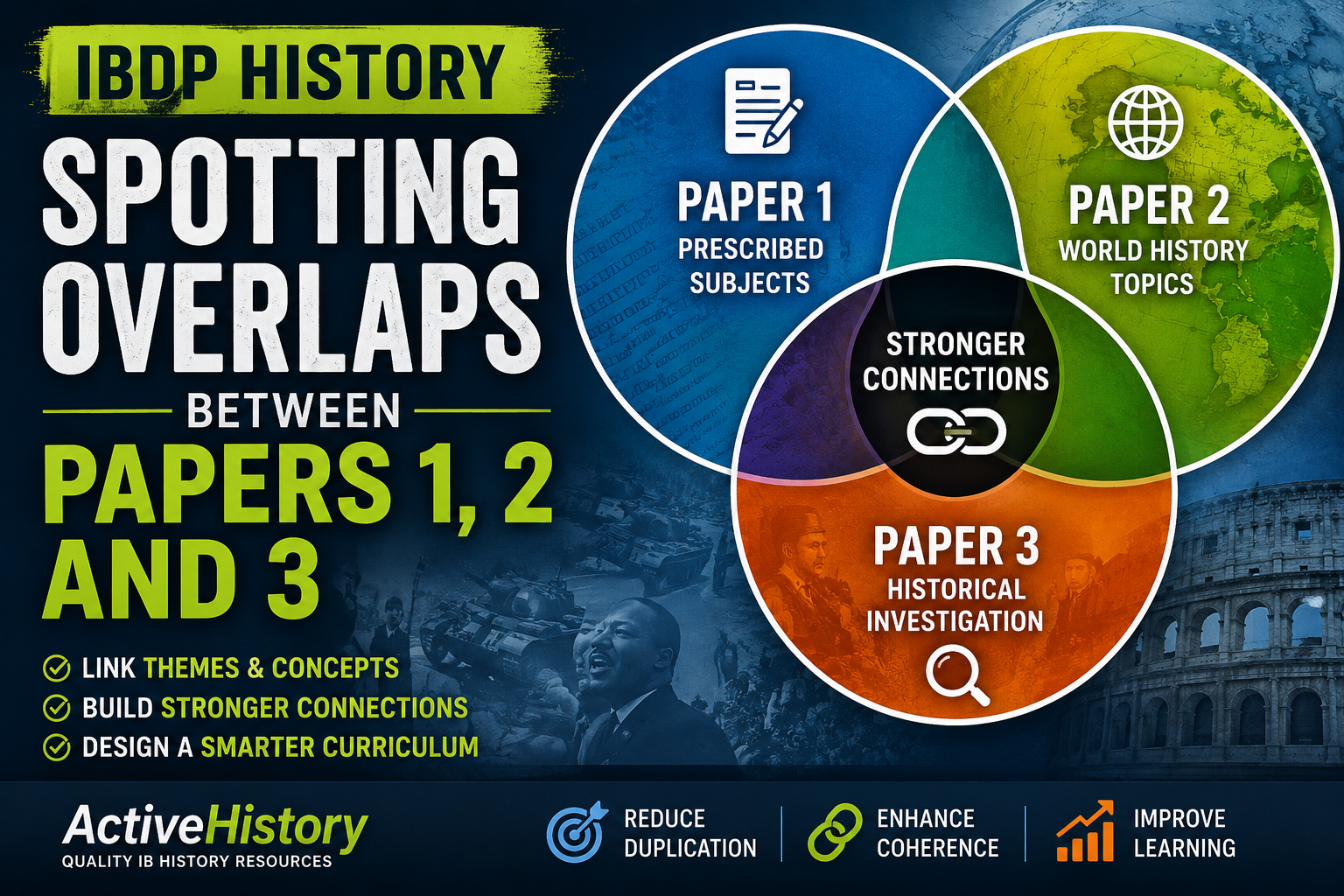
What follows are some ideas about how the various Paper 1 options might provide overlap with the case study you choose for Paper 2, and the regional option you choose for Paper 3.

💡
Important: Remember that you can choose different pairs of case studies for each of the four inquiry questions within your chosen thematic study for Paper 2. So, your Paper 1 topics might overlap strongly with only some inquiry questions, but additional case studies can be used to cover the remainder.

Climate and innovation

Best suited to Paper 2 "Innovation and Transformation", particularly environmental adaptation, maritime expansion and imperial organization.

Why did conflict emerge?

  • environmental pressures and competition for resources (Norse expansion)

What determined outcomes?

  • maritime technology and navigation (Norse)

Why did new innovations emerge?

  • environmental pressures (Norse)
  • political expansion (Aztecs)

How did innovations transform societies?

  • navigation and maritime expansion (Norse)
  • urban and political organization (Aztecs)

How were innovations resisted?

  • environmental and geographic limitations (Norse)

How did innovations affect lives?

  • trade and contact networks (Norse)
  • experiences of elites and subject peoples (Aztecs)

Indirect overlap only

  • centralized imperial control (Aztecs)

Indirect overlap only

  • role of ideas in expansion and identity (Norse)
Americas Indigenous societies in the Americas (Aztecs)

Independence and identity

Strongest overall pathway for Conflict and Popular Movements through anti-colonial struggle, nationalism and independence movements.

Why did conflict emerge?

  • economic causes: plantation slavery (Haiti)
  • political causes: colonial repression (both)
  • social causes: racial hierarchy (both)

What determined the outcome?

  • leadership (Toussaint / Kimathi)
  • guerrilla tactics (Kenya)
  • mobilization of enslaved and rural populations (both)

How did conflict affect people’s lives?

  • destruction and displacement (both)
  • experiences of enslaved and colonized peoples (both)

How was peace established?

  • military defeat of colonial rule (Haiti)
  • negotiated transition to independence (Kenya)

Why did innovations emerge?

  • Enlightenment ideas (Haiti)
  • anti-colonial nationalism (both)

How did innovations transform societies?

  • abolition of slavery (Haiti)
  • new national identities (both)

How were innovations resisted?

  • colonial resistance to reform (both)

How did innovations affect lives?

  • experiences of formerly enslaved and colonized peoples (both)

Limited overlap

  • colonial authoritarian structures (Kenya)
  • use of force and repression (both)
  • popular resistance to authoritarian systems (both)

Why did movements emerge?

  • colonial oppression (both)
  • nationalism and self-determination (both)

How did movements create change?

  • violent resistance (both)
  • political mobilization (both)

How were movements challenged?

  • colonial repression (Kenya)

What was the impact?

  • independence and identity formation (both)
Americas Independence movements
Africa African independence movements

Political and economic transitions

Probably the single most efficient overlap pathway in the syllabus, with particularly strong connections to Conflict, Innovation & Transformation, and Authoritarian rule.

Why did conflict emerge?

  • collapse of Soviet authority (Russia)
  • foreign pressure on Japan (Meiji)

What determined outcomes?

  • leadership and state planning (both)
  • mobilization of economic resources (both)

How did conflict affect people’s lives?

  • disruption from reform and instability (both)
  • Chechen conflict (Russia)

How was peace established?

  • consolidation of centralized state authority (both)

Why did new innovations emerge?

  • Western pressure (Japan)
  • collapse of communism (Russia)
  • economic crisis (both)

How did innovations transform societies?

  • industrialization (Japan)
  • economic liberalization (Russia)
  • westernization (Japan)
  • political restructuring (Russia)

How were innovations resisted?

  • traditional elites (Japan)
  • resistance to reform (Russia)

How did innovations affect lives?

  • rise of industrial elites (Japan)
  • oligarchic inequality (Russia)
  • social disruption during reform (both)

Why did authoritarian rule emerge?

  • instability after Soviet collapse (Russia)
  • nationalism and economic insecurity (Russia)

How was authoritarian rule maintained?

  • legal restructuring (Putin)
  • propaganda and media control (Russia)
  • popular support tied to stability (Russia)

How did authoritarian rule affect lives?

  • political restriction and inequality (Russia)

How was authoritarian rule challenged?

  • protest and opposition movements (Russia)

Why did movements emerge?

  • social responses to modernization and westernization (Japan)
  • dissatisfaction with post-Soviet reforms (Russia)

How did movements create change?

  • political participation during reform periods (both)
  • nationalist mobilization (Japan/Russia)

How were movements challenged?

  • conservative resistance to reform (Japan)
  • repression of opposition movements (Russia)

What was the impact?

  • changing political participation and civic expectations (both)
Asia Politics and economy in Japan
Europe USSR and post-Soviet Russia

Conflict and displacement

The clearest direct pathway into the Conflict unit, especially through refugee crises, Cold War tensions and the human consequences of warfare.

Why did conflict emerge?

  • Cold War ideological tensions (Indochina)
  • postwar instability (Europe)

What determined the outcome?

  • military technology (Vietnam)
  • Cold War leadership (superpowers)
  • mobilization of resources (Vietnam)

How did conflict affect people’s lives?

  • refugee crises (both)
  • social and economic devastation (both)
  • marginalized and displaced peoples (both)

How was peace established?

  • reconstruction and peace-building (both)

Why did innovations emerge?

  • reconstruction needs (Europe)
  • Cold War political pressures (Indochina)

How did innovations transform societies?

  • refugee systems and international institutions (both)

How did innovations affect lives?

  • migration and resettlement systems (both)

Why did authoritarian rule emerge?

  • Cold War polarization (Eastern bloc / Vietnam)

How was authoritarian rule maintained?

  • military and state control (communist systems)
  • border controls and restrictions on movement (both)

How did authoritarian rule affect lives?

  • restrictions on freedoms and movement (both)

How was authoritarian rule challenged?

  • refugee flight and international criticism (both)

Why did movements emerge?

  • refugee and displaced groups seeking protection and support (both)

How did movements create change?

  • humanitarian and refugee advocacy (both)

What was the impact?

  • increased international awareness of refugee crises (both)
Europe WWII Europe
Asia Cold War in Asia

Protest and change

The strongest pathway into Popular Movements, with additional strong overlap into Innovation & Transformation, and Authoritarian rule through rights movements, protest and political transformation.

Why did conflict emerge?

  • repression and inequality (Tunisia)
  • tensions around changing gender norms (USA)

What determined the outcome?

  • protest tactics and media use (both)

How did conflict affect people’s lives?

  • instability and social polarization (both)

How was peace established?

  • reform and negotiation (Tunisia)

Why did innovations emerge?

  • demands for rights and reform (both)

How did innovations transform societies?

  • changing gender norms (feminism)
  • digital activism and communication (Tunisia)
  • political transformation (Tunisia)

How were innovations resisted?

  • traditional gender norms (USA)
  • authoritarian resistance (Tunisia)

How did innovations affect lives?

  • expanded rights and participation (both)

Why did authoritarian rule emerge?

  • repression and inequality (Tunisia)

How was authoritarian rule maintained?

  • force and propaganda (Tunisia)

How did authoritarian rule affect lives?

  • restricted freedoms (Tunisia)

How was authoritarian rule challenged?

  • popular protest and resistance (Tunisia)

Why did movements emerge?

  • feminism, democracy and rights (both)
  • economic grievances (Tunisia)

How did movements create change?

  • protest and mobilization (both)
  • media and cultural influence (both)

How were movements challenged?

  • repression and divisions (both)

What was the impact?

  • women’s rights and reform (both)
Middle East Revolution and reform in the Middle East
Americas Social movements in the Americas