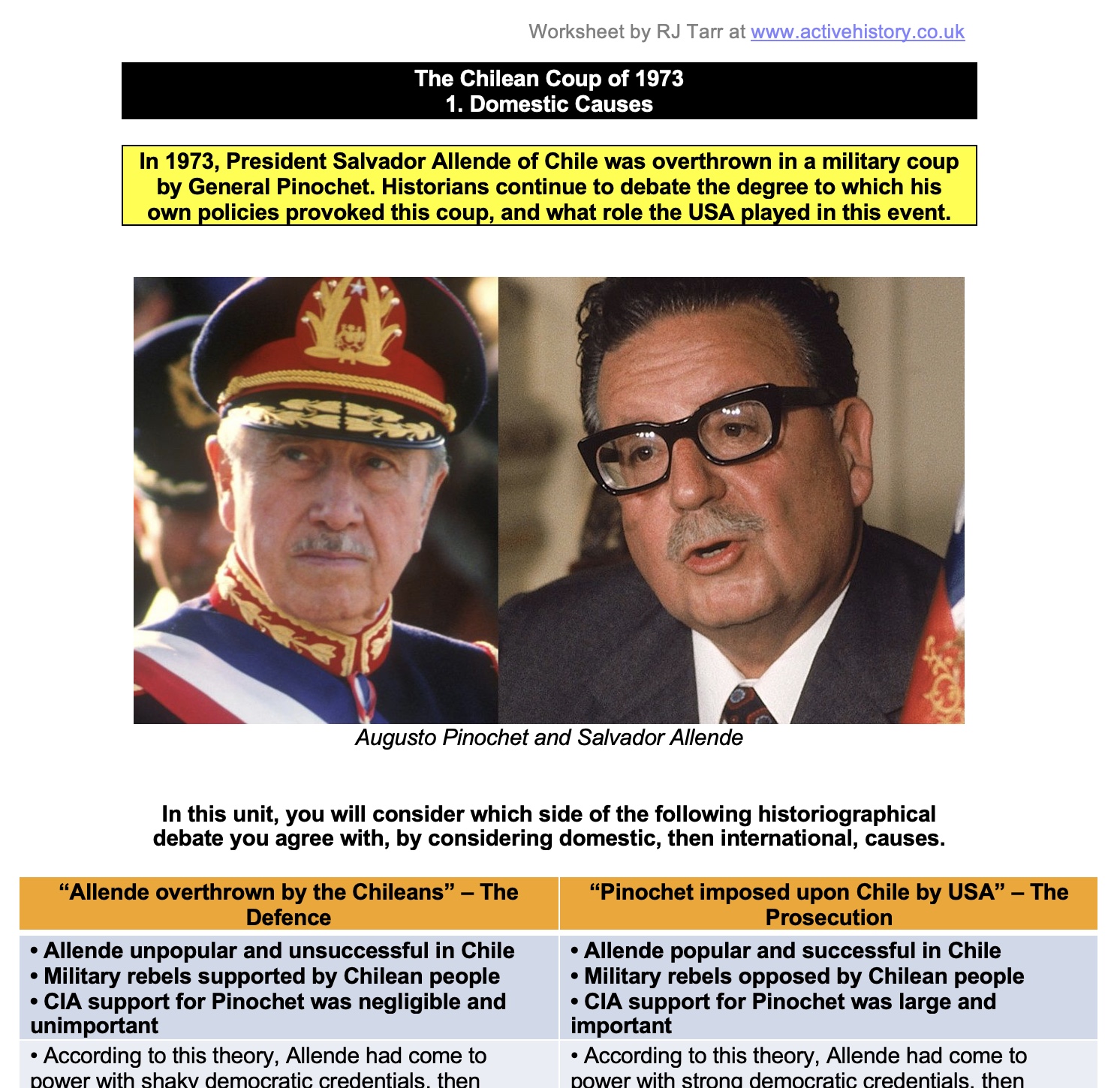
Students are presented with a series of images from which to draw their own initial deductions. They are then told what each one represents. A good introduction to the topic.
In this task, students consider how far the Chilean coup can be explained in terms of domestic factors - in particular, whether it is accurate to say that Allende precipitated his own overthrow with divisive and unpopular policies.
In this second part of the study, students investigate whether the USA was responsible for engineering both Allende's failures and Pinochet's coup.
A detailed analysis of the causes for Pinochet's rise to power presented as a "Fill the Blanks" quiz. There is a completed teacher version available.
With the research on Pinochet completed, the students now move on to compare and contrast his rise to that of Mao in China. This worksheet provides them with structured guidance on how to go about this process. As a popular format of question in the IB examination, this is a very useful exercise.
Students then get into pairs and small groups to compare their approaches to the previous task. There is a lengthy list of "discussion points" provided too in this worksheet designed to get them thinking more (e.g. the USA opposed Mao, but failed to prevent his rise; but they favoured Pinochet, who succeeded. Why the difference?). There are some teacher notes to help with this exercise too.
This short study unit should end with students writing an essay on the subject of "Compare and Contrast the Rise to Power of Two Single Party State Rulers" (focusing on Mao and Pinochet). I have written a model essay on this subject myself which is available in the teacher resources area.
I give students 10 minutes at the start of the lesson to try to complete the quiz. Anyone completing the quiz within the available time gets a score based on the amount of minutes left on the clock. They can then move on to the first lesson task, whatever that happens to be, whilst the other members of the class continue to play. I build up a 'leaderboard' of scores over the numerous lessons we have during revision time to build up momentum!
This podcast offers a focused investigation into one of the most contested case studies in Cold War Latin America: the overthrow of Salvador Allende in Chile in 1973. Through discussion of declassified U.S. documents, economic data, and Chilean political developments, it explores the relative importance of foreign intervention versus domestic factors. Students preparing for IB Paper 3 will find this episode particularly useful for evaluating U.S. foreign policy in the Americas, Cold War containment, and the causes and consequences of military rule in Latin America.
After a study of the 1973 Chilean Coup, and before/during a study of Pinochet's rule of Chile, ask two female students to read out the following dialogue poem to the class as a powerful starter activity. For further ideas about using "Dialogue Poems" in class, follow this link on Tarr's Toolbox: http://www.classtools.net/blog/writing-dialogue-poems-to-compare-and-contrast-viewpoints.
A model essay by RJ Tarr, ideal for revision purposes.
In this activity, students are presented from the outset with a model essay on the subject of the Rise of Pinochet. They then go through this reading it carefully for style and content, highlighting off key features and discussing their thoughts with the class. Next, each student is given a different key term or event to research which isn't currently covered in the essay and decide how to incorporate this into the essay most effectively. These thoughts again are shared so that the essay develops and improves further. Finally, they are given a factual test on the rule of Pinochet and write a timed essay on a different title relating to the same topic:
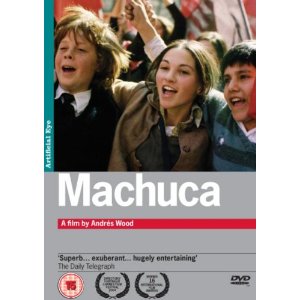 |
Recommended Film"Santiago, capital of Chile during the Marxist government of elected, highly controversial president Salvador Allende. Father McEnroe supports his leftist views by introducing a program at the prestigious "collegio" (Catholic prep school) St. Patrick to allow free admission of some proletarian kids. One of them is Pedro Machuca, slum-raised son of the cleaning lady in Gonzalo Infante's liberal-bourgeois home. Yet the new classmates become buddies, paradoxically protesting together as Gonzalo gets adopted by Pedro's slum family and gang. But the adults spoil that too, not in the least when general Pinochet's coup ousts Allende, and supporters such as McEnroe" (from imdb.com).
|