The Aztec Empire, at its height between 1428 and 1469, was a hub of remarkable innovation—urban engineering, agricultural mastery, and sophisticated imperial administration—all emerging from the challenges of a highland basin and the demands of empire. From the floating chinampas of Xochimilco to the grand causeways and aqueducts of Tenochtitlán, the Aztecs transformed their environment in ways that combined practicality, spirituality, and political control. This topic works exceptionally well for Paper 1 sourcework because the empire produced a wealth of visually rich primary sources—codices, annals, and pictorial tribute records—that reveal both everyday life and imperial ideology, allowing students to explore how evidence can reflect perspective, purpose, and bias while practicing critical source analysis.
Triple Alliance and the Establishment of the Aztec Empire
Political Unification and Military Expansion
In 1428, the city-states of Tenochtitlan, Texcoco, and Tlacopan formed the Triple Alliance after defeating Azcapotzalco under the Tepanec ruler Maxtla. This victory marked the beginning of coordinated imperial expansion under Itzcoatl of Tenochtitlan. The alliance’s combined armies required innovations in strategy and organization, including the use of military orders (telpochcalli and calmecac) for training and the creation of standardized tribute assessments for conquered regions.
Economic Integration and Tribute Systems
Following the alliance’s formation, a formal tribute system was codified in the Codex Mendoza (later recorded in the 1540s), illustrating innovations in economic record-keeping. Each province contributed goods—such as cacao, cotton, maize, or jade—to Tenochtitlan’s storehouses. This required advances in administrative oversight and long-distance transport, including the use of pochteca (merchant guilds) who acted as both traders and imperial spies, ensuring economic integration across the Valley of Mexico.
Urban and Infrastructural Development
The new imperial wealth funded massive urban projects in Tenochtitlan, located on Lake Texcoco. Engineers constructed three great causeways (connecting the island city to the mainland), an aqueduct from Chapultepec (completed circa 1450), and chinampa systems for intensified agriculture. These innovations reflected the city’s transformation into the imperial capital, with a population exceeding 150,000 by the mid-fifteenth century, and showcased the Aztecs’ mastery of hydraulic engineering.
Imperial Reforms, Including the Flower Wars
Military Reorganization and Ritual Warfare
During the 1440s, under Moctezuma I and Tlacaelel (the empire’s cihuacoatl or high counselor), the Aztec military was restructured to emphasize continual readiness. The Flower Wars (xōchiyāōyōtl)—staged battles primarily with Tlaxcala, Huexotzinco, and Cholula—served as both training and a source of captives for sacrifice. This system institutionalized warfare as a spiritual necessity, reinforcing the belief that the sun god Huitzilopochtli required human hearts to sustain cosmic order.
Social Hierarchy and Merit-Based Advancement
Reforms during this period linked military achievement directly to nobility and social advancement. Warriors who captured enemies in battle could ascend in rank, gaining privileges such as distinctive eagle and jaguar warrior costumes. This meritocratic incentive system encouraged tactical innovation and personal valor, ensuring that Tenochtitlan’s armies were both disciplined and ambitious.
Religious and Political Justifications for Expansion
The Flower Wars also served ideological purposes: they symbolically renewed cosmic balance and legitimized imperial dominance. Tlacaelel reinterpreted Aztec mythology, promoting the belief in the “Fifth Sun” era—an age sustained only by sacrifice. This fusion of theology and imperialism justified expansion and unified the diverse provinces under the empire’s divine mission, a key innovation in Aztec statecraft and religious propaganda.
Role of Moctezuma I (circa 1440–1469)
Administrative and Legal Reforms
Upon ascending to the throne in 1440 CE, Moctezuma I (Moctezuma Ilhuicamina) initiated reforms to centralize imperial governance. He introduced a legal code that distinguished between nobles and commoners and enforced strict penalties for corruption and theft. Provincial governors (calpixque) were appointed to ensure tribute collection and imperial loyalty, innovations that professionalized administration across distant territories.
Economic and Agricultural Innovations
In response to the severe famine of 1450–1454, Moctezuma I launched major agricultural reforms, including expanding chinampa farming and improving irrigation around Xochimilco and Chalco. He organized food redistribution from tribute provinces and established granaries for emergency use, setting a precedent for state-directed economic resilience. These innovations stabilized the food supply and enhanced the empire’s capacity to support large urban centers.
Cultural and Religious Consolidation
Moctezuma I also oversaw the reconstruction of the Templo Mayor in Tenochtitlan (completed circa 1469), symbolizing both religious devotion and political strength. The temple’s dual shrines—to Huitzilopochtli and Tlaloc—reflected the integration of war and fertility in Aztec ideology. He sponsored religious festivals, codified rituals, and patronized arts and education in the calmecac schools, transforming Tenochtitlan into the cultural and spiritual heart of the empire.
How did climate conditions shape innovation?
Environmental Conditions in the Mexican Basin
Geographic Diversity and Agricultural Adaptation
The Valley of Mexico, a highland basin surrounded by mountains and volcanic soils, presented both challenges and opportunities for innovation. Its varied environment—ranging from fertile lakeshores to arid highlands—required adaptable farming systems. The Aztecs developed chinampas (raised-field gardens) in the shallow lakes of Xochimilco and Chalco, transforming marshlands into some of the most productive agricultural zones in Mesoamerica. This ingenuity maximized limited arable land and ensured consistent food supplies for a growing urban population.
Urban Planning and Environmental Engineering
Tenochtitlan’s location on an island in Lake Texcoco demanded creative urban solutions. Engineers built dikes, canals, and causeways to control flooding and connect the city to the mainland. The Nezahualcóyotl Dike, constructed around 1450 CE, separated the freshwater and brackish parts of the lake, protecting the city’s chinampas and drinking water. These hydraulic innovations demonstrated the Aztecs’ capacity to reshape their environment for urban and agricultural stability.
Resource Management and Ecological Awareness
The scarcity of natural resources in the basin—especially wood, game, and fertile soil—led to innovations in resource recycling and trade networks. The Aztecs imported building materials like stone and timber from surrounding highlands and enforced reforestation laws under Moctezuma I. Markets such as Tlatelolco became hubs for exchanging regional goods, reflecting a sophisticated understanding of ecological balance and sustainable resource use.
Importance of Water Resources
Control of Lakes and Irrigation Systems
Water management was central to Aztec survival and innovation. The interconnected lakes—Texcoco, Xochimilco, Chalco, and Zumpango—formed a fragile ecosystem that required coordinated governance. The Aztecs developed irrigation channels, sluice gates, and aqueducts (notably the Chapultepec Aqueduct, begun circa 1450) to ensure steady water flow to both crops and the city. This infrastructure allowed year-round agriculture and supported population growth in the imperial capital.
Sacred Role of Water in Religion and Politics
Water was not only practical but deeply spiritual. The rain god Tlaloc and water deities of surrounding regions were worshipped in state rituals to ensure agricultural fertility. The Templo Mayor’s dual shrine honored Tlaloc alongside Huitzilopochtli, symbolizing the balance between war and sustenance. This intertwining of hydrology and faith motivated continued investment in water systems, linking environmental control with divine favor and political legitimacy.
Innovation in Urban Water Supply and Sanitation
As Tenochtitlan expanded to over 150,000 inhabitants by the mid-15th century, innovations in water delivery and sanitation became vital. Stone aqueducts delivered fresh water from Chapultepec springs, while waste was managed through canals and designated disposal areas. The Aztecs even implemented public cleanliness regulations, demonstrating an advanced understanding of hygiene and urban health tied directly to the management of water resources.
Drought, Including the Famine of One Rabbit
Climatic Crisis and Food Shortages (1450–1454)
Between 1450 and 1454, the Aztec Empire suffered a devastating drought known as the Famine of One Rabbit (Tochtli). Crops failed across the Mexican basin, and tens of thousands reportedly died or fled to neighboring regions. This environmental catastrophe exposed the vulnerability of the chinampa system and forced the Aztecs to innovate new strategies for food storage, redistribution, and tribute collection.
State Response and Agricultural Reform
In response to the famine, Moctezuma I ordered the construction of granaries and organized emergency food supplies from tribute provinces such as Morelos and Veracruz. These measures marked the first coordinated imperial relief program in Aztec history. The crisis also accelerated improvements in irrigation, soil management, and the diversification of crops like amaranth and maize varieties adapted to drier conditions.
Religious and Cultural Interpretations of Drought
The famine intensified religious devotion and ritual innovation. Believing the drought was a sign of divine displeasure, the Aztecs expanded sacrificial ceremonies to appease Tlaloc and the rain spirits (tlaloque). This period reinforced the connection between climate, faith, and statecraft, leading to the institutionalization of the Flower Wars as a means to procure sacrificial victims. Thus, environmental hardship directly shaped religious practice and imperial ideology in the mid-fifteenth century.
What innovations took place?
Urban Planning, Including in Tenochtitlán
City Layout and Architectural Design
The Aztec capital, Tenochtitlán, founded in 1325 CE and flourishing by the mid-15th century, was a masterpiece of urban planning. Built on an island in Lake Texcoco, the city was divided into four main districts (campan) connected by broad causeways to the mainland. At its center stood the sacred precinct, dominated by the Templo Mayor, flanked by palaces, administrative buildings, and schools such as the calmecac. The city’s grid-like layout, with canals serving as streets, reflected an advanced understanding of organization, accessibility, and symbolic alignment with the cardinal directions central to Aztec cosmology.
Engineering and Public Infrastructure
Tenochtitlán’s engineers developed remarkable hydraulic and architectural innovations to sustain a dense urban population. The Chapultepec Aqueduct, built around 1450 CE under Moctezuma I, supplied fresh water, while the Nezahualcóyotl Dike protected the city from flooding by separating saline and freshwater zones. Bridges with removable sections improved both defense and transport, and canals enabled canoe-based movement of goods and people. This blend of functionality and symbolism made Tenochtitlán one of the most advanced cities in pre-Columbian America.
Social Organization and Aesthetic Expression
Urban life in Tenochtitlán was also defined by communal design and aesthetic innovation. Public spaces like the Tlatelolco market (reportedly hosting 20,000–40,000 traders daily) reflected social coordination and economic vitality. Streets and plazas were lined with stuccoed buildings and sculptures, while gardens and courtyards demonstrated an integration of nature, art, and spirituality. Urban planning thus embodied Aztec ideals of harmony between humanity, the gods, and the natural world.
Food Production, Including Chinampas
Chinampa Agriculture and Environmental Engineering
The chinampa system, developed extensively around Xochimilco and Chalco, represented one of the Aztecs’ greatest innovations in food production. These artificial floating gardens were built by layering mud, reeds, and vegetation on shallow lakebeds, producing nutrient-rich plots that yielded crops multiple times per year. This intensive method could sustain up to seven harvests annually, ensuring a reliable food supply for Tenochtitlán’s large population and supporting imperial growth.
Crop Diversity and Agricultural Techniques
Aztec farmers cultivated a diverse range of crops, including maize, beans, squash, amaranth, and chilies, forming the basis of the Mesoamerican triad. They developed crop rotation, composting, and intercropping methods to maintain soil fertility. In regions less suited to chinampas, terraced farming and irrigation canals were used, showing innovation adapted to different ecological zones. Tribute records, such as those in the Codex Mendoza, reveal the empire’s efficiency in managing regional agricultural production.
Food Storage, Trade, and Famine Prevention
After the famine of One Rabbit (1450–1454), the Aztecs refined their food storage and distribution systems. Granaries (tlālcalli) were built to store surplus maize, while pochteca merchants expanded trade networks to import food and luxury goods from distant provinces like Veracruz and Guerrero. These innovations not only improved food security but also tied economic organization to imperial administration and diplomacy.
Aztec Expansion and Annexation of Totonacapan
Military Innovation and Conquest Strategy
During the reigns of Itzcoatl (1427–1440) and Moctezuma I (1440–1469), the Aztec Empire expanded rapidly, with conquests reaching Totonacapan on the Gulf Coast by the mid-15th century. The Aztecs employed innovative military organization, dividing forces into elite orders such as Eagle and Jaguar warriors, and using alliances and intimidation to secure submission. Their ability to project power far from the Valley of Mexico demonstrated logistical and tactical ingenuity.
Tribute and Economic Integration of Totonacapan
Following annexation, the Totonac region, known for its cacao, cotton, and vanilla, was integrated into the imperial tribute system. Tribute lists from the Codex Mendoza show regular deliveries of these goods to Tenochtitlán. The empire established tribute warehouses and appointed local administrators (calpixque) to oversee collection. This economic integration not only enriched the empire but also incentivized further innovation in record-keeping and bureaucratic management.
Cultural Exchange and Technological Influence
Conquest also facilitated the exchange of artistic, architectural, and agricultural innovations. From Totonacapan, the Aztecs adopted techniques in stone carving, featherwork, and rubber production. The flow of goods and ideas between the Gulf Coast and the central highlands stimulated creativity in imperial art, textile design, and luxury manufacturing. Thus, expansion was not merely military but also a catalyst for technological and cultural innovation within the Aztec world.
Recommended Sources
Primary Sources
Sahagún, Bernardino de.Florentine Codex: General History of the Things of New Spain. 12 vols. Translated by Arthur J. O. Anderson and Charles E. Dibble. Santa Fe: School of American Research, 1950–1982.
This vast ethnographic record, created in collaboration with Nahua elders, is the most comprehensive account of Aztec society, technology, and culture. Despite post-conquest influences, it remains highly reliable for reconstructing indigenous knowledge and innovation.
Codex Mendoza. Edited by Frances F. Berdan and Patricia Rieff Anawalt. Berkeley: University of California Press, 1992.
Produced circa 1541 for the Spanish Crown, this pictorial codex details Aztec tribute systems, economy, and urban planning. It is invaluable for studying material innovation and imperial administration.
Durán, Diego.The History of the Indies of New Spain. Translated and edited by Doris Heyden. Norman: University of Oklahoma Press, 1994.
Durán’s chronicle blends indigenous oral traditions with Spanish commentary, offering key descriptions of Tenochtitlan, the Flower Wars, and Aztec religious innovations. Its European bias requires critical reading but its ethnographic value is high.
Chimalpahin Cuauhtlehuanitzin, Domingo de San Antón Muñón.Annals of His Time: Don Domingo de San Antón Muñón Chimalpahin Quauhtlehuanitzin. Translated and edited by Arthur J. O. Anderson and Susan Schroeder. Norman: University of Oklahoma Press, 1997.
A Nahua noble’s annals offering internal perspectives on Aztec governance and daily life. Provides a rare indigenous voice reflecting continuity between pre- and post-conquest systems.
Codex Fejérváry-Mayer. In The Codex Fejérváry-Mayer: An Old Mexican Picture Manuscript in the Liverpool Free Public Museums, edited by Karl A. Nowotny. Graz: Akademische Druck- u. Verlagsanstalt, 1974.
A ritual and cosmological manuscript that offers visual evidence of Aztec worldviews and calendrical innovations. Though symbolic and interpretive, it is crucial for understanding technological and agricultural cycles.
Secondary Sources
Berdan, Frances F.The Aztecs of Central Mexico: An Imperial Society. Belmont, CA: Wadsworth, 2014.
A concise, authoritative overview of Aztec political, economic, and technological systems. Highly reliable and widely used in academic courses.
A leading synthesis by a major scholar of Aztec archaeology. Provides detailed discussions of urban planning, chinampa agriculture, and imperial expansion.
Richly illustrated and accessible, this work offers balanced insights into Aztec art, architecture, and innovation. Reliable for both scholarly and general audiences.
Carrasco, David.City of Sacrifice: The Aztec Empire and the Role of Violence in Civilization. Boston: Beacon Press, 1999.
Explores religious innovation and ritual warfare as instruments of imperial cohesion. Provides valuable cultural context for the Flower Wars and Moctezuma I’s reforms.
Matos Moctezuma, Eduardo, and Felipe Solís.Aztecs. London: Royal Academy of Arts, 2002.
A collaborative volume by leading Mexican archaeologists, offering artifact-based evidence for technological and artistic innovation. Reliable and visually compelling.
Educational site curated by experts on Mesoamerican cultures. Offers classroom resources and essays reviewed by academic advisors. Reliable for educational use.
Contains authoritative exhibitions and research notes on Aztec history and culture. Maintained by museum professionals, ensuring accuracy and scholarly integrity.
Videos
“Engineering an Empire: The Aztecs.” History Channel, 2005.
A well-produced documentary examining Aztec engineering feats, including aqueducts and chinampas. Useful for visual learners, though simplified for general audiences.
BBC Documentary – “Lost Cities of the Aztecs.” BBC, 2019.
Explores archaeological discoveries in Tenochtitlan. Highly reliable and engaging, featuring commentary by leading researchers.
Short educational videos that clearly explain Aztec innovations and political systems. Peer-reviewed content suitable for classroom use.
National Geographic – “Inside the Aztec Empire.” National Geographic, 2020.
Features 3D reconstructions of Tenochtitlan and discussions of urban planning. Reliable, visually detailed, and grounded in archaeological data.
The Great Courses – “Mesoamerican Civilizations: The Aztec Empire.” Lecture by Edwin Barnhart, 2017.
A university-level lecture series combining archaeological and ethnohistorical perspectives. Reliable and academically oriented.
Podcasts
“Tides of History” – Episode: “The Rise of the Aztecs.” Wondery, hosted by Patrick Wyman, 2020.
A clear and analytical discussion of Aztec political and economic innovation. Well-researched and cited.
“Fall of Civilizations” – Episode 13: “The Aztecs – A Dying Sun.” Hosted by Paul M. M. Cooper, 2020.
In-depth narrative on Aztec history, religion, and innovation. Meticulously researched and widely praised for accuracy.
“Ancient Americas Podcast” – Episode: “Engineering Tenochtitlán.” Hosted by Dr. David Carballo, 2021.
Focuses on Aztec urban and technological innovation. Expert-led and grounded in current archaeological scholarship.
“Stuff You Missed in History Class” – Episode: “The Aztec Empire’s Rise.” iHeartRadio, 2018.
Accessible and informative overview of Aztec expansion and infrastructure. Reliable for general audiences, though less academic in depth.
“ArchaeoEd” – Episode: “The Aztec World.” Hosted by Dr. Ed Barnhart, 2022.
Combines archaeological field experience with scholarly analysis of Aztec engineering and governance. Reliable and engaging for both students and enthusiasts.
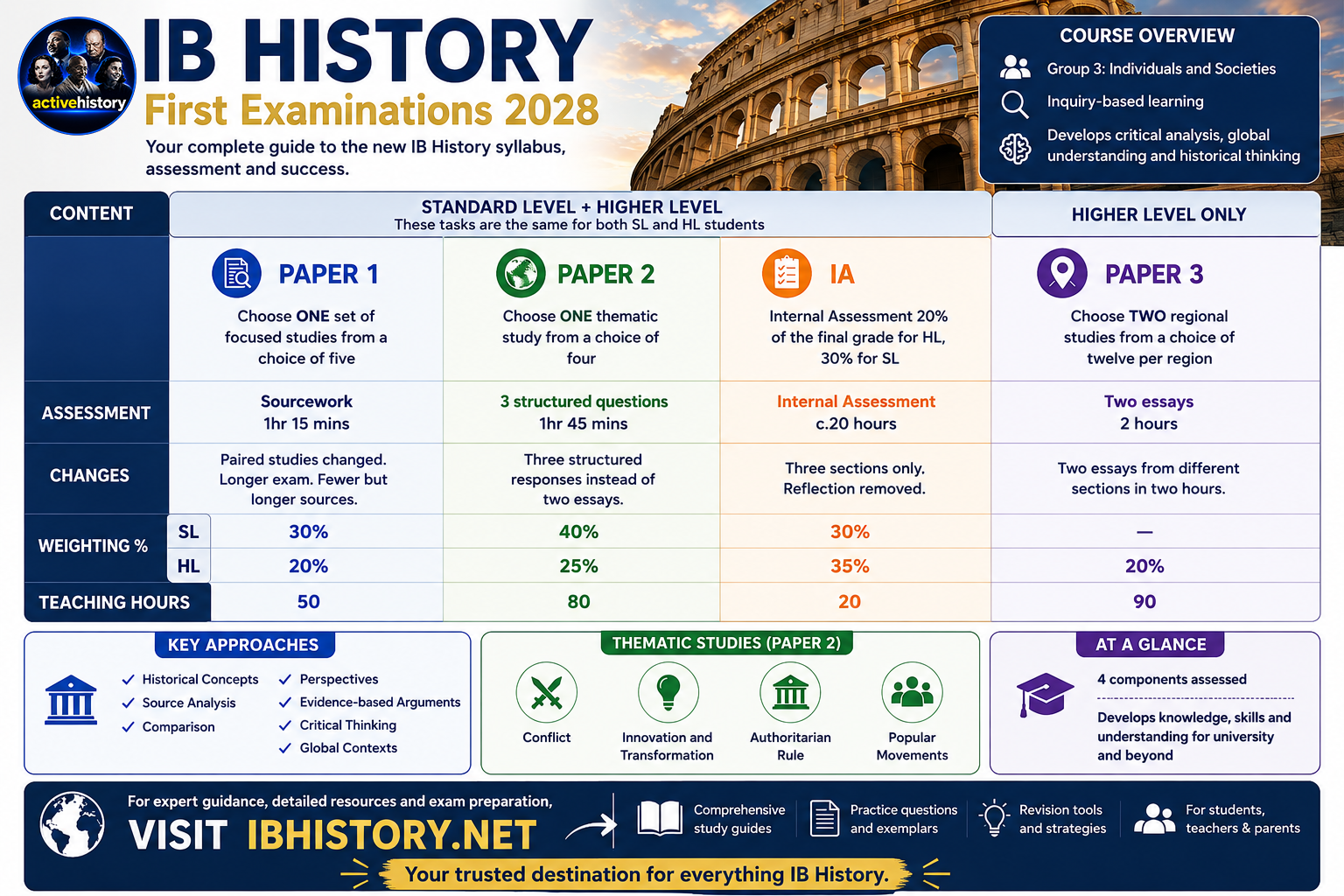
Click image to enlarge
📘 Free IB History Poster
Download this classroom-ready poster summarising the
new IB History syllabus (first examinations 2028),
including Papers 1–3, Internal Assessment requirements,
thematic studies, assessment weightings and key course features.
Ideal for classroom displays, department noticeboards,
student handbooks and induction sessions.