The Russian Federation from 1985 to 1999 offers a compelling case study of political, economic, and social transformation, making it an ideal topic for Paper 1 sourcework. This period encompasses the final years of the Soviet Union under Gorbachev, the rise of Boris Yeltsin, and the turbulent transition to a market economy and democratic institutions. Students can analyze firsthand documents, propaganda, and media reports to explore themes of reform, crisis, and social upheaval, while evaluating multiple perspectives on authority, legitimacy, and change in a post-communist society. Its richness of sources and rapid historical shifts make it both accessible and intellectually stimulating.
What caused the transition to take place?
Role of the Communist Party
Decline of Party Control under Gorbachev
Mikhail Gorbachev became General Secretary (1985) promising perestroika and glasnost, but these reforms weakened Party control. The 19th Party Conference (1988) introduced limited elections; Article 6—guaranteeing one-party rule—was abolished in 1990. Reformers like Boris Yeltsin challenged the CPSU openly. After the failed August 1991 coup, Gorbachev resigned as General Secretary and the Party was banned. What began as renewal ended as disintegration—Gorbachev’s own reforms dismantled the institution that had ruled for seventy years.
Factionalism and Reform from Within
Gorbachev’s reforms divided the CPSU. Reformers such as Aleksandr Yakovlev and Eduard Shevardnadze promoted democratization, while conservatives like Yegor Ligachev resisted. Between 1987–1990, the Politburo deadlocked. Regional branches, especially in Lithuania and Ukraine, aligned with nationalists. Party membership fell from 19 to 15 million (1986–1991). Reformers undermined central authority, conservatives froze change, and paralysis followed. By 1991, the CPSU was fragmented, unpopular, and ideologically hollow—its collapse inevitable once Gorbachev removed its constitutional monopoly on power.
Loss of Ideological Legitimacy
Glasnost revealed Soviet crimes—Stalin’s purges, Katyn, Afghanistan—destroying the myth of Party infallibility. Magazines like Ogonyok exposed corruption, while dissidents such as Andrei Sakharov demanded reform. Public faith in Marxism-Leninism evaporated as citizens encountered Western ideas and living standards. By 1990, ideology had lost authority; even Party elites doubted socialism’s future. When Yeltsin stood on a tank during the 1991 coup, he embodied a new democratic legitimacy that eclipsed the Party’s fading moral claim to rule.
Impact of Stagnation and Failed Economic Reform
The Brezhnev “Era of Stagnation”
Under Leonid Brezhnev (1964–1982), Soviet growth fell from 5% to under 2%, while corruption and inefficiency spread. Central planning produced shortages; the shadow economy thrived. Massive defense spending—about 15% of GDP—drained resources from innovation. Oil revenues masked decline, but productivity collapsed. By 1985, the USSR was technologically backward and demoralized. Historian Moshe Lewin called it “an empire running on empty.” This stagnation made reform essential yet impossible within the old command system.
Perestroika’s Economic Contradictions
The 1987 Law on State Enterprises gave autonomy without real markets, worsening shortages. The 1988 Cooperatives Law legalized private trade, enriching a few and breeding resentment. Inflation and falling output—GDP down 4% (1990)—discredited perestroika. Gorbachev’s refusal to liberalize prices or privatize fully alienated both conservatives and reformists. The hybrid economy collapsed: factories hoarded goods, queues lengthened, and the ruble lost value. Economic chaos convinced many, including Yeltsin, that only full capitalism could save Russia.
Collapse of the Soviet Social Contract
The Soviet promise of security for obedience crumbled. By the late 1980s, real wages stagnated, goods disappeared, and frustration soared. The 1989 miners’ strikes in Kuzbass and Donbas demanded not just pay but democracy. Glasnost broadcast their protests, exposing regime weakness. The Chernobyl disaster (1986) further shattered trust through official secrecy and mismanagement. Citizens no longer believed the state could provide stability. Economic despair transformed reform from a choice into an unavoidable transition.
Challenges to Communism in Eastern Europe
Reform and Revolution in the Eastern Bloc
Gorbachev’s Sinatra Doctrine (1989) ended the Brezhnev Doctrine, allowing Eastern Bloc nations independence. Poland’s Solidarity won elections; Hungary opened its border; the Berlin Wall fell (November 1989). Gorbachev’s refusal to use force showed Moscow’s loss of control. These peaceful revolutions revealed communism’s fragility and inspired reformers in the USSR. The collapse of allied regimes exposed the moral and ideological bankruptcy of Soviet authority at home.
Nationalism and Secession within the USSR
Inspired by Eastern Europe, republics turned nationalist. Lithuania’s independence (March 1990) triggered wider secession. The Baltic Way (1989) united two million in protest; Gorbachev’s New Union Treaty failed to hold the state together. In December 1991, Yeltsin, Kravchuk, and Shushkevich signed the Belavezha Accords, dissolving the USSR. National identity overpowered Soviet unity, turning a crumbling empire into the Russian Federation.
End of the Cold War and Western Influence
Gorbachev’s new thinking emphasized peace and integration. The INF Treaty (1987), withdrawal from Afghanistan (1989), and dialogue with Reagan and Bush ended confrontation. Western capitalism, visible through glasnost, appealed to reformers. The Velvet Revolution and German reunification (1990) showed democracy’s success. Western advisers soon guided Yeltsin’s “shock therapy” (1992). The USSR’s collapse thus paralleled its entry into a Western-dominated global order.
How was the transition achieved?
Roles of Mikhail Gorbachev and Boris Yeltsin
Gorbachev’s Political Reforms and the End of the USSR
Mikhail Gorbachev, General Secretary from 1985, initiated perestroika and glasnost, aiming to reform socialism. The Congress of People’s Deputies (1989) introduced limited democratic elections, weakening the CPSU’s monopoly. His New Union Treaty (1991) sought to preserve the USSR through decentralization, but conservative opposition triggered the August 1991 coup. Its failure fatally undermined Communist control. By December 1991, the Belavezha Accords dissolved the Soviet Union, enabling transition to the Russian Federation.
Yeltsin’s Rise and Democratic Consolidation
Boris Yeltsin, expelled from the Politburo (1987) after criticizing Party privilege, returned as a populist reformer. Elected Chairman of the Russian Supreme Soviet (1990), he declared Russian sovereignty within the USSR. During the 1991 coup, his defiance atop a tank outside Moscow’s White House made him a national hero. As President of Russia (June 1991), Yeltsin dismantled Soviet institutions, banned the CPSU, and assumed control of state property—asserting Russia’s independence from Gorbachev’s crumbling union.
Conflict between Reform and Stability
Yeltsin’s early presidency faced contradictions between rapid reform and maintaining order. His alliance with reformer Yegor Gaidar prioritized economic liberalization, but conservative lawmakers resisted. Power struggles culminated in the 1993 constitutional crisis, when Yeltsin ordered tanks to shell the Russian White House after parliament’s impeachment attempt. Though over 140 died, Yeltsin prevailed militarily and politically. This confrontation consolidated presidential power and symbolized Russia’s decisive, though turbulent, break with its Soviet past.
Constitution of 1993
Crisis and Drafting
The 1993 crisis exposed the need for a new constitutional order. After dissolving the Congress of People’s Deputies, Yeltsin called a referendum. A draft constitution, largely written under his direction, aimed to prevent parliamentary obstruction and ensure executive dominance. Despite opposition boycotts, the December 1993 referendum passed with 58.4% approval, creating the legal foundation of the Russian Federation and institutionalizing Yeltsin’s vision of a strong presidency and market-oriented democracy.
Creation of a Strong Presidency
The 1993 Constitution centralized authority in the president—empowered to issue decrees, appoint ministers, and dissolve the State Duma. Yeltsin’s model reflected Western-style separation of powers but tilted heavily toward the executive. Critics like Sergei Baburin warned it created “super-presidentialism.” Yet it provided short-term stability during volatile reforms. The new Federal Assembly, divided into the State Duma and Federation Council, institutionalized political pluralism but left real power in the Kremlin.
Federalism and Rule of Law
The 1993 Constitution declared Russia a “democratic, federal, law-based state,” recognizing 89 federal subjects with varying autonomy. It affirmed civil rights, judicial independence, and the supremacy of law. However, regional leaders like Mintimer Shaimiev (Tatarstan) negotiated special treaties, creating an asymmetrical federation. The Constitutional Court, restored in 1994, mediated disputes but often deferred to presidential authority. This legal framework achieved transition by codifying democracy within centralized executive control.
Privatization, Market Liberalization and Tax Reforms
Shock Therapy and Price Liberalization (1992)
Guided by Yegor Gaidar, Yeltsin launched “shock therapy” in January 1992, freeing 90% of prices overnight. Inflation surged to 2,500%, eroding savings but ending chronic shortages. The ruble depreciated sharply, and output collapsed –20% (1992). Yet price liberalization broke the command economy’s structure, allowing private trade. Western economists, notably Jeffrey Sachs, endorsed the painful but necessary shift. Russia’s market transition thus began abruptly, prioritizing speed over social protection.
Voucher Privatization and the Rise of the Oligarchs
Under Anatoly Chubais, voucher privatization (1992–1994) distributed 150 million vouchers to citizens, exchangeable for shares in former state firms. In practice, insiders—factory managers and emerging financiers—acquired control, birthing the oligarchs. By 1994, over 70% of small and medium enterprises were privatized. Critics like Joseph Stiglitz called it “giveaway privatization.” While flawed, the policy created a private sector and entrenched capitalist ownership, crucial to achieving post-Soviet economic transformation.
Tax Reform and Fiscal Stabilization
Russia’s chaotic early 1990s economy lacked effective taxation. By 1998, tax revenues fell below 10% of GDP, contributing to the August 1998 financial crisis and ruble devaluation. Recovery began under Yeltsin’s 1999 reforms, later advanced by Putin’s 2001 tax code, which introduced a 13% flat income tax. Simplification boosted compliance and revenue, stabilizing public finances. These fiscal reforms completed the transition to a functioning market economy, capable of sustaining post-crisis recovery.
What challenges did society face after the transition?
Communist Hardline Coup (1991) and the Constitutional Crisis (September–October 1993)
August 1991 Coup Attempt
In August 1991, hardline Communists, including Gennady Yanayev and Dmitry Yazov, attempted a coup to stop Gorbachev’s reforms and the New Union Treaty. Tanks rolled into Moscow, but Boris Yeltsin famously stood on a tank outside the White House, rallying crowds. The coup collapsed in three days, but it exposed deep divisions, accelerated the dissolution of the USSR, and left society politically unstable, uncertain of authority and the legitimacy of emerging Russian institutions.
Parliamentary Resistance to Reform
After Yeltsin became president, the Russian parliament resisted his economic reforms and privatization policies. By 1993, tensions escalated as deputies opposed decrees dissolving the Congress of People’s Deputies. Lawmakers barricaded themselves in the White House, refusing to yield to presidential authority. The standoff polarized Russian society between reformist supporters and conservative loyalists, leaving citizens fearful of violence and uncertainty about Russia’s political future.
October 1993 Armed Conflict
The crisis climaxed when Yeltsin ordered military forces to shell the Russian White House (October 4, 1993). Over 140 people died, with hundreds injured. While Yeltsin prevailed, the event highlighted the fragility of Russia’s transition, showed the extremes of power struggles, and left a lasting legacy of political trauma. Society confronted the reality that democratic institutions were fragile and that force could determine political outcomes.
Labour Strikes, Protests and Organized Crime
Economic Hardship and Strikes
Russia’s transition brought inflation, wage arrears, and unemployment. In 1992–1993, miners in Kuzbass and Donbas staged repeated strikes, demanding unpaid wages and pension guarantees. Factory workers in Moscow and St. Petersburg joined protests. Strikes paralyzed local economies and highlighted the failure of privatization to protect workers. Citizens faced uncertainty and poverty, undermining confidence in both government and reform policies.
Public Protests and Social Discontent
Beyond economic grievances, protests reflected anger over corruption and rising inequality. In 1993, Moscow saw demonstrations against Yeltsin’s decrees and economic reforms, sometimes violently suppressed. The gap between urban elites and rural populations widened, and media reports described queues, crime, and destitution. Russian society struggled to adjust to a market economy, experiencing insecurity, dislocation, and frustration with slow or uneven reforms.
Rise of Organized Crime
The economic chaos of the 1990s allowed organized crime to flourish. Mafia groups, such as those in Moscow and St. Petersburg, seized former state enterprises, extorted businesses, and infiltrated privatization deals. Police corruption often protected criminals, and by 1995, criminal networks controlled significant sectors, including oil, metals, and banking. Society faced a breakdown of law and order, insecurity, and a pervasive fear of violence, complicating the fragile transition to capitalism and rule of law.
First Chechen War (1994–1996)
Origins of the Conflict
In 1994, the Russian Federation sought to prevent Chechen independence declared by Dzhokhar Dudayev. Chechnya’s defiance threatened territorial integrity and post-Soviet authority. Russia deployed poorly trained conscripts into Grozny, underestimating Chechen resistance. The war emerged as a national crisis, revealing weaknesses in military, political, and social structures. Society was drawn into a conflict that consumed resources, attention, and morale.
Military and Civilian Impact
The conflict caused massive destruction: 25,000–50,000 deaths, including civilians, and widespread urban devastation. Russian soldiers faced poor supplies and leadership, with conscripts drafted from across the Federation. Media coverage highlighted atrocities, fueling domestic outrage. Families experienced trauma and displacement, while distrust in government competence increased. Chechnya became a symbol of instability, showing society the human cost of a fragile state struggling to maintain unity.
Political and Social Consequences
The war undermined Yeltsin’s popularity, with approval ratings dropping sharply. Public disillusionment intensified with reports of corruption, human rights abuses, and military failure. The conflict exacerbated social divisions, strengthened nationalist rhetoric, and contributed to regional unrest. Society grappled with insecurity, political cynicism, and economic strain, while the unresolved status of Chechnya foreshadowed prolonged instability in the Russian Federation, highlighting the fragile nature of post-Soviet transition.
Recommended Sources
Primary sources
JSC “Kremlin‑Archive,” The August 1991 Coup: Documents of the State Committee on the State of Emergency (Moscow: Rossiĭskiĭ gosudarstvennyi arkhiv noveishei istorii, 2005).
Useful because it provides first‑hand documents from the failed coup attempt that triggered the collapse of the Soviet Union and the transition to the Russian Federation. Reliability is high as genuine archival material, though selection may be politically filtered.
Yeltsin Presidential Library, Russian Federation Decree No. 1400 of 12 December 1993: “On the Approval of the Constitution of the Russian Federation” (Moscow: Yeltsin Presidential Library, 1993).
This is the foundational constitutional text for the new Russian state (1993). It’s essential primary legal material. Very reliable as an official legal document, though interpretation requires caution about the political context.
Gaidar, Yegor, “The 500 Days Programme” (Moscow: Institute of Economic Policy, January 1991).
This draft programme for economic transition shows early reform thinking in Russia. Utility: insight into reformers’ intentions; reliability: draft document, may not reflect final policy and has ideological bias.
USSR State‑Soviet Archive, “Plenary Meeting of the Politburo of the CPSU, 24 August 1991,” transcript (Moscow: RGANI, 1992).
This provides verbatim discussion inside the Communist Party leadership during the coup. Very valuable for political history; reliability is good but some excerpts may have been declassified selectively.
Russian Federation, Federal Law No. 34‑FZ, “On the Privatization of State‑Owned Enterprises,” adopted 3 July 1991 (Moscow: Rossiĭskaia Federatsiia, 1991).
Official law on privatization – primary legal source for economic transition. Highly reliable as a legal document; utility for studying structural change, but practical implementation diverged from text.
Secondary sources
Smith, Stephen A., Russia in Revolution: An Empire in Crisis, 1890 to 1928 (Oxford: Oxford University Press, 2017).
Though earlier period, provides long‑term context for understanding the Russian Federation’s post‑1985 challenges. Reliability is high; utility for history of Russian state.
Sakwa, Richard, Russia Against the Rest: The Post‑Cold War Crisis of World Order (Cambridge: Cambridge University Press, 2017).
Analyses Russia’s post‑Soviet repositioning (including 1985‑99) in global order. Useful for linking domestic transition to international context; reliability: scholarly, but covers wide period.
Colton, Timothy J., Yeltsin: A Revolutionary Life (New York: Basic Books, 2008).
Detailed biography of Boris Yeltsin, core actor in the transition. Very useful; reliability: well‑researched although certain personal details may depend on memoirs.
White, Stephen, Russia’s New Politics: The Management of a Postcommunist Society (Cambridge: Cambridge University Press, 2000).
Focuses on Russian politics in the 1990s, very relevant. Reliable academic source; utility: good for understanding institutional change, though slightly dated.
Åslund, Anders, How Russia Became a Market Economy (Washington D.C.: Brookings Institution Press, 1995).
Examines economic reform in Russia; useful for transition period analysis. Reliability is good though written in the mid‑1990s so lacks later retrospective critique.
Provides access to vast archival collections (CPSU documents 1903‑1992). Very useful for primary research; reliability high though some materials still inaccessible.
A curated guide to primary sources in Russian/Soviet history; useful for researchers locating documents; reliability good though it compiles links rather than content.
Contains primary documents, memos, transcripts relating to Russia in the 1990s. Very useful; reliability: high, though as always cross‑check documents.
Highly useful visual documentary covering the era under study; reliability: journalistic/documentary style, so interpretive and selective, but rich in archival footage.
Citizen K (2019; director Alex Gibney) – documentary available via streaming platforms.
Focuses on post‑Soviet Russia and oligarchs (Khodorkovsky). Useful for economic/social dimension of transition; reliability: well‑reviewed film, but not strictly academic.
Provides firsthand interviews and footage of 1990s Russia; useful for social history; reliability: depends on production quality and sourcing, check bias.
Useful primary‑style oral history of diplomacy and economic transition; reliability: firsthand interview, but limited to one perspective (U.S. diplomatic).
Covers life in Russia in the 1990s, social history; utility: good for cultural/societal insight; reliability: podcast, so anecdotal content, need cross‑check facts.
Although post‑1999, it offers reflective insight into how the 1990s transition laid groundwork for Putin’s era. Utility: broader perspective; reliability: high quality production, but interpretive and retrospective.
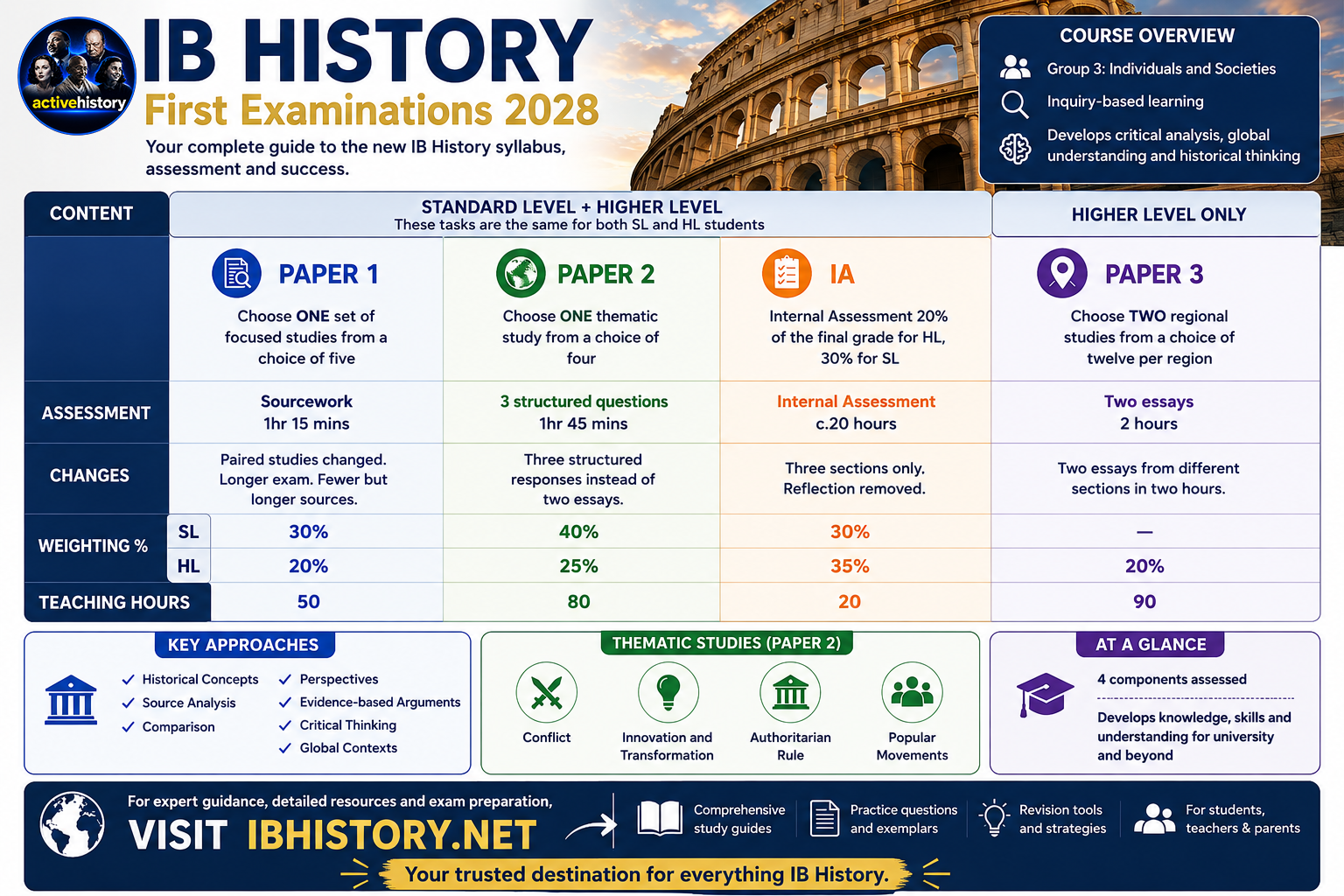
Click image to enlarge
📘 Free IB History Poster
Download this classroom-ready poster summarising the
new IB History syllabus (first examinations 2028),
including Papers 1–3, Internal Assessment requirements,
thematic studies, assessment weightings and key course features.
Ideal for classroom displays, department noticeboards,
student handbooks and induction sessions.