IB History Internal Assessment (IA)
The ultimate survival guide for first examinations in 2028: with step-by-step support, examples, and practical advice. Courtesy of ActiveHistory.
First examinations: 2028
- The Internal Assessment in History is an individual research essay of 2,200 words maximum. It provides a chance to study a topic that interests you in depth. It can cover preetty much any historical topic of your choice.
- It counts for 20% of the final grade for Higher Level students, and 30% for Standard Level students.
- Your teacher will give comments on the first draft of your work.
- The final draft you submit is then marked by your history teacher, but is subject to moderation by the IBO.
Choosing a topic for your Internal Assessment in History
- An Internal Assessment in History involves applying your skills to explore a topic of personal interest in an imaginative, critical, focused way.
- It is important that you choose a topic that lends itself to critical investigation and analysis (e.g. the causes, consequences or significance of an event, development or individual), rather than one that steers you towards a descriptive or narrative piece of writing.
- You cannot investigate the same question that frames your Extended Essay, but beyond this you have great freedom to choose your period, place and theme.
- The only date restriction is that the study must cover a period after 750 AD, and that contemporary topics must be studied historically (e.g. you can study the CAUSES of a contemporary conflict, but not its consequences).
TOP TIP: Use the ActiveHistory IBDP Historical Question Generator to help you at this stage!
www.activehistory.co.uk/ibdp/question-generator
TOP TIP: Use the ActiveHistory Historical Podcast Database to search for your favoured topic!
www.activehistory.co.uk/library/podcasts
Framing your question
- You should then use your topic to generate a workable, focused research question.
- Key points to consider when framing your question:
- Is my question framed around a command term which allows for an evaluative approach (e.g. "To what extent...?", “How far...?”, “How successful...?”, “How significant...?").
- Is the inquiry question focused enough to be answered within the time and word limit?
- Can my inquiry question by answered from a variety of angles / factors / perspectives?
- Are there sufficient relevant and diverse sources that I can access?
- If my inquiry question is contemporary, can I address it historically (e.g. CAUSES of a current event rather than its RESULTS)?
TOP TIP: Use the ActiveHistory IBDP Historical Question Generator to help you at this stage!
www.activehistory.co.uk/ibdp/question-generator
The following table could help you get started.
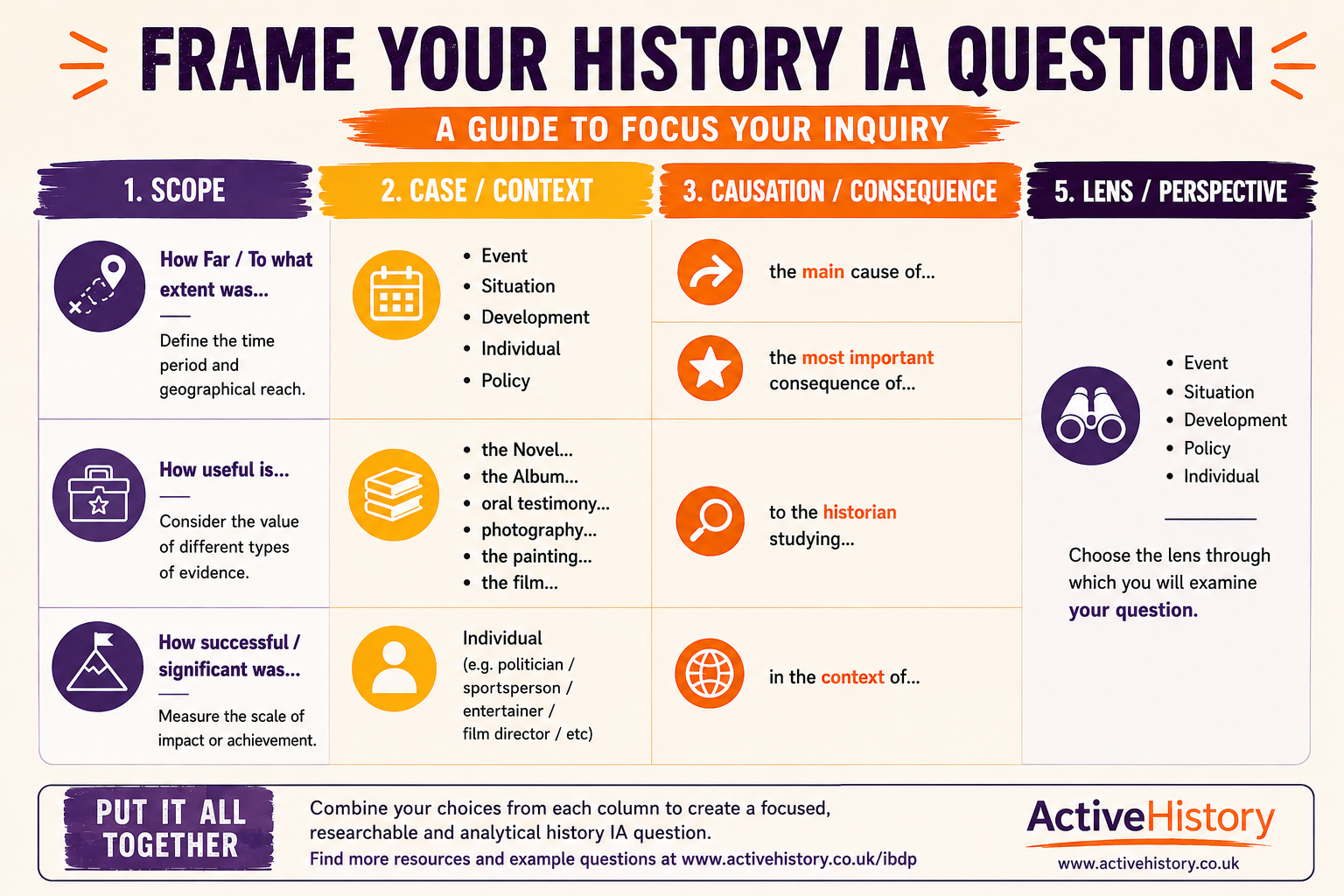
| How Far / To what extent was... |
[Event]
[Situation]
[Development]
[Individual]
[Policy] |
the main cause of... |
[Event]
[Situation]
[Development]
[Policy] |
| the most important consequence of... |
| How useful is... |
the Novel...
the Album...
oral testimony...
photography...
the painting...
the film... |
to the historian studying... |
| How successful / significant was... |
[Individual] (e.g. politician / sportsperson / entertainer / film director / etc) |
in the context of... |
Here are some sample questions that might give you some ideas.
- “Evidence based"
- How useful are oral testimonies in understanding civilian experiences during the Partition of India in 1947?
- How significant are archaeological discoveries in shaping modern understanding of Viking settlement in Britain?
- To what extent do declassified government documents improve historians’ understanding of the Cuban Missile Crisis?
- “Event based”
- To what extent did militant Zionist groups influence British withdrawal from Palestine between 1945 and 1948?
- How significant was the storming of the Bastille in causing the French Revolution?
- How successful was the policy of appeasement in preventing war in Europe between 1936 and 1939?
- “People based”
- To what extent was Napoleon Bonaparte responsible for the spread of nationalism in Europe?
- How significant was the contribution of Emmeline Pankhurst to women’s suffrage in Britain?
- How successful was Mikhail Gorbachev in reforming the Soviet Union between 1985 and 1991?
Identifying your sources
- You will be expected to locate and make use of a diverse range of primary and secondary sources in your Internal Assessment.
- NOTE: You will only be allowed to use only a maximum of SEVEN sources, so choose these very carefully.
- Engaging with different types of sources, such as primary and secondary sources, and considering a range of perspectives will be highly beneficial.
- The following links might prove useful.
JSTOR | Google Books Search | Google Scholar Search | Amazon Search | BBC History Magazine Search | History Today Magazine Search | ActiveHistory Podcast Archive
Submitting your Internal Assessment Proposal Form
- You are now ready to complete the Initial Proposal Sheet and hand it to your teacher.
- Make sure that this is a detailed, considered proposal. Your supervisor will schedule a meeting with you to talk about how you plan to structure your essay in particular.
How to Structure your Internal Assessment in History
- The IA is submitted as one document that includes the three required sections and a bibliography. The IA must be no more than 2,200 words. References, headings and the bibliography do not count towards the total. The total word count must be clearly stated at the start of the document.
- As part of the learning process, teachers should read and give advice to students on one draft of the work. The teacher should provide oral or written advice on how the work could be improved, but not edit the draft. The next version handed to the teacher must be the final version for submission.
Title page (not included in the word count)
- A title page is not formally required by the IBO, but it provides a good opportunity to clearly state your question and the word count (which is required).
- Use it to include the following sort of information:
Student Code: 987653
“How successful was the policy of appeasement in preventing war in Europe between 1936 and 1939?”
Internal Assessment in History (Group 3, Individuals and Societies)
Word Count: 2100
Top Tip: You might also choose to include an accompanying relevant image, but if you do so make sure you include a caption in the Chicago format.
Section 1: Historical Inquiry Question (6 marks, 400 words)
- In this section, you need to clearly state the historical inquiry question and provide a full explanation of how this question is appropriate for historical inquiry. It will also provide precise and detailed references to an appropriate concept, with a clear explanation of how this concept informs the historical inquiry.
- The four specified concepts (cause and consequence, continuity and change, perspectives, significance) can be a very useful starting point in helping students to formulate a question.
- However, students are not limited to the specified concepts of the course and can identify a different concept that they have explored in their course, or elsewhere, to guide their inquiry.
The following writing frame should prove useful
1
State the historical inquiry question
Clearly state your historical inquiry question.
In most cases, "To what extent...?" is the most suitable command term for IB History Paper 2 and Paper 3 style investigations.
"This essay will examine an inquiry question which continues to generate historical debate: ..."
State the exact question your investigation will address.
2
Explain why the question is historically appropriate
Explain why the topic is suitable for historical inquiry, particularly in terms of differing interpretations and perspectives found within the source material.
"The question is historically appropriate because it can be considered from a variety of perspectives, for example..."
Outline the main perspectives, interpretations, or factors your investigation will consider.
3
Identify and explain the key historical concept
Refer precisely to an appropriate historical concept and explain clearly how it informs the investigation.
"This study will specifically address the concept of [X]..."
Define the concept and explain how it relates to the inquiry question.
Section 2: Sources and Perspectives (6 marks, 400 words)
- In this section, provide a well-developed explanation of how the sources you have chosen (seven sources maximum) provide diverse historical perspectives, and clearly explain how the perspectives will help answer your historical inquiry question.
- Engaging with different types of sources, such as primary and secondary sources, and considering a range of perspectives will be highly beneficial.
The following writing frame should prove useful
1
Outline different historical perspectives
Identify and explain a range of historical perspectives relating to the inquiry question.
Each perspective should be explored in a separate paragraph. Aim to address at least three perspectives overall.
"One perspective on the inquiry question is that..."
Example: orthodox or socio-economic interpretation.
"A second perspective on the inquiry question is that..."
Example: revisionist or political interpretation.
"A third perspective on the inquiry question is that..."
Example: post-revisionist or military interpretation.
2
Support each perspective with source evidence
Within each paragraph, refer to relevant historical sources to support the perspective being discussed.
Aim to include at least two sources for each perspective.
"...one source which adopts this perspective is..."
"...another source which adopts this perspective is..."
3
Evaluate the utility of the sources using OPVCL
Consider the origin, purpose, value, and limitations of the sources you are using.
"...a particular value of this source is that... although we should also consider that it is limited in the sense that..."
Top Tip: Add a footnote for each source mentioned giving a full Chicago-style reference.
Top Tip:
Do not structure the investigation as a source-by-source account.
The sources should be used to support and illustrate historical perspectives, rather than becoming the focus themselves.
|
Socio-Economic Factors |
Political Factors |
Military Factors |
PARAGRAPH 1 = Perspective 1
e.g. Agree / Thesis / Orthodox Viewpoint |
➜ |
➜ |
➜ |
PARAGRAPH 1 = Perspective 2
e.g. Disagree / Antithesis / Revisionist Viewpoint |
➜ |
➜ |
➜ |
PARAGRAPH 3 = Perspective 3
e.g. Mixed / Synthesis / Post-Revisionist Viewpoint |
➜ |
➜ |
➜ |
Sample idea about how Section 2 could be planned out (each row forming the basis of a separate paragraph)
Section 3: Synthesis and Evaluation (1400 words, 12 marks)
- This section is a sustained analysis that is clearly focused on the historical inquiry question. This analysis is fully supported with evidence from the sources used in section 2, and these sources are evaluated in terms of their reliability / utility.
This section should end with a carefully reasoned judgement that is consistent with the analysis.
- On the simplest level, Section 3 could therefore be regarded as an expansion of Section 2, which provides the ‘abstract’ of the argument. In other words, you could feasibly copy and paste Section 2 as the starting point for Section 3, and then expand it with more evidence from the sources and background knowledge, and add an overall conclusion.
- However, this is intellectually rather repetitive and undemanding. So a good way to develop your ideas from Section 2 would be to take the planning grid for Section 2, and base the paragraphs around the COLUMNS rather than the ROWS:
|
PARAGRAPH 1 = Socio-Economic Factors |
PARAGRAPH 2 = Political Factors |
PARAGRAPH 3 = Military Factors |
Perspective 1
e.g. Agree / Thesis / Orthodox Viewpoint |
➜ |
➜ |
➜ |
Perspective 2
e.g. Disagree / Antithesis / Revisionist Viewpoint |
➜ |
➜ |
➜ |
Perspective 3
e.g. Mixed / Synthesis / Post-Revisionist Viewpoint |
➜ |
➜ |
➜ |
Sample idea about how the planning grid for Section 2 could be repurposed for Section 3 (each column now forming the basis of a separate paragraph. rather than each row)
Bibliography (not included in the word count)
- A bibliography, which clearly references a maximum of seven sources used in the IA, must be included at the end of the study. This is not included in the overall word limit.
- All sources should be listed alphabetically (by author surname), using the Chicago format.
- This bibliography must list only the sources cited in the footnotes (remember: a MAXIMUM of seven sources is allowed in total).
- TOP TIP: You should maintain a bibliography and a list of page references from the outset. That way you are less likely to forget to include a citation. It is also easier than trying to add references at a later stage.
Footnotes and Referencing
Footnotes
- Footnotes should only be used for referencing your chosen sources, using the Chicago format:
- Author. Title (Publisher, Date), Page, e.g.
Tarr, Russel. Luther and the Reformation 1500-64 (Hachette, 2015), Page 27
Top Tip: Use the ClassTools Citation Generator to efficiently generate your footnotes:
www.classtools.net/citation-generator
- Any references to interviews should state the names of the interviewer and interviewee, the date and the place of the interview.
- Websites that do not give references or that cannot be cross-checked against other sources should be avoided.
- Avoid footnotes to lame sources like Wikipedia, GCSE Bitesize, History.com, Biography.com and similar. These are amateurish!
- Any information that is important to the argument must not be included in appendices or footnotes/endnotes. The examiner will not read notes or appendices.
Use of tables, maps, charts, illustrations
- These should appear in the body of the essay, as close as possible to their first reference. Such sources should only be used if they are relevant and appropriate to a point being made as part of the argument of the essay.
- Any labelling should be clear and contain the minimum information to ensure the examiner understands the significance of the map, chart, table, diagram, image or illustration.