World History teaching resources for the high school classroom: lesson plans, worksheets, quizzes and simulation games for KS3, IGCSE, IB and A-Level teachers.
Introduction: Why was the European Reformation so significant?
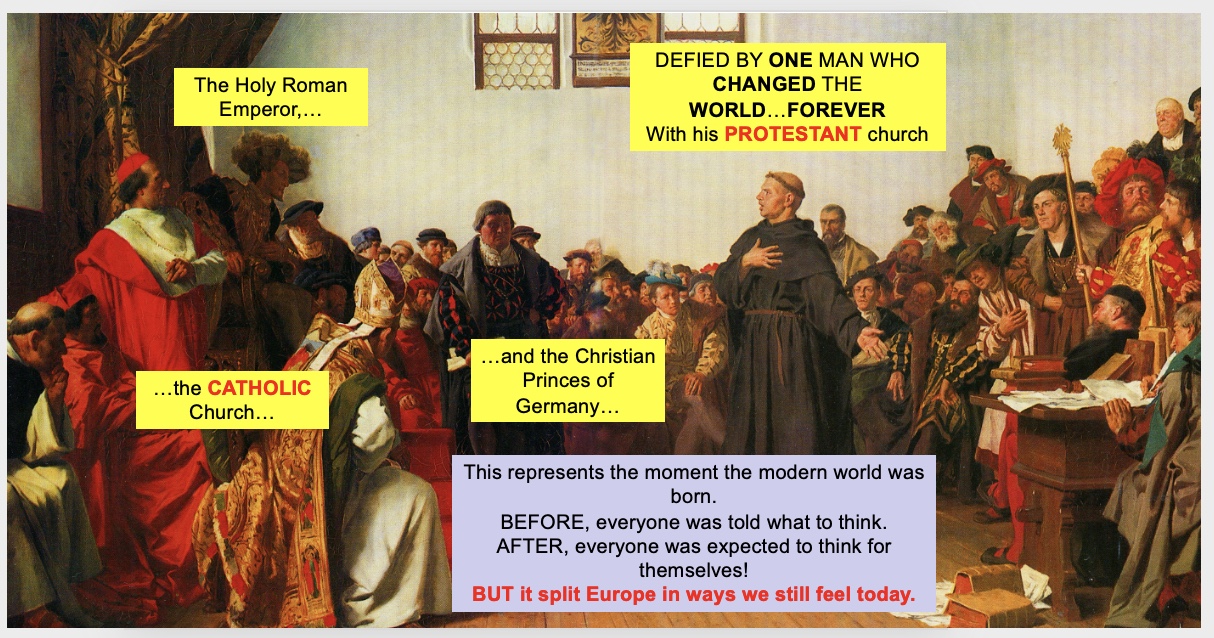
A animated Powerpoint slide designed to be used as a lesson starter.
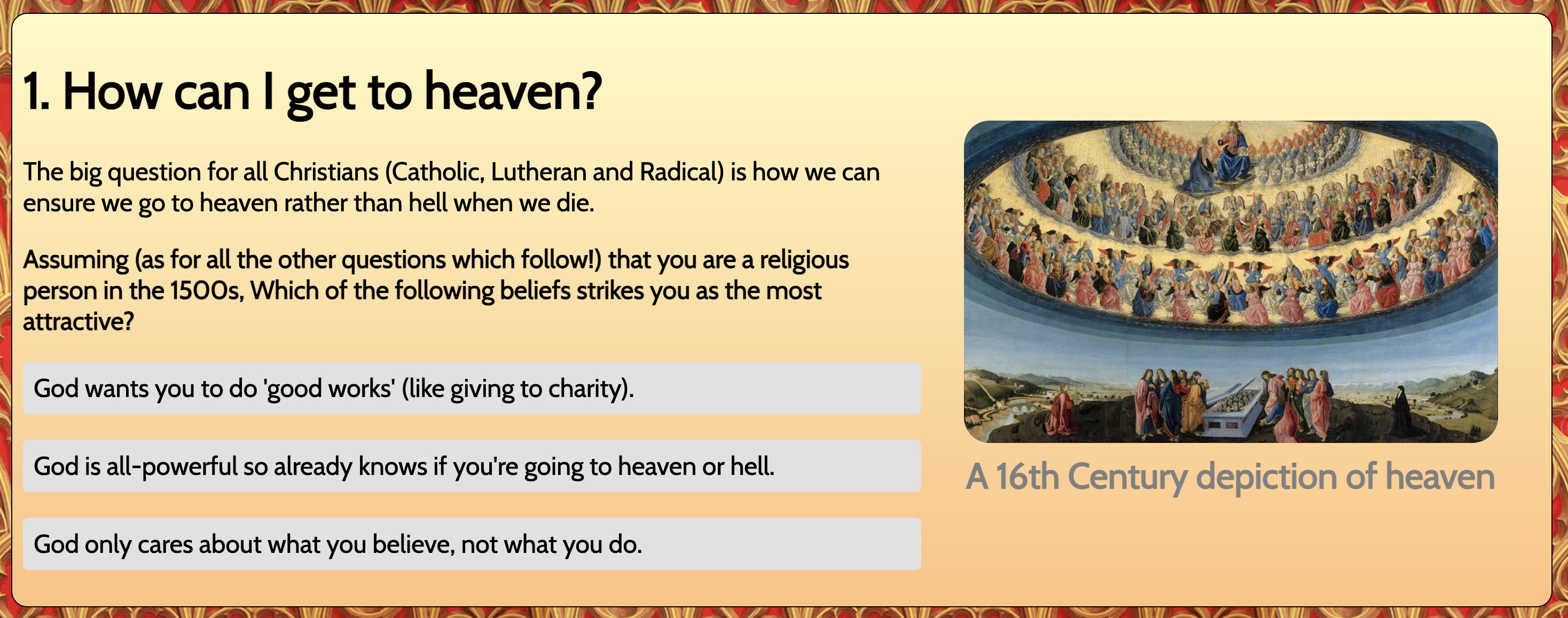
Decision Making Simulation: Are you a Lutheran, a Catholic or a Radical?
This simulation really encourages students to reflect on which points of view make most sense to them personally, especially because at the end of it they are provided with follow-up questions which the computer tailors specifically to their individual responses.
Classroom Discussion: Lutherans, Catholics and Radicals
The teacher leads a discussion based around what the students learned from the simulation. The class thereby gets a full picture of what each of the three religious groups believed on each of the key issues. This is important because the simulation will tell students which group they sympathise with, but will not summarise the differences between the groups.
Role Play: Protestants and Catholics
This is a simpler version of the same exercise. The teacher comes into class in role firstly as Luther, then as Pope Leo X, answering a series of tough questions about their faith in a way designed to persuade the audience that their faith is the "right" one. The class takes a vote at the end.
Homework
Students should do one of the following tasks:
(a) Produce a written piece answering the question "What did the Protestants and
the Catholics disagree about?" OR
(b) Produce a propaganda poster - using only images, no words - summarising the
main beliefs of one of the three religious groups. The class could be divided
into three groups (Lutherans, Catholics, Radicals) and then each member within
each group could be given a different area to focus on - Bible, Eucharist,
Priesthood and so on.
3. The life of Martin Luther - Design a film trailer! | Factual Test
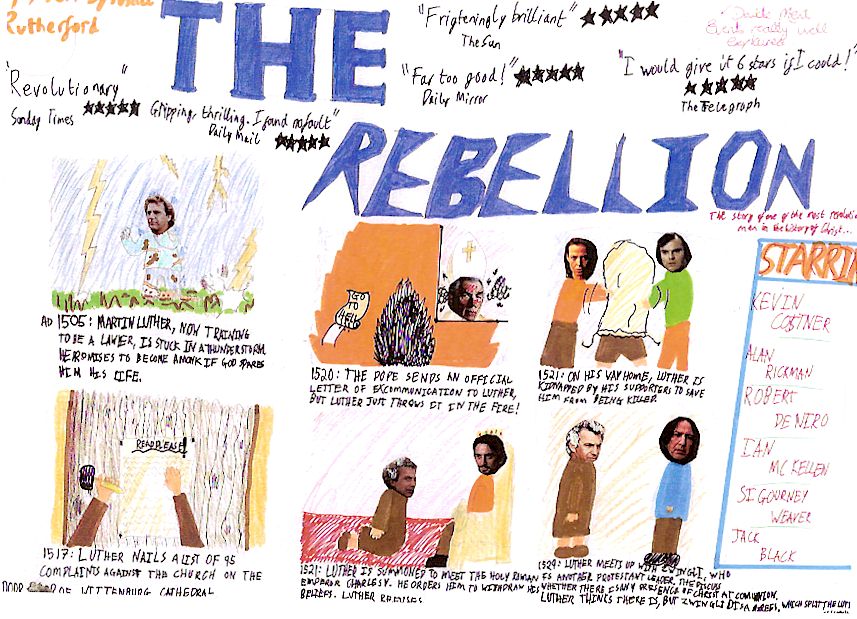
It's a great story - and in this activity, students use a timeline to produce a Hollywood Film Poster advertising a new blockbuster about the life of the Reformation giant. Focusing on the cast list, the film title and the key events of his life, it can be great fun. This cast list PowerPoint Template gets students thinking about which actors they want to play the key characters (there is also a completed version, with ideas for inspiration). For added spice, insist that half of the class need to make a film very hostile to Luther, whilst the other half will be highly sympathetic. Here is a sample poster produced by one of my students, and here is a video trailer produced by another:

KeyWord Challenge: The Reformation
If you are unfamiliar with the format of the game, click here for instructions. Alternatively, students could complete this Factual Test based on the timeline of Luther's life.
Consolidation: Religious events in the Early Modern Period
Before moving on to the next topic of study, this activity gets students to investigate a wide range of other events going on in Europe at the same time as the Lutheran Reformation. In this way they get a useful overview of the entire period rather than merely a narrow view of one or two events.
Revision / End of Unit Quizzes

© 1998-2026 Russel Tarr, ActiveHistory.co.uk Limited (Reg. 6111680)
1 Torrin Drive, Shrewsbury, Shropshire, SY3 6AW, England
Privacy Policy | Contact