Transform your history classroom
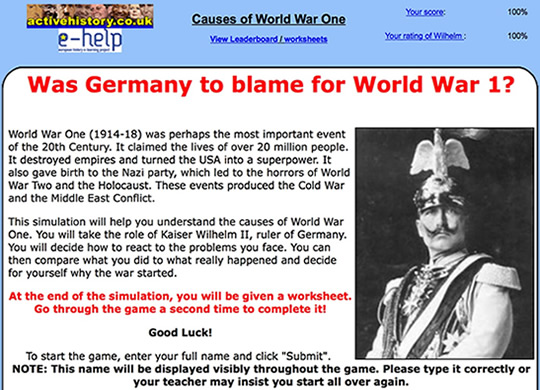
ActiveHistory provides interactive simulations, self-marking quizzes, lesson plans, worksheets and multimedia activities designed by full-time history teacher Russel Tarr.
Build and deliver complete history courses with resources for classroom teaching, remote learning and independent study - from multimedia lectures to interactive games and historical simulations.
World History teaching resources for the high school classroom: lesson plans, worksheets, quizzes and simulation games for KS3, IGCSE, IB and A-Level teachers.
Overview
The following materials have been designed to help deliver Theory of Knowledge (TOK) in History at IB (International Baccalaureate) Level to my students at the International School of Toulouse.
As well as making regular reference to TOK issues within normal lessons, I also deliver three sessions of one hour each to all of Grae 11 (whether or not they study history), and round the unit off by setting a relevant TOK essay title from the IB syllabus (these are provided annually in advance).
1. An Introduction to Theory of Knowledge in History
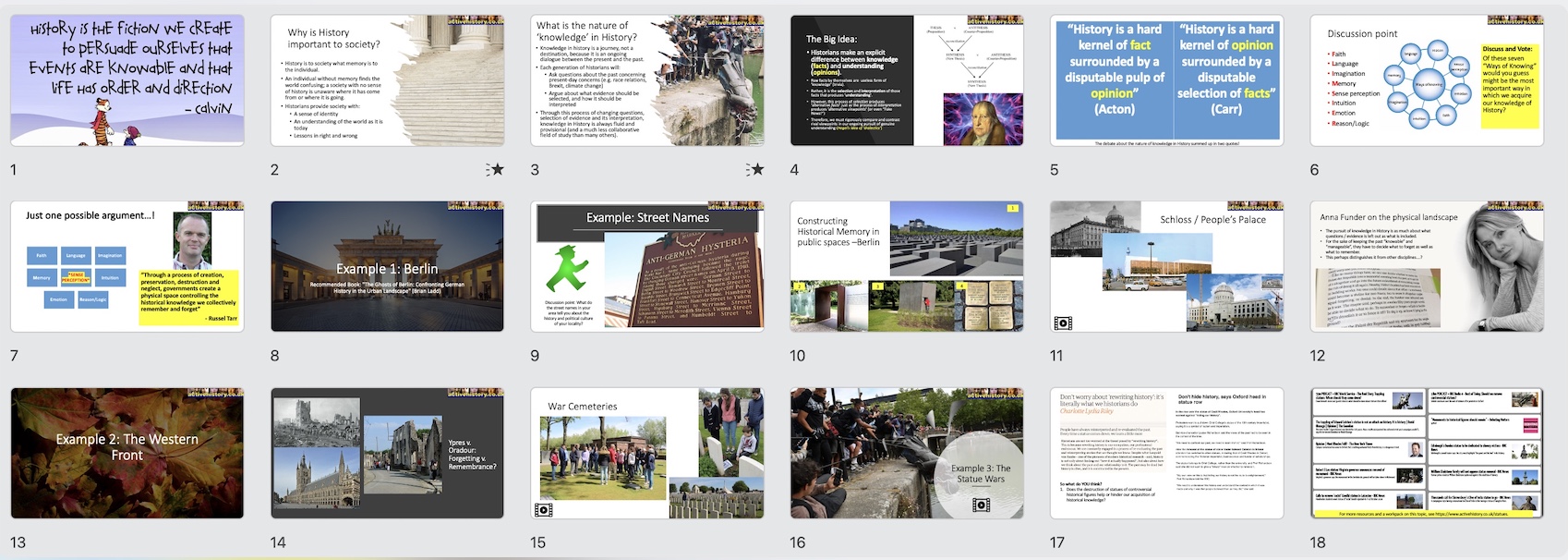
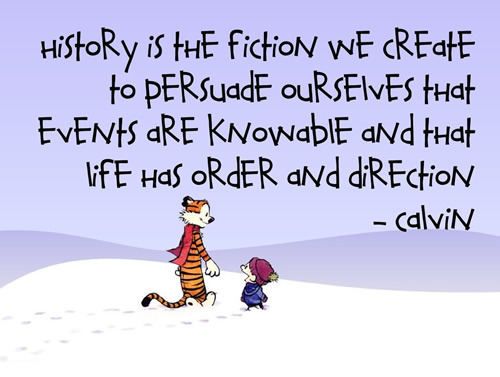
In this 20-slide presentation, students are introduced to the concept that "Knowledge" in History consists not only of the selection of facts from an incomplete historical record, but the interpretation of those facts and of the gaps in that record by historians. There is also a detailed consideration of the role played by sense perception as a source of knowledge in History, complete with case studies focusing on the recent "statue wars" and other examples from public spaces.
 2. The "What" of History: Sources
[student worksheet | teacher notes]
Introduction: Why and How is History Produced?
- "History" is not "What happened in the past" or even "The surviving evidence of what happened in the past".
- It means "What historians choose to interpret from the surviving evidence of the past"
- To reduce this to a formula, we might say:
- Sources + Historians = Histories
- So it is important to consider what the nature of the surviving evidence is, and how historians then choose to select and present it.
- In these three TOK sessions, I therefore investigate three ways in which we gain a "knowledge" of History:
- Session 1. The Sources: What are the limitations of the surviving evidence?
- Session 2. The Historians: What are the limitations of the historians using that evidence?
- Session 3. The Histories: What, therefore, are the limitations of the histories produced?
The Historians and Their Sources
- The first way in which we gain knowledge of the past is through historical evidence ("sources"). Two questions raise themselves:
- How can we extract knowledge from the sources? (issues of quality and quantity)
- How useful is the knowledge that we extract in this way? (issues of comprehensibility and the 'language gap')
This session makes use of the following two video clips which illustrate the problem of the 'language gap' when trying to interpret historical sources:
| Video Clip 1: Great Train Robbery | Video Clip 2: World War Two Pilots |
 |
 |
3. The "Why?" of History: Causation
[Student worksheet | Teacher notes | Teacher Multimedia Presentation]
- It has been said that "all history is contemporary history" (Croce) and “History tells us more about the person who wrote it than about the people being written about” (Carr).
- In this sense, works of history themselves become sources for later generations of historians!
- In this session, we will look at the three broad interpretations about the course of history that historians have formulated.
- Whig School
- Marxist School
- Annales School
This session makes use of the following two video clips which demonstrate the ideas of accidentalism and determinism respectively.
4. The "Meaning" of History: Interpretations and Judgements
[Student worksheet | Teacher notes]
- Sources are incomplete, untypical and unreliable, as we found out in our last session. Historians therefore need to:
- Select sources to use, based on what questions need answering;
- Interpret those sources and make deductions from them;
- Organise and present their main conclusions to the public.
- Arguably, this process of selection and interpretation distorts our "knowledge" even further. All historians have their own views and interests, formed by upbringing, social background, and current affairs; this will determine the questions they choose to investigate, the sources they choose answer those questions, the interpretation which they put on those sources and even the words they use (“one man’s terrorist is another man’s freedom fighter”).
- In this session, we will therefore investigate the different approaches of historians to the way they choose to "package" the past. We will do this by looking at three main approaches:
- To inform
- To persuade
- To entertain
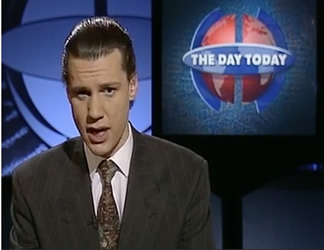
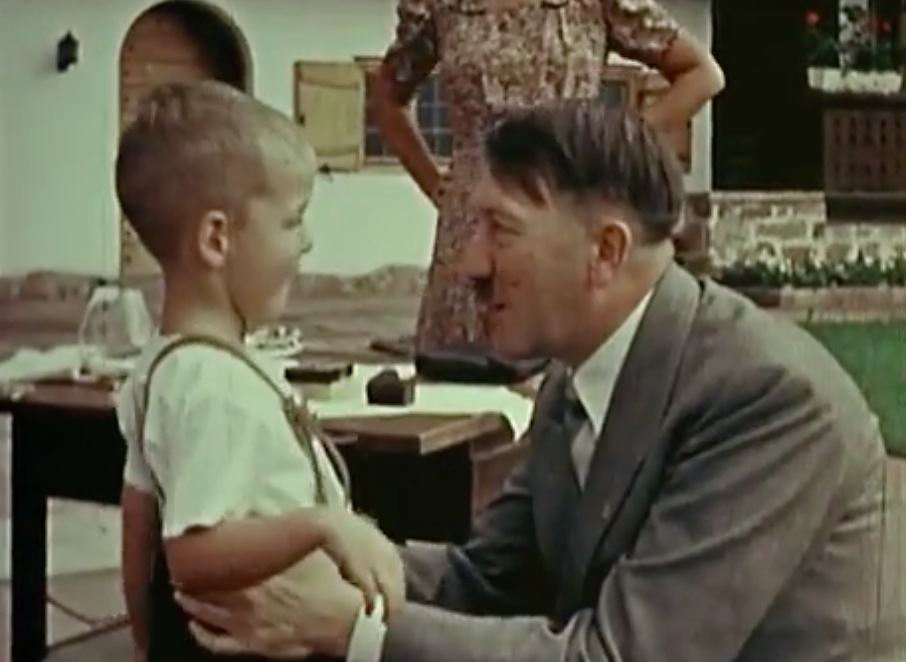
This session makes use of the following two video clips, both of which demonstrate the danger of taking even 'documentary' evidence at face value:
| Video Clip 1: World War Two | Video Clip 2: The World at War: Demonisation of Hitler |
 |
 |
Appendix 1: TOK in History - stimulus questions grid
The following grid outlines the main Ways of Knowing identified in the TOK history syllabus, along with the specified areas for consideration with regard to History in particular. These are laid out in a grid with a question provided which covers all possible crossover discussion points. Useful for classroom stimulus and ideas for how to incorporate TOK into classroom discussions, debates, starters and plenaries.

[click here for a printable version]
Appendix 2: A revision summary grid of historiographical terms
Observations: Leopold von Ranke's Historicism movement in the late 19th Century laid the framework for modern historiography. From the scientific methods of source analysis it promoted, historians quickly moved from describing "what" happened and towards a consideration of "why". In the late 20th Century, however, the postmodernists argued that Historicism was fundamentally flawed: all historical sources were both biased and incomplete so it was impossible to reach any valid conclusions. This created "The Crisis of History" which has called into question the whole validity of the discipline.
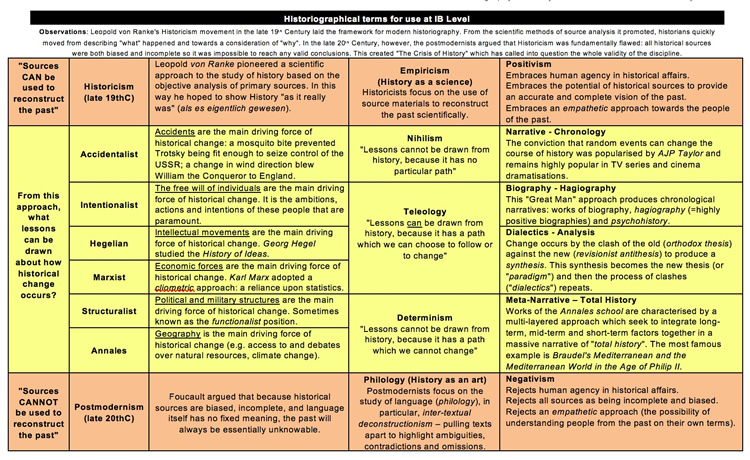
[click here for a printable version]

© 1998-2026 Russel Tarr, ActiveHistory.co.uk Limited (Reg. 6111680)
1 Torrin Drive, Shrewsbury, Shropshire, SY3 6AW, England
Privacy Policy | Contact