
Designed to accompany the worksheet which follows, this introduces some of the key issues that will be investigated, along with some arresting imagery.
Students are introduced to the terrible social conditions that prevailed in East End of London and make deductions about how these could have helped "Jack". They are presented with a list of the problems and deprivations in the East End and consider how each would have helped the killer. They also analyse an extract from a report produced at the time and rank the problems listed within it from the most horrendous downwards.
After each student has generated a random fictional name, the class is provided with some initial text to copy which provided historical context about why women were drawn to the cities. Six possible developments were then placed around the classroom on information slips, and each student then rolls a die and moves to the appropriate desk to discover and copy down what happened in their character's life (and then chat with other students to compare). This process is repeated for seven further 'chapters' to create individual stories which are then converted into a letter to the Central News Agency using these life stories to draw attention to the experiences and challenges faced by women in working-class London.
Students investigate the sad lives of each of Jack's victims - Polly Nicholls, Annie Chapman, Lizzie Stride, Catherine Eddowes and Mary Jane Kelly - and compare similarities and differences between them by construcing parallel timelines. Were these women to blame for the condition they found themselves in by 1888, or were they victims of the system?
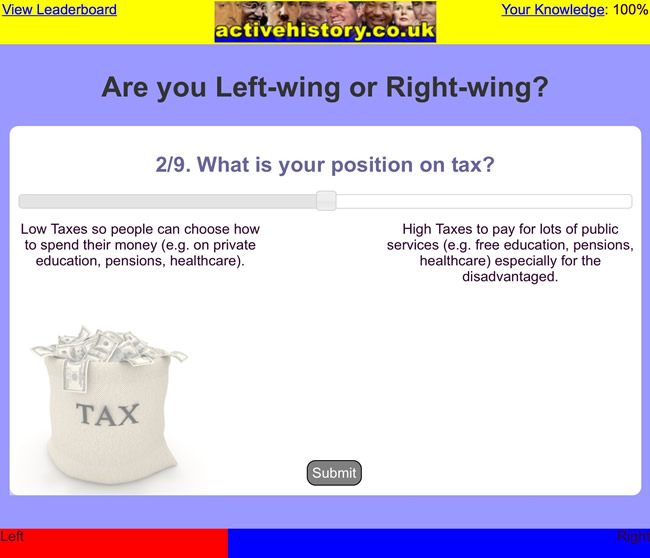
Left-wing and Right Wing: Which are you? [online simulation]
At this point, after a discussion of whether students feel that the victims of Jack the Ripper were responsible for their own poverty or whether instead they were crushed by 'the system, students complete this computer questionnaire, which will provide them with some initial suggestions about whether they are Left- or Right-Wing. This can be completed in class, or set as a homework activity. Students are then asked to complete a Triangle Nine Template by completing the following steps: "Step 1: COPY the 9 statements you agreed with from your table and PASTE them into the diagram - but Organise the statements you agree with most strongly towards the TOP of the diagram, and the statements you are less bothered about towards the BOTTOM. Step 2: Colour Left-wing statements in RED and Right-Wing statements in BLUE. Step 3: Give your diagram a title: "The political profile of [YOUR NAME]".

"Plot the location of each murder on this map. Number them 1-5. Based on the information about geographic profiling provided above, where do you think that the murderer is most likely to live?"
This worksheet introduces Charles Warren and Sir Robert Anderson, the policemen in charge of the investigation. Students consider a detailed list of the measures that could have been taken and try to deduce which ones were simply not possible at the time; which ones were possible but which were vetoed by the Home Office and why; and which ones were actually taken but why they nevertheless failed. They then have to consider whether Queen Victoria was right to suggest that the police were failing to do all they could to catch the murderer.
This worksheet accompanies the first 40 minutes of the video available from here . It provides a good overview of the East End, the victims and the problems faced by the police.
Using witness reports from the crime scenes along with visual sources from "Penny Dreadfuls" at the time, students build up their own physical profile of the killer. How old was he? What social background? What witnesses can be trusted? Why are there such discrepancies between the witness reports?
Students analyse the gruesome "Dear Boss" letter to make deductions about Jack's character. Was he educated? Was he an egomaniac? Can we trust this evidence?
Students are presented with other key facts about Jack and use this to make their own deductions about the killer. These ideas can then serve as the basis for a lively discussion in class.
Armed with the profiles that they have built up, students go to this ActiveHistory Simulation which asks them a series of questions about what they think they now know about the personality and appearance of the Ripper. The computer then analyses their responses to present them with a list of the most likely suspects based on their preferences. The simulation also asks a series of factual questions as it progresses and gives them a score at the end. A worksheet accompanies the simulation, which also brings in fresh evidence such as the 1988 FBI profile, the 2006 EFIT profile and the coroner's reports. The simulation should occupy at least 30 minutes, and the follow-up debate a similar amount of time.

As an alternative to producinga straightforward 'Wanted' poster for the killer following the computer simulation, students could instead consider producing a 'Crime Board' connecting the various pieces of evidence to different suspects to produce an overall theory.

This worksheet accompanies the final 20 minutes of the video available from here. In this part of the documentary, the top suspects are suggested and the video narrator offers his own view on who the murderer was. This is a stimulating way of following the classroom debate and usually provides some lively discussion.
A consolidating lesson which looks at the social outcomes of the Ripper murders.
Complete with markscheme to test knowledge and understanding (1 hour).
Complete with markscheme to test knowledge and understanding (30 minutes).